What is the purpose of direct negotiations? For Lebanon, it is to restore sovereignty by ending the occupation and securing the withdrawal of the Israeli enemy from Lebanese territory, based on international laws and resolutions and the Armistice Agreement. For the United States and Israel, however, the objective is a peace agreement between the two states, irrespective of any legal references and based solely on the occupation forcefully establishing its various “security” lines, while threatening to expand the occupation unless all weapons outside the authority of the Lebanese state are removed.
Meanwhile, the enemy is not negotiating to achieve that “peace,” but continues its daily acts of destruction, bulldozing, and altering landmarks—geographically, historically, architecturally, and socially—to consolidate the occupation. In the meantime, neither the American nor Israeli parties seem concerned that such Israeli practices, supported by the follies of “peace lobbies” in America and Lebanon and the stupidity of Ella Wawiyeh intruding on a children's school in Debel on Independence Day, continue to profoundly distort that “peace.”
What is the alternative to direct negotiations? For Iran, it is armed “resistance” against the occupation, a principle that is legally, ethically, and nationally legitimate. However, no historical experience or human science, not even religious teachings, indicates that this is an exclusive right of a particular sect or denomination. Nor is there any provision allowing a state (Iran) to recruit a group in another state (Lebanon) to wage war on its soil against a third state (Israel), even if the latter is criminally occupying its territory.
Even if this group—which here is “Iran's Party,” or Hezbollah—was allowed to fight to liberate the South in 2000, it is unacceptable for it to continue fighting thereafter on the orders of the sponsoring state and for its benefit, merely because that state's “doctrine” requires perpetual, open-ended “resistance,” even if militarily defeated and even if it provokes a resurgence of the occupation. Thus, this group cannot simultaneously be “resistance” against an occupying enemy and an antagonistic force against the Lebanese state, seeking to occupy it and subjugate all its people's factions. For all these reasons, Iran and “its party” seem determined to distort the meaning of “resistance.”
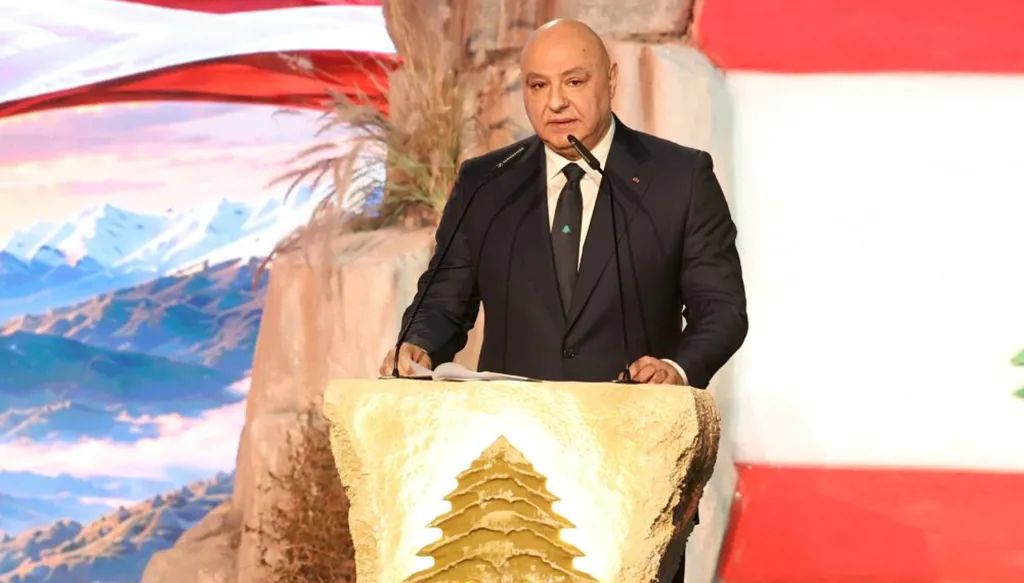
What was “the party” expecting from the Lebanese president on the occasion of Independence Day, which no longer deserves to be called a “celebration”? And what did the “Shiite duo,” in its “larger” and “smaller” forms, expect? Perhaps they wanted the president to praise the “support” wars, anticipate involvement in any future wars, or declare the abandonment of the framework agreement in favor of adopting the Islamabad path, even after the Iranian foreign minister announced that the “Memorandum of Understanding” was no longer the basis for negotiations with Washington?
The reality is that the president, a former army commander, can maneuver to maintain a minimum level of internal stability. However, Presidents Joseph Aoun and Nawaf Salam bear responsibility for the state and its people and have no illusions about the intentions of any external parties. As for “the party,” it is clear that it is no longer responsible even toward its own sectarian environment, appearing concerned only with carrying out the orders of the “Revolutionary Guard,” which is getting closer to issuing operational orders to interfere in Lebanese affairs through bombings, assassinations, and the incitement of discord between regions and sects.
Supporters of Iran and “the party” believe that President Aoun's equating of the Israeli occupation with Iranian intervention came at “the wrong time,” yet they do not suggest when the right time would be. What is certain is that they deliberately ignore the fact that most Lebanese recognized long ago that “the party's” practices and crimes are not merely “intervention,” but rather an “Iranian occupation.” This is not only because of assassinations and intimidation, but also because of fabricated presidential vacuums, the seizure of parliamentary functions, the suppression of popular protests, the Beirut port explosion, and even concessions to Israel in maritime demarcation.
They reject the comparison between occupation and intervention, but it came too late, as no former president or government was expected to make it, given that they all feared the dominance of the Iranian occupation even more than that of the Israeli occupation.
Disclaimer: The opinions expressed by the writers are their own and do not necessarily represent the views of Annahar.