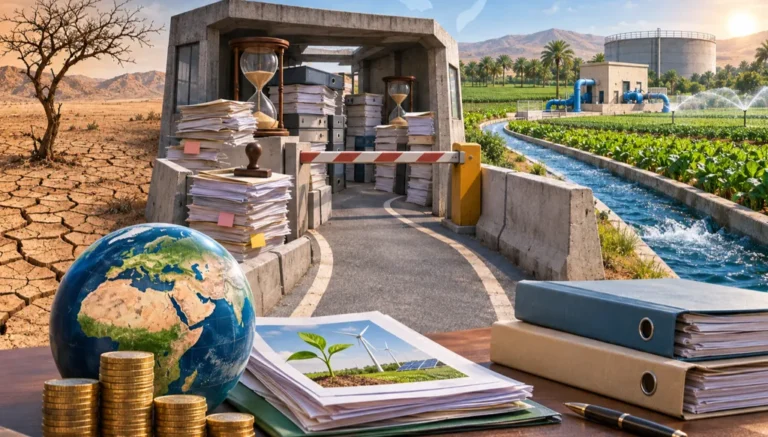
ANTALYA: Turkey's Antalya opens the COP31 climate conference on Monday, November 9, facing a difficult equation: the world is investing more in energy, but emissions are not being reduced at the required pace. As wars push governments to secure fuel and electricity supplies, does energy security accelerate the climate transition, or does it give fossil fuels a longer lifespan?
The conference runs until November 20, with the leaders' summit scheduled for November 11 and 12. Turkey hosts and presides over the conference, while Australian Chris Bowen leads the negotiations, an arrangement that places the ability to build consensus at the heart of Antalya's test.
According to the United Nations Environment Programme's 2026 Emissions Gap Report, current policies could lead to warming of up to 2.8 degrees Celsius this century compared with pre-industrial times. Even the full implementation of national contributions, alongside the continuation of similar efforts, would not lower the projection below 2.6 degrees. The report attributes the deteriorating outlook partly to the U.S. withdrawal from the Paris Agreement and revised estimates of historical emissions.
To chart a path that limits the overshoot of the 1.5-degree threshold before eventually returning warming to or below it by 2100, emissions need to be cut by 18% by 2030 and 45% by 2035 relative to 2025, alongside increased carbon removal. Current pledges would allow for a reduction of only 11% to 15% by 2035. These scenarios are conditional, not climate guarantees.
Politically, this gap places negotiators before a test that goes beyond drafting a statement: translating targets into decisions affecting power plants, factories, transportation, and finance in economies wary of rising prices and job losses.
The International Energy Agency predicts that global energy investments will reach $3.4 trillion in 2026, a 5% increase. Around $2.2 trillion is expected to be directed toward sources and technologies including renewables, nuclear energy, grids, storage, and efficiency, compared with $1.2 trillion for oil, gas, and coal.
The agency notes that disruptions in the Middle East are reshaping risk calculations, increasing importing countries' interest in local energy sources, including renewables and nuclear power, and, in some cases, coal. In its 2026 estimates, gas investments rise to $330 billion, supported by liquefied gas projects, particularly in the United States and Qatar.
These trends show that energy security can either support or slow the climate transition. Building grids and storage expands the economy's capacity to use clean electricity, while new fossil fuel infrastructure may lock economies into long-term emissions and costs.
Interests differ between fuel-exporting and fuel-importing countries, and between economies capable of financing the transition and those facing debt crises. The region therefore stands to benefit from negotiations that link emissions reductions with accessible financing, technology transfer, and protection for workers and consumers.
The outcome of Antalya can be tested through three questions: Have energy plans become more implementable? Have finance pledges been turned into clear paths for disbursement? Can weaker states afford to protect their populations? The answers will reveal the extent of progress behind the language of consensus.