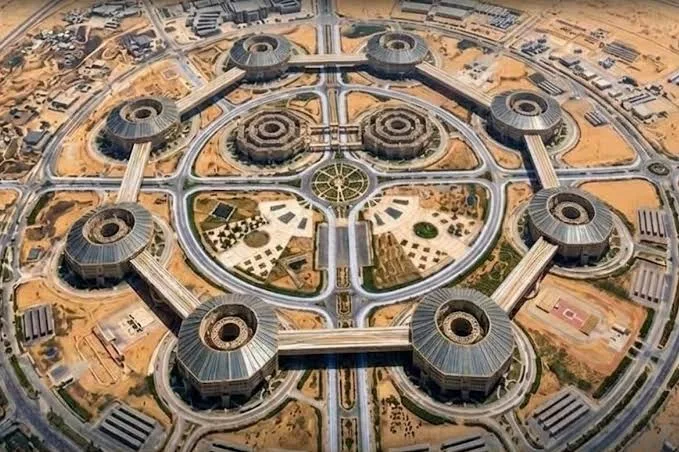
Since 2013, Egypt’s military has undergone an unprecedented programme of development and strategic rebuilding. The aim is to modernise its combat capabilities and establish a comprehensive deterrent force that can protect national security and meet fast-moving regional and international threats in a highly volatile region. The programme rests on an integrated approach that combines advanced military technology, the localisation of defence industries, the training of personnel and the diversification of arms suppliers, so that national decision-making remains fully independent. The Octagon This year marked the high point of the modernisation drive with the opening of the new Strategic Command headquarters, known as the Octagon, in the New Capital. It is the newest and largest facility of its kind in the Middle East and Africa, and rivals the world’s leading command centres. The complex consists of eight main buildings joined in a single shape, representing the branches of the Armed Forces and their sovereign departments. At its centre stands the Central Command building, which is responsible for securing policy decisions and speeding the flow of information and security directives under one integrated umbrella. The headquarters relies on a vast, highly advanced digital infrastructure to store and process national data, built to the highest cybersecurity standards and described as impenetrable. It also runs on an intelligent command-and-control system that operates entirely on 5G technology and computerised artificial networks, and is fitted with alternative, independent sources of power. Air force and air defence The air force and air defence have made a major leap in quality, designed to protect Egyptian airspace against all threats. The air force has been strengthened with advanced multi-role fighters, chiefly the French Rafale, which offers high-level air superiority and precision-strike capability. It has also received advanced Kamov Ka-52 attack helicopters, and its reconnaissance, early-warning and logistical transport systems have been modernised. The air defence system has been built on multiple layers and a range of arms suppliers. This secures airspace and troop operations through a layered network that can counter modern aircraft and missiles. Navy Egypt must protect a naval theatre stretching more than 1,000km along the coasts of the Mediterranean and the Red Sea. To do so, it has formed two fleets, one northern and one southern, equipped with the latest international vessels. As the eastern Mediterranean has become a centre of competition over energy, protecting the navy has become a top priority. Advanced German-built Type 209 (209/1400) diesel submarines have been brought in to strengthen undersea deterrence and allow naval operations to be run effectively. French Mistral class helicopter carriers have also entered service, boosting the ability to conduct combined naval, air and amphibious operations. Modern frigates such as the FREMM have been added to combat capability and long-range naval strike power. The upgrades have also covered missile corvettes and stealth boats. Strategic military bases Military infrastructure has taken a historic leap forward with the construction of integrated bases secured with the latest combat and administrative systems. They include Mohamed Naguib Military Base, Baranis Military Base, Berenice Military Base. Industrial localisation The state has crowned its efforts to achieve self-sufficiency and localise defence technology through its military production factories, the Arab Organisation for Industrialisation and the Armed Forces Engineering Authority’s industrial complex. Output includes the production and development of multi-role armoured vehicle families, such as the Fahd 240, the Fahd 300, the Timsah family (1, 2, 3 and 4), the Sinai 200 and Sinai 300, and the Vulcan and Shaheen armoured vehicles. The manufacture of naval boats, logistical support vehicles and engineering equipment (such as bulldozers, mine-clearing equipment and evacuation vehicles), alongside individual weapons, ammunition, artillery and mortar shells, and advanced communications and surveillance systems. Military diplomacy Egypt has built a national security equation based on diversifying its arms suppliers, including France, Germany, Russia, the United States, China and others, rather than depending on a single source. This has given national decision-making more room to manoeuvre and reduced the chances of political pressure. Egypt’s modern military is built on the principle that “early preparedness is not a call to war, but a guarantee that it will not happen”. It rests on a firm creed: “victory or martyrdom”. Military development and the building of strength are not meant as a show of force, but to create a genuine shield of deterrence that protects the nation’s borders and wealth. Through the integration of its branches and the localisation of its technological and human capabilities, the Egyptian military will remain a shield for the nation and a sword that defends its cherished land against every challenge. The post Armed Forces build deterrence shield appeared first on Egyptian Gazette.