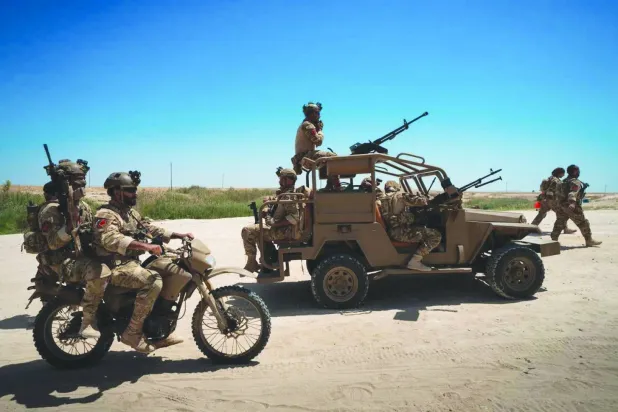
Iraqi sources revealed that the armed factions are suffering from a “financial crisis” due to US sanctions against their commanders. They ruled out however that the salaries of fighters of the Popular Mobilization Forces (PMF) would come to a halt because they are being funded from the state budget. Commander of the US Central Command Brad Cooper said on Friday the US naval blockade has cost Iran $25 billion in lost oil revenue and the Treasury Department have managed in recent weeks to freeze $350 million that Iran had in cryptocurrency. In a video message released Friday, Cooper revealed that Iran-backed groups such as Hezbollah, Hamas and armed factions in Iraq, which have been funded by the Iranian Revolutionary Guards Corps (IRGC) for years, now have to give the money back, reported Axios. "The financial strain on Iran's military has become so significant that there are reports about Iran-aligned militia groups across the region withholding payments for their soldiers in order to funnel money back to the IRGC, which also isn't paying its troops," he said. Cooper said the Iranian government is withholding salaries, pensions and benefits from public sector workers, including the internal security forces and the IRGC. However, reliable sources, including some familiar with the internal dynamics of Iraqi factions, dismissed the US claims as “inaccurate”. One of the sources told Asharq Al-Awsat that the factions are generally experiencing genuine financial problems, which began months ago as a result of US Treasury sanctions against most of their leaders, as well as associated banks and institutions accused of financial dealings with Tehran. However, the source stressed that all members of the factions, who mostly operate under the PMF, receive their salaries regularly, and they have not been cut. Financial allocations for the PMF reached around 3.6 billion US dollars under the 2025 budget to fund a force boasting around 238,000 members. This coincides with government efforts to reorganize the legal and security structure of the PMF, amid local and regional scrutiny. The sources explained that the total number of members linked to the factions does not exceed 50,000 fighters, or slightly more. Even assuming Cooper's statements are true, their total salaries could not cover a financial deficit in Iran. A source, who spoke on the condition of anonymity, said that Iran and IRGC circles are linked to vast financial interests inside Iraq, spanning the energy, construction, and trade sectors. Furthermore, they control state-linked contracts that generate revenues far exceeding what they spend on the salaries of faction members. The source did not rule out the existence of shadow institutions or banks linked to the factions that could continue their secret financial dealings with Iran, similar to what was recently uncovered in the case of one of the banks. The US Treasury had placed the Iraqi International Development Bank on the sanctions list last Thursday for facilitating Iran's access to dollars, assisting it in obtaining American currency, and circumventing the economic sanctions imposed on it. Washington accused the bank of being linked to Iranian companies that contributed to its establishment from the very beginning, and of working to transfer and deliver profits to Tehran, in addition to its connection to Iranian state and banking entities, including Bank Melli.