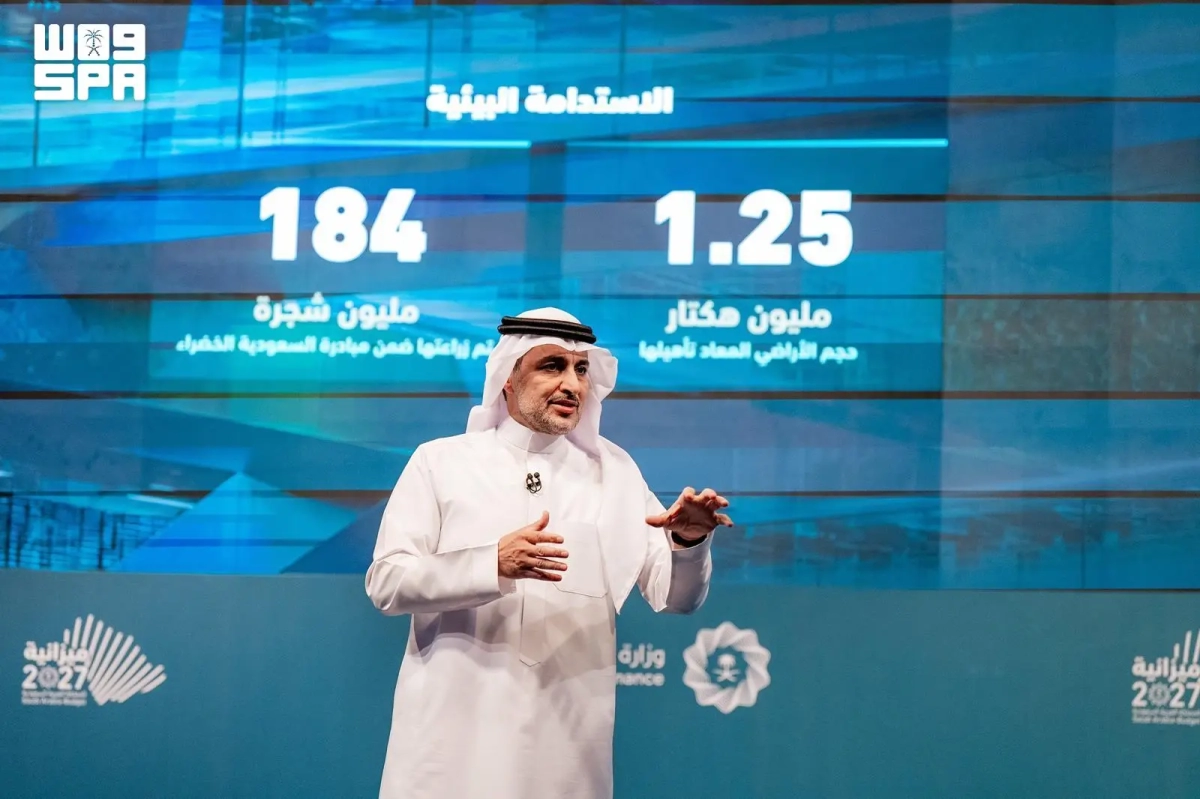
RIYADH — Deputy Minister of Environment, Water and Agriculture Eng. Mansour Al-Mushaiti said that the agricultural sector is a key pillar of food security and a driver of economic and social development. “Over the past 10 years, the Agricultural Development Fund has provided loans exceeding SR40 billion, equivalent to the total amount it had extended over the preceding five decades. This has helped stimulate private-sector investment in agriculture, which has exceeded SR60 billion,” he said while attending the Budget 2027 Forum in Riyadh on Wednesday.Al-Mushaiti said that these investments had contributed to increasing agricultural production from 6 million tons in 2015 to more than 13 million tons in 2025, while the sector's contribution to gross domestic product (GDP) rose from SR54 billion to SR124 billion over the same period. The deputy minister emphasized that Saudi Arabia is now reaping the rewards of a decade of achievements under Saudi Vision 2030. “The Kingdom continues to pursue its targets through a development model that measures progress by tangible results and the economic and social benefits experienced by citizens,” he said. Al-Mushaiti noted that the environment, water, and agriculture system had achieved significant milestones in food security, water security, and environmental sustainability, with generous support from the wise leadership. The deputy minister reviewed the key achievements of the environment, water, and agriculture sectors. He highlighted the impact of government investments and partnerships with the private sector in promoting sustainable development, improving resource efficiency, and achieving national targets. Al-Mushaiti also noted that the Sustainable Agricultural Rural Development Program (Saudi Reef) represents an effective model for translating government support into lasting economic and social benefits. Over seven years, the government invested SR3 billion in the program, generating economic returns of SR10.7 billion, providing more than 92,000 income-generating opportunities, and increasing rural production by more than 480,000 tons, in line with the comparative advantages of different regions. Al-Mushaiti stressed that Saudi Arabia had adopted a balanced approach to agricultural development, combining increased production and stronger food security with the preservation of natural resources. This has resulted in a reduction of more than 40 percent in non-renewable groundwater consumption, from 21 billion cubic meters to less than 11 billion cubic meters. On environmental sustainability, he said the Kingdom was leading a green era through local, regional, and international initiatives, driven by its belief that environmental sustainability is a gateway to development and prosperity. These initiatives reflect the Kingdom's commitment to protecting the environment and promoting the sustainability of resources at regional and global levels. He reviewed key achievements of the Saudi Green Initiative, which has helped increase the proportion of protected areas from 4 percent in 2015 to more than 18 percent of the Kingdom's total area, with a target of reaching 30 percent by 2030. The initiative has also contributed to the rehabilitation of 1.25 million hectares and the planting of 184 million trees. He pointed out that the Kingdom's environmental sustainability efforts had extended to the regional level through the Middle East Green Initiative, which has attracted more than 35 countries. At the global level, he highlighted notable initiatives, including the launch of the Global Coral Reef Research and Development Accelerator Platform in 2020 during the G20 Summit and the Riyadh Global Drought Resilience Partnership at the 2024 Conference of the Parties to the United Nations Convention to Combat Desertification. Al-Mushaiti affirmed that these achievements had been made through the grace of God Almighty and the Saudi formula for success. He said this formula is based on the support of the wise leadership, the ambition of Saudi citizens equipped with knowledge, education, and a commitment to hard work, and integration among the public and private sectors and members of society. These factors strengthen the Kingdom's development journey, advance its ambitious national targets, and reinforce its leading position across various fields.