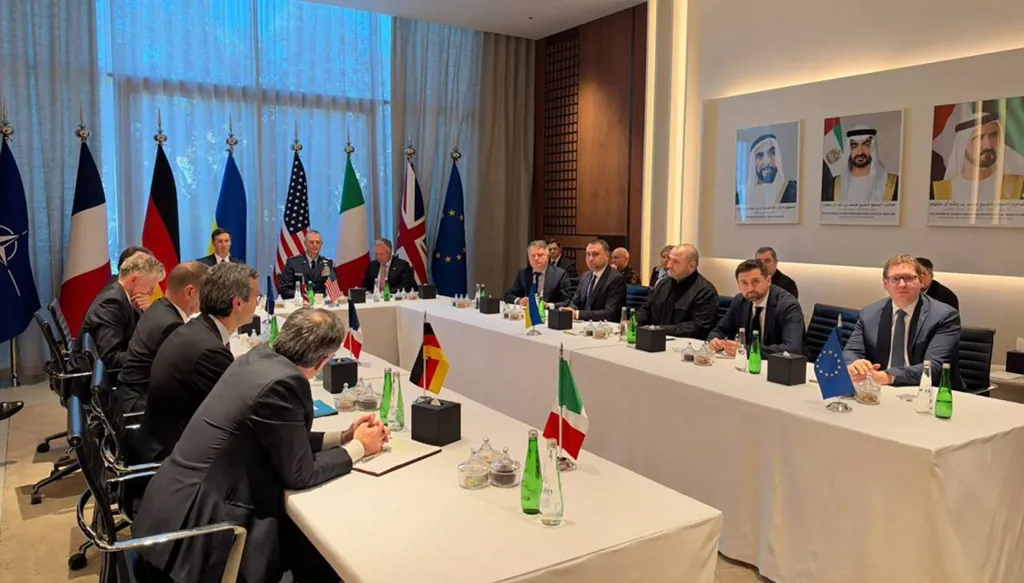
The choice of Abu Dhabi to host international negotiations is no longer merely a decision about the venue. Rather, it has become a reflection of the standing the United Arab Emirates has achieved in the international relations landscape and its ability to build trust between parties whose positions are far apart and whose differences are increasingly complex. As a new round of Russia-Ukraine talks gets underway in Abu Dhabi under US auspices, questions are once again being raised about the role the UAE can play in making peace, not merely hosting negotiations.
The gathering of representatives from Russia, Ukraine, and the United States in the Emirati capital, following previous rounds hosted by Abu Dhabi, highlights the importance of the diplomatic environment the UAE has managed to foster. This is built on balanced relations, strategic partnerships with international powers, and a political approach grounded in the belief that dialogue remains possible, even amid the most complex crises.
Perhaps the figures offer the clearest evidence of the effectiveness of this approach. As of October 23, 2026, Emirati mediation had successfully facilitated 27 prisoner and detainee exchanges between Russia and Ukraine, involving 8,537 people, according to data from the UAE Ministry of Foreign Affairs. These are not merely humanitarian figures; they represent a reservoir of political trust built up over years of war and demonstrate the UAE's ability to turn diplomatic relations into tangible results.
His Highness Sheikh Abdullah bin Zayed Al Nahyan, Deputy Prime Minister and Minister of Foreign Affairs, has stressed that the close ties between His Highness Sheikh Mohamed bin Zayed Al Nahyan, President of the UAE, and Russian President Vladimir Putin and Ukrainian President Volodymyr Zelenskyy have been a key pillar in strengthening trust and bringing positions closer together. This underscores the importance of personal relationships between leaders when they become effective tools for promoting international stability.
Meanwhile, US President Donald Trump spoke of the possibility of reaching a comprehensive agreement to end the war, including European security arrangements, and expressed his belief that its end could be near. Ukrainian President Zelenskyy, for his part, stressed the importance of strengthening his country's negotiating position. These statements reveal the scale of the political stakes surrounding the Abu Dhabi meetings, even as disagreements over territory and security guarantees remain fundamental obstacles to a settlement.
From a strategic perspective, what sets Abu Dhabi apart is its ability to bring together three elements that rarely coincide: political trust, humanitarian credibility, and the institutional capacity to manage sensitive dialogue. These qualities make it an important partner in creating the conditions for international settlements, without implying that the success of negotiations is guaranteed or that responsibility for reaching an agreement rests with the host country.
The soft power of states is increasingly measured by their ability to open channels of dialogue when conflicts close them, as well as by the solutions they offer to ease people's suffering. This is where the significance of the Emirati experience becomes clear, with humanitarian action and diplomacy serving as two complementary tracks.
If the Abu Dhabi talks succeed in bringing the prospects for peace closer, this will add significantly to the UAE's international standing. But the deeper truth is that the Emirati capital has become a key player in one of the world's most complex and pressing issues, reflecting how international trust has evolved into an established diplomatic standing.
Ultimately, countries do not build their standing through what they say about themselves, but through what the world trusts them to deliver.