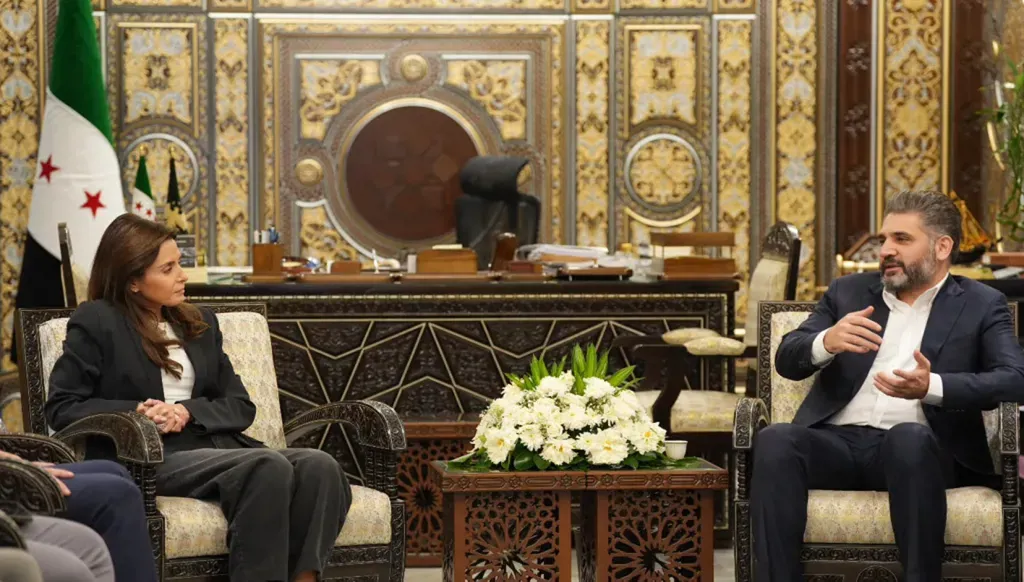
Annahar visited Syria. This should have been the closing sentence of what I am about to write about the visit. But the symbolism of Annahar’s presence in Damascus takes center stage, reflecting the extent of the profound changes in the underlying equation. It has thus become the headline and introduction to everything I will recount. The visit came at the invitation of the Syrian Ministry of Culture, with the accompaniment and presence of Minister Mohammad Yassin Saleh, who fully understood the significance and symbolism of Annahar’s return to Syria.
The decision was made to send an Annahar delegation to Syria after an absence that had lasted for years, following the assassination of the late Gebran Tueni. Annahar had adopted a clear stance opposing the Syrian regime and its policies in Lebanon and Syria, turning its platform into a space for Syrian opponents of the Assad regime. Many members of the delegation had visited Syria both before and after the fall of the regime, while for others, this was their first visit.
The delegation was headed by Nayla Tueni, Chairwoman of the Annahar Group. Her presence carried an entire story within it. Neither of the two Assads had acknowledged Lebanon's independence or statehood, nor had they admitted responsibility for their crimes in Lebanon, including the assassination of Gebran. Nayla Tueni crossed the border and passed close to the Presidential Palace, where Assad once resided. Perhaps this image speaks louder than any words: Bashar is on the run, while Nayla is in Syria.
During one of our meetings with Syrian Culture Minister Mohammad Yassin Saleh, he said, in essence, that the Syrian people owed a debt of gratitude to Nayla Tueni and Annahar. Nayla paid a heavy price when her father was assassinated while championing the Syrian people's struggle for freedom. Gebran Tueni gave his life for both the Lebanese and Syrian peoples. Syria's liberation from the Assad regime is a victory for the Syrians, Nayla and Annahar alike. Those who shared in the injustice now share in the victory.
Two striking contrasts stood out to me during the visit:
- The first was the collapse of the fear barrier at the Lebanese-Syrian border. During the Assad era, border checkpoints were a source of anxiety and a reason for the distance between the two countries despite their geographical proximity. A mere similarity in names or a fabricated political or security-related case could land someone in prisons from which they would never emerge alive. Many people avoided visiting Syria out of fear of checkpoints manned by the Fourth Division. We carried this constraint with us despite knowing that circumstances had changed, because our memories are burdened with bloody experiences and refuse to forget their victims.
For others, however, who were not involved in politics and had no reason to fear fabricated charges or mistaken identities, the border was a place where they had to pay up. Bribes at checkpoints operated by the Fourth Division and other Assad forces were factored into the cost of any trip to Syria. Some soldiers would settle for a bundle of bread or a carton of cigarettes from an ordinary person, while others extorted traders and wealthy individuals.
The Syrian authorities responsible for border crossings, namely the General Authority for Borders and Customs, were determined to replace these memories with a different reality. The first sign encountered by anyone entering Syria, after the welcome sign, read: "Bribes are prohibited." The process was professional, and just a few minutes were enough to complete the crossing formalities. There were no queues or problems, just routine procedures.
- The second contrast was the change in a long-standing stereotype. The practices of the Assad regime had fostered a negative perception of relations between Lebanese and Syrians. A visit to Damascus reveals quite the opposite. The warm welcome extended to the Annahar delegation by the Syrian leadership and people, the hospitality shown by the Ministry of Culture's team, and even the reactions of Syrians in the streets who did not know the media identity of our delegation all conveyed the same message: they were delighted to see Lebanese people walking through their alleyways and markets.
During my first visit to Syria, two weeks after the fall of the Assad regime, pictures of Assad, his brother Bassel and their father Hafez still dominated the streets. The images that had spread across the country, reflecting the narcissism of Assad and his regime, were too numerous for Syrians to remove all at once after the regime's collapse. They stood atop cracked walls and dilapidated buildings, including government buildings. Assad's portrait seemed more important than the building itself and the services it provided.
During our most recent visit, Syria's new visual identity was everywhere, dominating the streets and cars. After spending an entire day walking around Damascus, I could not spot a single picture of Syrian President Ahmed al-Sharaa. A clear shift in mindset is underway: from deifying an individual to respecting institutions, and from loyalty to a regime to a sense of belonging to a state. This profound change has less to do with the appearance of the streets than with the emergence of a new mindset.
Damascus's architectural identity reflects the reality of its political role. During the tour organized by the Ministry of Culture for Annahar, the differences in the city's architecture became apparent. One part of the capital features residential complexes resembling Soviet-style architecture, with closely spaced buildings containing small apartments. In another part, alleyways bear a striking resemblance to the streets of Europe. This reflects Syria's political and economic role between East and West, as well as its geographical position, which could turn it into a major corridor for energy and trade between Asia and Europe.
Years of war have not erased Damascus and its people's love of culture. The two Assads attempted to obliterate Syria's true civilizational and historical identity. They replaced reading with thuggery and art with prisons. But when Syria shook off the dust of Assad rule, it also cleared away the dust from art halls and libraries that had once been home to intellectuals, singers and musicians. The Damascus Opera House was among the stops on the Ministry of Culture's program for Annahar, reaffirming that the Syrian people cannot be separated from their culture.
In addition to the Opera House, the visit's itinerary included the National Museum, Azem Palace, Al-Hamidiyah Souq, the Umayyad Mosque, Mount Qasioun and Bab Touma. All these sites and landmarks reflect Syria's rich cultural and historical identity.
Yet on the other side of this beautiful scene, another picture emerges. Anyone walking through the streets of Damascus cannot fail to notice the tired, pale faces, the vacant eyes and the weary expressions. Fifty years of Assad rule left deep-seated fear in the hearts of Syrians. One need only pass by the State Security headquarters or the Air Force Intelligence building in the capital to see that fear persists despite the regime's collapse. Fifteen years of war, marked by loss and displacement, have left their imprint on people's faces.
Syria's collective memory is wounded and burdened with the remnants of difficult years. Two years are not enough to transform the expressions etched on people's faces. The efforts of the current Syrian authorities are visible in the streets and in the smallest details, from traffic police officers to waste collectors, as they seek to change the way Syrians view their state. Much has been achieved, but what remains to be done is far greater. Fifty years of Assad rule and 15 years of war were enough to set Syria back.
The Annahar delegation left Syria, but did not want to. The magic of Damascus was overwhelming, and the fragrance of history and civilizations lingered in the air. More visits await Syria and Annahar, along with other places and landmarks that still need to be explored. Damascus does not tell the whole story of Syria; the country's outskirts offer other scenes, and perhaps even greater suffering. But if the central idea takes hold across the country, it suggests that Syria is on the threshold of even greater and more profound transformations.