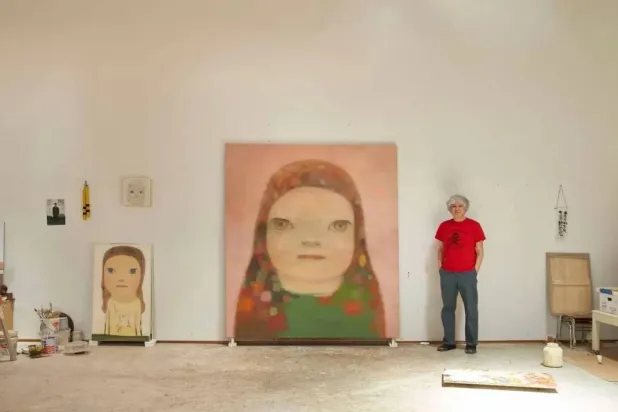
The big-headed, wide-eyed girls that made Yoshitomo Nara one of the most beloved Japanese artists of the 21st century are everywhere — if you know where to look. They can be found on T-shirts, skateboards, plastered on water bottles as stickers, or blown up and rendered in monumental scale in the artist's sculptural works, according to CNN. They can also be found scrawled by the artist himself in confident, graphic lines, on the walls of a Manhattan dive bar he visited in 2009. Angry, spiteful, mischievous, bored, confused: Nara's figures are both enigmatic and instantly legible, recognizable both for the artist's distinct style and their punching emotional effect. Now, Nara's characters are conquering new territory with a retrospective at David Zwirner Gallery, his first major solo show in New York City in close to a decade. The exhibition, which dovetails with a show at the Hirshhorn Museum and Sculpture Garden in Washington, DC, features new, unseen works along with older pieces. There are both tiny drawings on torn fragments of paper as well as huge, richly painted portraits whose luminescent eyes seem to follow you around the room. At the Zwirner show's opening night last Thursday, Nara fans queued for close to an hour in a line that extended two blocks, some holding umbrellas to ward off the rain. It was a distinctly young and stylish crowd: There was no shortage of Labubus dangling from bags and tabi ballet flats. A few subway stops away at Niagara — the East Village bar that Nara graffitied a decade ago — a steady stream of devotees made pilgrimages before or after the opening, a bartender said. There they found a series of graphic drawings, now protected behind plastic, of Nara figures rocking out. These isolated, defiant figures have become a throughline for the artist's nearly four-decade career. They are, in Nara's telling, self-portraits of a sort, ciphers for his own emotions in the aftermath of Japan's wartime history and multiple environmental disasters. For the waves of young fans who flock to Nara exhibits and emblazon his images on their belongings, they’re a representation of something different: The ennui and turmoil that has defined Gen Z's coming-of-age in a turbulent world marked by existential threats at every turn. No matter how they’re perceived, the artworks have made Nara a significant name in the art world, with his work selling for millions, such as “Knife Behind Back,” a huge painting of a frowning girl, one arm tucked behind her back, which went for a whopping $24.94 million at an auction in 2019 (a record high for the artist). It's classic Nara, featuring a figure who is both adorable and slightly menacing, resisting the reduction of herself to something simple and endearing. Nara grew up the 1960s and 70s in rural northern Japan, during the delicate decades after World War II. The war haunts his work, said Mika Yoshitake, an independent curator specializing in postwar and contemporary Japanese art, and curator of the artist's 2021 LACMA retrospective and forthcoming 2027 exhibition at SFMOMA. “There's lots of hidden messages about solitude and bearing the history of the loss that Japan had felt.” Nara’s experiences in Germany, where he studied at the prestigious Kunstakademie Düsseldorf in the late 80s, further added to the political dimensions of his work (“Stop the Bombs,” an acrylic painting from 2019 later repurposed as a design for one of his collaborations with fashion designer Stella McCartney, is one example of the more literal political messaging of his art, what Yoshitake calls his “resistance to the system, or to war, or to things that he feels wrong in society.”) Amanda Quach, a Los Angeles-based fashion and lifestyle content creator whose videos include a roll call of all her Nara merch, said she first discovered Nara's work at LACMA’s 2021-2022 retrospective. In the aftermath of the Covid-19 pandemic, she felt isolated and disaffected. In Nara's paintings and drawings, she saw younger versions of herself. He has a startling ability, she said, to “capture what it feels like to be a young girl with those complex, frustrating emotions, but looking so cute and innocent at the same time.”