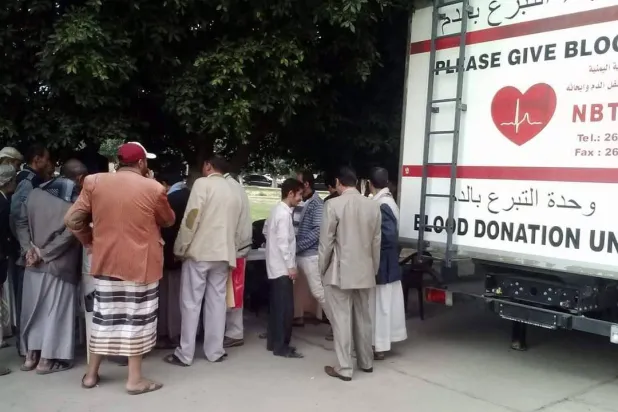
The Houthi group has sent blood donation vehicles into streets, neighborhoods and squares across Sanaa and four Yemeni provinces over the past two days, urgently appealing for donors amid signs of rising numbers of wounded fighters following recent military developments. Vehicles and trucks belonging to the so-called “National Blood Transfusion and Research Center” were deployed across the seized Yemeni capital and the provinces of Dhamar, Ibb, Al-Mahwit and Hodeidah in an intensive drive to mobilize residents to donate blood. The vehicles toured densely populated areas, broadcasting appeals through loudspeakers. Local sources told Asharq Al-Awsat that the group had ordered medical workers, neighborhood officials and community leaders in the targeted provinces to mobilize residents and direct them to donation centers as fighting spread across several fronts. The sources said Houthi-controlled health facilities were on high alert, with demand rising for various blood types. Hospitals were receiving growing numbers of wounded Houthi fighters, according to local accounts. The Houthi-controlled National Blood Transfusion and Research Center in Sanaa (Facebook) Residents in Sanaa and elsewhere described the heavy deployment of donation vehicles over the past two days as striking, citing repeated loudspeaker appeals urging people to visit donation points. They linked the campaigns to recent battlefield developments and questioned the scale of injuries behind the group’s decision to expand the drive to more areas. High alert, mounting losses “Houthi appeals this time are more urgent than in previous campaigns,” said Qassem, a Sanaa resident. “No one refuses to donate blood to save a human life, but the question is: Why do they keep sending people to the front lines, then ask residents to provide blood to treat the consequences of those battles?” In Ibb, 193 kilometers south of Sanaa, resident Majdi said the intensified appeals “do not come out of nowhere.” The group was using various methods to mobilize residents, he said, without disclosing the scale of losses driving the surge in demand for blood. “People are struggling with poverty, rising prices and deteriorating services, and now they are also being asked to bear the consequences of war and provide blood for the wounded,” he said. In Dhamar, 100 kilometers south of Sanaa, sources and residents reported that blood donation vehicles from the center’s local branch were operating in several city neighborhoods, alongside urgent appeals for donors. They said growing numbers of wounded Houthi fighters continued to arrive at hospitals, particularly Dhamar General Hospital, putting further pressure on health facilities. In Al-Mahwit and Hodeidah in the west, local sources said turnout was initially very low. The group then expanded the campaigns to government institutions and private establishments, urging employees and workers to donate. Houthi vehicles used loudspeakers to urge residents to donate blood (Facebook) The sources described the campaigns as part of a wider state of high alert. Their timing, alongside military developments, reinforced residents’ belief that large numbers of wounded fighters urgently needed blood. Residents in Houthi-controlled areas, meanwhile, face deteriorating health services and shortages of medicines and medical supplies. They are calling for treatment services that meet civilians’ needs, rather than further burdens on facilities already stretched by limited resources.