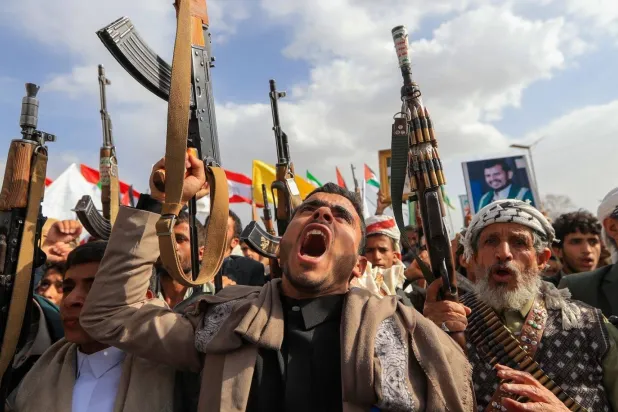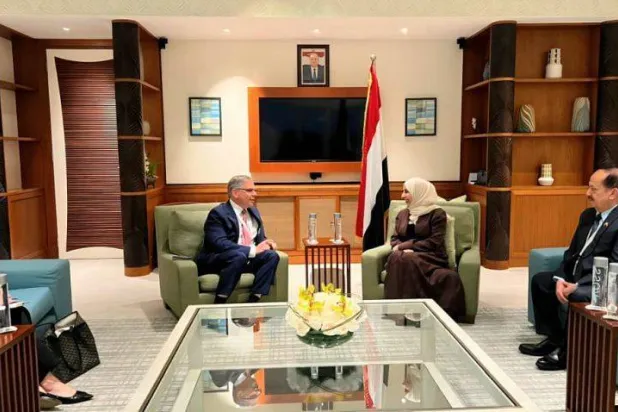
The Yemeni government has intensified its diplomatic efforts to mobilize a firmer international stance against Houthi military aggression, as well as the security and humanitarian threats posed by the group. It called on the United Nations and the international community to shift from political support to practical measures that enable the government to reclaim state institutions, end the coup, and protect civilians and international shipping lanes. The government presented US and UN officials with a portfolio of priority issues. Chief among these are the repeated attacks on Aden International Airport, the ongoing blockade of the city of Taiz, the planting of anti-personnel landmines in residential areas and rural roads, and threats facing the security of the Red Sea and the Bab al-Mandeb Strait. On the sidelines of her participation in the Manama Dialogue 2026 conference in Bahrain, Minister of Foreign Affairs and Expatriates Afrah Al-Zouba discussed developments in Yemen and the wider region with US Assistant Secretary of State for Near Eastern Affairs Donald Blome, focusing on ways to support the government and bolster the capabilities of state institutions. Al-Zouba reviewed the repercussions of the Houthi military escalation and its ongoing blockade of Taiz, which is obstructing the delivery of food, medicine, and fuel to the people. She highlighted the repeated attacks on Aden International Airport, which she said threaten civilian safety and civil aviation, while hindering the movement of patients and the arrival of humanitarian aid. The minister stressed the importance of translating international positions supporting the Yemeni government into practical steps that assist it in ending the coup, restoring state institutions, and extending its authority over the entire territory of the country. This represents the foundation for achieving security and stability in Yemen and the region, Al-Zouba said. The meeting also addressed international efforts aimed at halting arms smuggling to the Houthis and countering their threats to navigation in the Red Sea and Bab al-Mandeb. For his part, the US official affirmed the continuation of coordination with the Yemeni government and regional and international partners regarding the developments of the crisis, renewing Washington's support for the government and its institutions to boost the security and stability of Yemen and the region. In the same context, the Yemeni government renewed its demand before the UN General Assembly for support to state institutions, enabling them to exercise their authority across the entire national territory, protect citizens, and achieve a comprehensive and sustainable peace based on agreed-upon references, foremost of which is Security Council Resolution 2216. Yemen's Permanent Representative to the UN Abdullah Al-Saadi said the government is committed to cooperating with the UN and its relevant human rights mechanisms, as well as implementing the international agreements and covenants to which it has acceded. The government warned of an unprecedented humanitarian catastrophe in the city of Taiz, home to approximately 4 million residents, due to the compounding Houthi blockade. The ongoing road closures, shelling of residential areas, and denial of food, water, medicine, fuel, and healthcare have created a critical emergency. Pregnant women, children, and vulnerable groups bear the brunt of the blockade. The government said that these actions represent flagrant violations of international humanitarian law that may amount to war crimes requiring immediate legal accountability. The government demanded urgent international intervention from the UN and the global community to lift the blockade and reopen roads. It called for the immediate securing of safe, sustainable corridors to transport the sick and wounded and deliver unhindered humanitarian aid. It also accused the Houthis of expanding attacks using artillery, missiles, and drones against residential areas, displacement camps, and schools. This escalation includes recent ballistic missile and drone strikes targeting the presidential palace in the interim capital of Aden, which resulted in fatalities and injuries.