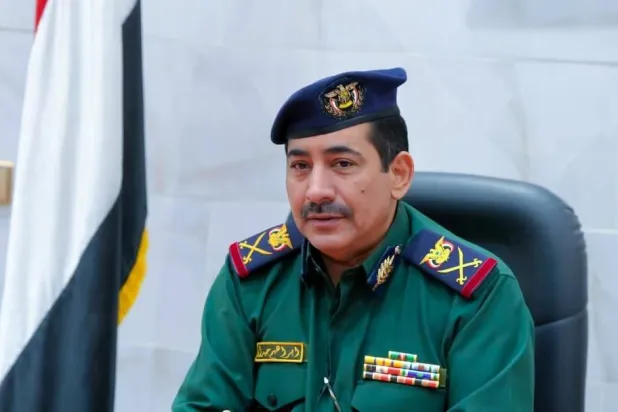
Yemen’s Interior Minister Major General Ibrahim Haidan warned that Iran is seeking to establish long-term military influence over the Bab al-Mandeb Strait and its surrounding islands and coastlines by exporting to the Red Sea the model it developed to “militarize maritime corridors” in the Strait of Hormuz. Haidan said experts from Iran’s Revolutionary Guards Corps (IRGC) were helping the Houthis strengthen their capabilities and build fortifications, operations rooms and facilities for missiles, drones and remotely guided boats. “The danger is not limited to the threats that exist today, but extends to what is being built for the future,” Haidan told Asharq Al-Awsat. He warned that continued Houthi control of strategic areas could give Iran leverage over one of the world’s most important shipping lanes and help it connect Yemen with the Horn of Africa through smuggling networks and armed groups. His remarks followed sweeping government losses along Yemen’s western coast. In an offensive from Sept. 3 to 11, the Houthis seized Hays, Al-Khokha, Mokha and its port before advancing to Bab al-Mandeb, Mayyun Island and the remaining Yemeni islands in the southern Red Sea. Haidan said security readiness had been raised in Aden, Lahj and areas behind the frontlines following the developments in Mokha and along the western coast. The defense and interior ministries were coordinating through a joint operations room to prevent operatives and cells from infiltrating those areas or exploiting waves of displacement to carry out security breaches, he added. ‘Militarizing’ Bab al-Mandeb Haidan placed the latest developments in a broader context, saying Yemen was “part of a regional and international security system” and that events there quickly reverberated around the world because of the Bab al-Mandeb Strait. The gravest danger, he said, was the military infrastructure being built in the area for future use. Experts linked to the IRGC were providing the Houthis with expertise and guidance to conduct operations and develop their military capabilities, he said. Those efforts included building “capabilities, fortifications, bases, operations rooms and caves used to manufacture drones and remotely guided boats and to develop missiles” across Bab al-Mandeb and the surrounding islands, coastlines and highlands. Haidan said Iran aimed to replicate in Bab al-Mandeb its experience of “militarizing maritime corridors” in the Strait of Hormuz. That could turn an open international waterway into a source of influence and pressure for future use, he warned. Iranian and Houthi assurances about the safety of navigation should not be treated as sufficient guarantees, he said, arguing that such messages merely gave the Houthis more time to expand their military systems and fortifications. Houthi leaders at Mokha port after its capture (Houthi media) Could Mayyun become another Larak? Haidan outlined a more specific threat to the Red Sea islands, warning that additional time could allow the Houthis to build bases, hideouts and fortified caves, backed by advanced surveillance, tracking and jamming systems. Mayyun Island, at the heart of Bab al-Mandeb, could take on a military role similar to that of Iran’s Larak Island in the Strait of Hormuz, he said. Zuqar and the Hanish Islands, as well as the highlands and coastlines along the Red Sea, could also become part of an “integrated military system” if the Houthis consolidated their presence in the strait, he added. From the Red Sea to the Horn of Africa The danger extends beyond Bab al-Mandeb, according to Haidan. Houthi control of the strait could give the Revolutionary Guards greater scope to connect Yemen with the Red Sea and the Horn of Africa, he said. Smuggling networks and maritime routes could be used to move weapons, equipment and expertise, strengthen Houthi military and logistical capabilities and expand communication with armed groups and terrorist organizations operating in the Horn of Africa, particularly Somalia’s al Shabaab. Haidan warned that those groups’ capabilities could merge with those of the Houthis and IRGC networks. Such coordination could turn Bab al-Mandeb into “a foothold for multifaceted Iranian influence across several arenas” and give Tehran a strategic tool to deploy during any regional escalation, he said. Destruction in Mokha after being attacked by the Houthis. (Getty Images) Coastguard needs urgent support Government forces continue to confront the Houthis and work to regain and secure lost territory, Haidan stressed. He singled out smuggling as one of the main arteries for financing and supplying the Houthis. Yemen’s coastguard was carrying out its duties despite limited resources, but needed “urgent, specialized support” from allied and friendly countries, he remarked. That support should include maritime surveillance and reconnaissance capabilities, tracking and monitoring systems, patrol boats and modern equipment. Intelligence capabilities must also be strengthened to uncover smuggling networks, track their routes and intercept their shipments, he added. Protecting Bab al-Mandeb and combating smuggling were no longer purely domestic Yemeni concerns, Haidan declared. “The security of navigation and international trade routes begins with the state exercising sovereignty over its territory and waters,” he said. Confronting the threats required regional and international support for the Yemeni state and stronger state capabilities, he added. Securing Aden and Lahj Security deployments have been reinforced at the entrances to Lahj province, the interim capital Aden and surrounding areas as displacement increased following the developments along the western coast, Haidan said. The Interior Ministry treated the crisis as extending beyond the military frontlines. It acted simultaneously to protect displaced civilians and raise security readiness under plans prepared in advance for different scenarios. The measures sought to balance the protection of displaced people with the need to stop the Houthis from exploiting their movement “for security purposes or to carry out infiltration and penetration operations,” he said. Authorities have stepped up coordination and information-sharing among security agencies, local authorities and military units. They have also intensified preemptive intelligence efforts to prevent operatives from entering government-held areas or carrying out acts of sabotage. A view of a village on the coast of Bab al-Mandeb, Yemen April 2, 2026. (Reuters) Joint operations room The defense and interior ministries were coordinating through a “joint operations room,” Haidan said. Its work included producing a unified assessment of the situation, assigning responsibilities and speeding up responses to developments on the ground. Security and military services had also strengthened communication and information-sharing, focusing on frontlines, roads and areas that could be used to infiltrate operatives and cells or transport weapons and explosive devices. Displacement remained “primarily a humanitarian issue,” Haidan said, but it also required careful security management to prevent it from being used as cover to infiltrate operatives or cells into government-held areas. Sleeper cells and smuggling Asked about the threats facing the security services, Haidan cited infiltration attempts and the potential use of displacement movements to conceal operatives or transport information and materials for acts of sabotage. Sleeper cells, smuggling networks and organized crime also posed risks, he told Asharq Al-Awsat. The heightened security measures in Aden and Lahj were largely “preventive and preemptive,” Haidan explained. They aimed to stop military pressure on the frontlines from spilling into cities while preserving a humanitarian approach toward displaced people. People fleeing clashes between Houthi militants and Yemeni government forces gather at the Markazi refugee camp after arriving in Djibouti, September 15, 2026. (Mylaèle Negga/International Organization for Migration/Handout via Reuters) Mokha a ‘practical test’ Haidan described the events in Mokha as a “direct and practical test” of the security establishment’s readiness and the Interior Ministry’s contingency plans. From the outset, those plans accounted for advances and retreats, shifting frontlines, widening displacement and mounting pressure on provinces behind the fronts, he said. Protecting the home front was not a temporary task tied to a particular military development, but an “integral and permanent” part of the Interior Ministry’s work. Resources and security deployments had been adjusted to battlefield developments, while information-sharing among security agencies, local authorities and military forces had been strengthened, he added. ‘Collusion’ with terrorist groups Beyond the Houthi threat, Haidan warned that terrorist organizations, smuggling networks and organized crime groups could exploit the widening war, shifting frontlines and troop redeployments to create security vacuums. He said there was “collusion” between the Houthis and those groups and networks. The relationship predated the latest developments and included links with Somalia’s al Shabaab. Security agencies did not treat the Houthi threat, terrorism, organized crime and smuggling as separate files, but as “a single security system,” Haidan said. That required heightened readiness, stronger deployments in sensitive areas and tighter monitoring of entry points, roads and smuggling routes to prevent the military developments from triggering a broader security crisis.