“Nuclear weapons should be completely banned and entirely dismantled to build a world free of nuclear weapons.”
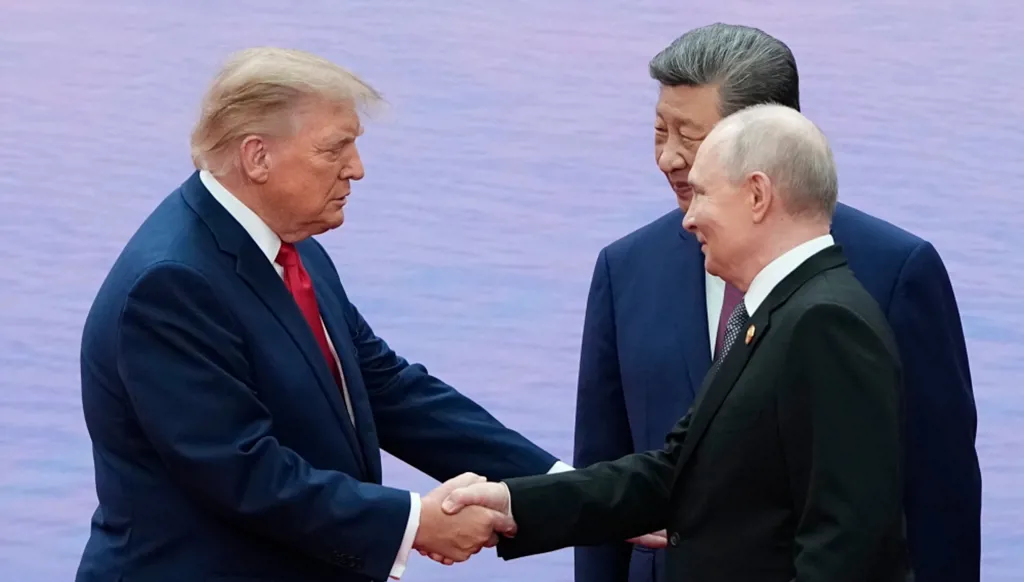
Based on this quick translation of the news agencies’ reports, it can be said that Chinese President Xi Jinping pulled off a “masterful manoeuvre” at the Shenzhen summit. He turned the “nuclear tables” on his two guests.
US President Donald Trump came prepared to discuss exploring new mechanisms to limit the nuclear arsenals of the United States, China and Russia. Xi, however, put the ball in the Americans’ court, as well as the Russians’.
Why talk about “limiting” nuclear weapons when abolishing and banning them altogether would be better for world peace?
The United States and Russia will not agree to abolish nuclear weapons for one simple reason: they have invested so heavily in these weapons that giving them up would come at a greater cost to them. China has an estimated 500 to 600 nuclear warheads, while the United States and Russia each possess around 4,000 (the US arsenal is slightly smaller, and the figures vary depending on whether retired warheads in both countries are included). Dismantling these two arsenals would represent a greater loss for Moscow and Washington than it would for Beijing.
Russian President Vladimir Putin will certainly not welcome this proposal. The nuclear arsenal is virtually all that Russia has left to maintain its position as a global power. This is despite the fact that the coercive power of its nuclear arsenal is losing its effectiveness in dealing with Europe, at a difficult moment amid the ongoing war with Ukraine.
To some extent, therefore, the expiry early this year of the New START Treaty, the last agreement limiting US and Russian strategic nuclear forces, without a replacement deal being reached, worked in Russia’s favour. However, the treaty’s expiry does not necessarily mean that the two sides will rush to manufacture more nuclear warheads, for political and financial reasons. The nuclear arms race is costly, given the need for maintenance and modernisation.
For China to join a new nuclear treaty with the Americans and Russians, it would have to provide transparent information about the status of its nuclear programme. Such disclosures could reveal secrets or potential vulnerabilities in a programme that is relatively small to begin with and therefore ill-equipped to withstand the risks of inspections. This reduces Beijing’s incentive to sign a trilateral nuclear treaty.
China would therefore prefer a bilateral agreement with the United States that guarantees “strategic stability” while allowing it to continue expanding its arsenal. In fact, the joint trilateral statement on holding talks to reduce nuclear risks and prevent proliferation is more of a symbolic gesture, albeit an important one, than a practical initiative in the foreseeable future.
At the same time, China adheres, at least in theory, to the principle of not being the first to use nuclear weapons, whereas neither of its two rivals subscribes to this principle.
Simply put, Xi put forward an appealing proposal, one that is, in fact, so appealing that its outright rejection by the United States and Russia was almost a foregone conclusion. Meanwhile, earlier this year, Beijing launched its “15th Five-Year Plan”, which includes “strengthening and expanding” its strategic deterrence capabilities.
This approach leaves China in an almost enviable position: it presents itself as a peaceful power to countries of the Global South while simultaneously maintaining the fastest pace of growth in its nuclear forces, even when compared with the US and Russian rates of expansion.