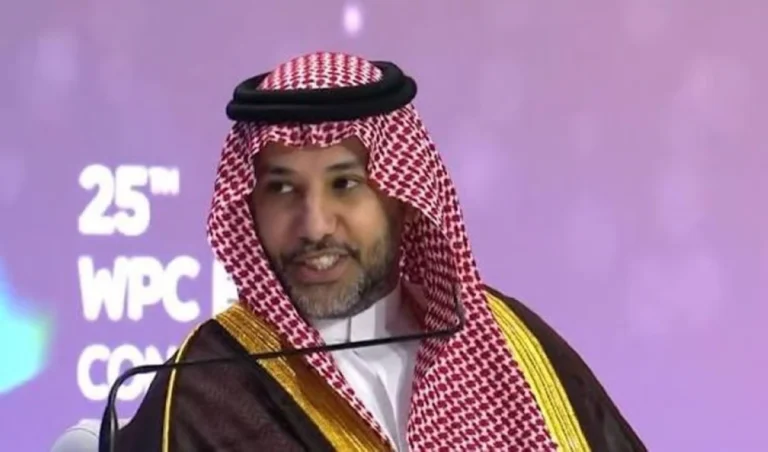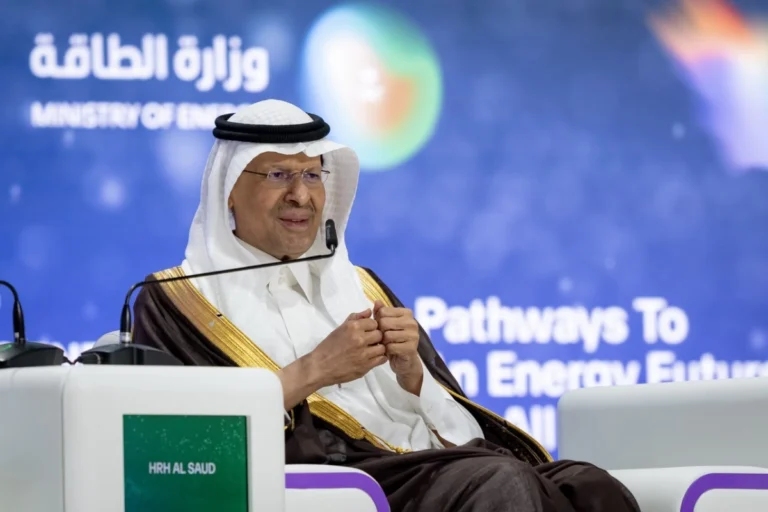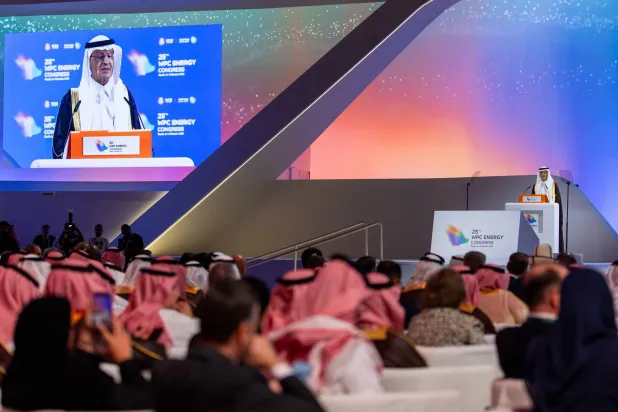
Disruptions to global energy supplies put supply security and infrastructure resilience at the forefront of the 25th WPC Energy Congress in Riyadh on Monday, as Saudi Arabia reaffirmed its commitment to continued investment to strengthen its ability to withstand crises. Saudi Minister of Energy and Minister of Industry and Mineral Resources Prince Abdulaziz bin Salman said advance planning had enabled the Kingdom to deal with the repercussions of the crisis, stressing that "the word fear in the Saudi dictionary does not exist." He revealed plans to expand the East-West Pipeline to raise its capacity to 10 million barrels per day within two to three years. For his part, Aramco President and CEO Amin Nasser said the company was studying, in coordination with the Ministry of Energy, additional options for crude oil exports and expanding storage capacity outside the Kingdom, as part of efforts to strengthen the resilience of the supply system and diversify its routes. WPC Energy President Pedro Miras emphasized the need to balance energy security, sustainability and affordability, while US Energy Secretary Chris Wright said oil flows through the Strait of Hormuz had returned to 80% to 90% of pre-conflict levels, compared with 25% to 35% for refined petroleum products. On the market outlook, OPEC Secretary General Haitham Al Ghais projected that global oil demand growth would rise to 1.7 million barrels per day in 2027 as some deferred demand materializes. The conference, which Saudi Arabia is hosting for the first time in its more than 90-year history, is addressing a range of major energy issues, including supply security, markets, investment, technology, innovation, sustainability and human capital development. In his opening address before a large gathering of ministers, officials and industry leaders, Prince Abdulaziz bin Salman said the Kingdom would overcome its current challenges, continue moving forward and fulfill its commitments as it pursues its vision, guided by its responsibility to future generations. He pointed to the scale of the transformation the Kingdom had undergone in a short period and its determination to continue shaping its future. He explained that recent experiences had demonstrated the importance of advance preparation and building an energy system capable of adapting to different circumstances. Resilience, he said, is measured not only by the ability of systems to withstand shocks but also by their ability to repair damage, restore operations and continue meeting market needs. He said energy system resilience goes beyond spare production capacity, pipelines and power generation capacity to include maintenance, repairs, rerouting supplies, finding alternatives, recovering and, most importantly, continuing to meet market needs under pressure. Prince Abdulaziz opened his remarks by declaring that fear has no place in the Saudi dictionary, stressing that the resilience of the Kingdom's energy system and the determination of its people strengthen its ability to confront crises, ensure continuity of supplies, continue its transformation and achieve the goals of Vision 2030. Infrastructure Prince Abdulaziz said recent developments in the region and the Kingdom had underscored that energy security cannot be taken for granted amid pressure on supply routes and attacks on infrastructure. He noted that Saudi Arabia believes the ability to withstand and confront such challenges must be built before crises occur. He highlighted the Kingdom's investments over several decades in infrastructure, spare capacity, storage, alternative export routes, technology, domestic supply chains and human capital. The minister also said localization, for Saudi Arabia, goes beyond being an economic objective to become a strategic capability that supports business continuity and recovery when international supply chains are disrupted. He explained that the resilience of energy systems cannot be measured solely by spare production capacity, pipelines or power generation capacity, but also by their ability to carry out maintenance and repairs, reroute supplies, find alternatives, recover and continue delivering supplies under pressure. He added that resilience is a state of readiness built and maintained over time and demonstrated through action. The Kingdom's proven ability to withstand shocks and recover supports the reliability of international energy supplies and reinforces its continued standing as a trusted partner in the global economy. Power Grids Prince Abdulaziz stressed that there can be no energy future for all without energy security for all, emphasizing that energy security and the energy transition must go hand in hand. He said Saudi Arabia would continue investing in reliable oil and gas supplies, expanding renewable energy deployment, strengthening power grids, storage capacity and gas infrastructure, developing low-emissions technologies and solutions, building domestic manufacturing capabilities, improving supply chain resilience and investing in human capital. He also stressed that the Kingdom would continue implementing Vision 2030 plans and programs and investing in and developing its energy system and industrial capabilities. He reaffirmed Saudi Arabia's firm commitment to the security and well-being of its people as well as its international partnerships. During a subsequent panel discussion, Prince Abdulaziz spoke about the East-West oil pipeline, describing it as an important example of infrastructure that provides alternative routes for transporting oil to markets and strengthens the Kingdom's ability to confront risks that could affect conventional supply routes. He revealed plans to expand the pipeline to carry 10 million barrels of oil per day within two to three years. Advanced Technologies For his part, WPC Energy President Pedro Miras highlighted in his opening remarks the Kingdom's pivotal and leading role in developing global energy systems through increased investment and critical innovations. According to Miras, the world is moving toward developing advanced technologies and innovative energy solutions to maintain global energy security, achieve economic stability and help improve the lives of billions of people worldwide. He said these efforts come amid a rapidly evolving global economy that requires improvements in energy infrastructure and new, sustainable solutions. He said energy security was essential to economic growth and social stability, and that a successful energy transition required steady and sustained investment. He pointed to the role of artificial intelligence, digitalization, new fuels and carbon storage technologies in shaping the sector's future. Miras stressed the importance of international cooperation in achieving shared energy goals, saying collective action was the best way to ensure a secure and sustainable future for all. US Solidarity US Energy Secretary Chris Wright reaffirmed his country's unwavering support for Saudi Arabia, condemning what he described as cowardly attacks targeting the Kingdom, its infrastructure and its citizens. He stressed that the United States stands alongside its allies and partners in the Gulf region. Speaking via video link during the WPC Energy Congress, Wright expressed pride in working with regional leaders amid what he described as unprecedented challenges to energy security. He highlighted the importance of strengthening international cooperation to ensure stable energy supplies to global markets and enable Gulf producing countries to continue supporting their economies and protecting their citizens. Wright accused Iran of seeking to harm the region's economies and energy security, emphasizing the need for closer coordination between the United States and its partners to confront challenges threatening supply security and the stability of global energy markets. He added that oil flows through the Strait of Hormuz had recovered to between 80% and 90% of pre-conflict levels, equivalent to an average of around 13 million to 14 million barrels per day. He noted that increased oil flows through alternative pipelines had helped support supplies to global markets. Global Demand in 2027 During another panel discussion, OPEC Secretary General Haitham Al Ghais said the organization expected global oil demand growth to rise to 1.7 million barrels per day in 2027 as deferred demand materializes following developments in the markets this year. He noted that OPEC had lowered its estimate for demand growth in 2026 to 400,000 barrels per day, down from the 1.4 million barrels per day projected at the beginning of the year. Al Ghais explained that several factors had helped contain movements in oil markets, including a decline in Chinese imports due to accumulated inventories, withdrawals from strategic petroleum reserves in several countries, particularly members of the Organization for Economic Cooperation and Development (OECD), and slowing demand. He described Saudi Arabia's East-West Pipeline as a model of advance preparation to ensure energy security, saying the Kingdom provides the best example of what could be described as an insurance policy for energy security. According to Al Ghais, oil still accounts for more than 30% of the global energy mix, and supplies remain an essential component of global energy security. OPEC Secretary General Haitham Al Ghais participates in a session at the WPC Energy Congress (Asharq Al-Awsat) Saudi-French Cooperation Meanwhile, French Minister of the Economy, Finance and Industrial and Digital Sovereignty Roland Lescure said Saudi Arabia plays a pivotal role in strengthening global energy security and market stability. He praised the Kingdom's ability to adapt to recent disruptions and stressed the importance of expanding Saudi-French cooperation to protect critical infrastructure and secure energy supply chains. According to the French minister, recent developments have brought energy security and price volatility back to the forefront of priorities for policymakers, companies and citizens. He emphasized that the current situation requires greater dialogue and cooperation among major players in energy markets. He added that the shared responsibility lies in stabilizing markets, maintaining open and reliable energy flows and ensuring that prices remain at levels affordable to economies and citizens. Protecting Oil Facilities For his part, Aramco President and CEO Amin Nasser warned that the consequences of attacks on energy infrastructure in the region were not confined to its markets but extended to economies and markets around the world. He stressed that protecting energy facilities and supply routes requires international cooperation amid the challenges that recent disruptions pose to global energy security. He explained that disruptions in the Strait of Hormuz and attacks on energy infrastructure in the region had exposed the extent to which the different links in the global supply chain are interconnected. He said continued disruptions were intensifying pressure on crude oil and refined petroleum product markets, particularly diesel. Nasser stressed that Saudi Arabia's energy system had continued operating with high reliability throughout the crisis, thanks to strategic investments in infrastructure and operational capabilities, along with diverse export routes, integrated facilities and digital protection systems. Aramco CEO Amin Nasser speaks at the WPC Energy Congress (Asharq Al-Awsat) Export Options Nasser revealed that Aramco was currently studying, in coordination with the Ministry of Energy, additional options for crude oil exports, alongside expanding storage capacity outside the Kingdom, deploying advanced technologies to inspect facilities, accelerating maintenance and repair work, and limiting damage. He said more than 90% of the materials used to restore operations over the past eight months had been sourced locally, allowing restoration work to be completed in hours or days rather than weeks or months. He added that localizing supply chains was an important factor in strengthening crisis preparedness, alongside its role in supporting the local economy, developing domestic industries and creating jobs. Regarding the company's future plans, Nasser disclosed that expanding gas production was a central pillar of Aramco's strategy, with a target of increasing sales gas production by around 80% by 2030 compared with 2021 levels. During one of the sessions, Nigeria's Minister of State for Petroleum Resources Heineken Lokpobiri affirmed his country's solidarity with Saudi Arabia following the recent attacks against it, stressing the importance of international cooperation to address energy security challenges and ensure the availability of supplies at affordable prices. Meanwhile, Algeria's Minister of State and Minister of Hydrocarbons Mohamed Arkab said his country was working to strengthen its production capacity and expand investments in the natural gas sector, supporting energy security in Algeria and Europe.