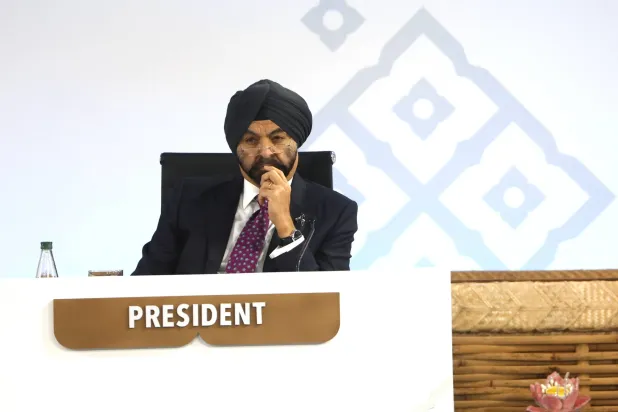
World Bank Group President Ajay Banga has warned of mounting challenges in creating jobs worldwide, noting that around 1.2 billion young people will enter the labor market over the next 10 to 15 years, while the market is expected to generate only about 400 million jobs. This places job creation at the forefront of economic development priorities. Speaking at the plenary session of the World Bank Group’s 2026 Annual Meetings in Bangkok on Friday, Banga said the institution faces two interconnected challenges: making the most of limited resources and helping countries create jobs at scale. Addressing both, he said, requires combining public financing, private investment, philanthropy and technology according to each country’s needs. He added that ongoing conflicts, shrinking fiscal space, rising debt burdens and persistently high commodity costs, including energy and fertilizers, are making development and job creation more difficult. He stressed that a job is more than a statistic: it represents dignity and the ability to build a future. He warned that failing to harness the potential of young people would have consequences extending beyond national borders. Banga said the World Bank Group has made changes to the way it operates over the past three years to strengthen its capacity to finance development and accelerate project implementation. These changes include reducing project preparation time from 19 months to nine months, cutting performance assessment indicators from 153 to 22 with a greater focus on impact, and increasing results-based financing from around one-third to one-half. The Group also restructured the International Bank for Reconstruction and Development’s balance sheet, unlocking more than $100 billion in additional lending capacity over a decade. As part of efforts to strengthen the role of the private sector, Banga said the Group had mobilized around $112 billion in private capital last year, compared with approximately $35 billion in fiscal year 2022, an increase of nearly threefold. When financing provided by the Group itself is included, the total exceeded $230 billion. He said private capital mobilization had nearly tripled in lower-middle-income countries and quadrupled in upper-middle-income countries, while more than doubling in Africa. However, he noted that attracting commercial financing to low-income countries remains difficult, with mobilized capital holding steady at around $3 billion. He emphasized the importance of supporting micro, small and medium-sized enterprises as a key means of expanding economic activity and creating jobs. Banga stressed that the World Bank Group’s jobs strategy rests on three main pillars: developing physical and human infrastructure, strengthening regulatory and policy certainty, and removing barriers to private investment, including foreign-exchange risks and difficulties in accessing finance. He said the Group allocated $40 billion last year to infrastructure and essential services, while 30 percent of its public-sector financing supported policy and institutional reforms. In key sectors, Banga said the Mission 300 initiative, in partnership with the African Development Bank, aims to provide electricity access to 300 million people in Africa by 2030, with 59 million people having benefited so far. The Group and its partners also aim to improve water security for up to one billion people, with the World Bank Group committed to reaching 400 million people. In addition, it is supporting 200 million smallholder farmers as part of broader efforts to reach 300 million farmers by 2030. He added that the Health Works initiative aims to provide high-quality, affordable healthcare services to 1.5 billion people by 2030 and has already reached around 600 million. The Group is also expanding investments in critical minerals and economic corridors, with the goal of developing local industries, improving the movement of goods to markets and creating jobs. Banga said technology, particularly practical applications of artificial intelligence, can help farmers, teachers, healthcare workers and entrepreneurs improve productivity and expand access to markets, provided they have the necessary electricity, connectivity, devices and skills. He concluded by stressing that the next phase requires scaling up project implementation and strengthening cooperation between multilateral development banks and investors. This would allow investments to be transferred to long-term financing institutions, freeing up capital to fund new projects. Banga said the projected jobs gap is not inevitable, and that building a future capable of generating more employment opportunities will require a development model that brings together public financing, private capital, technology and international partnerships.