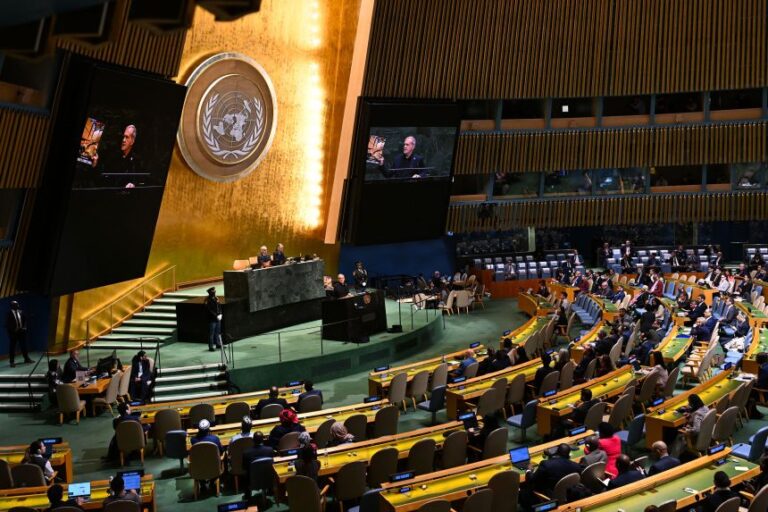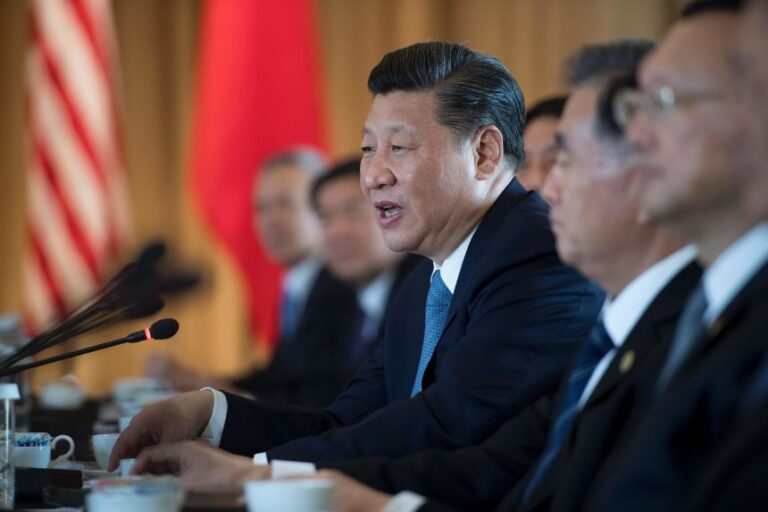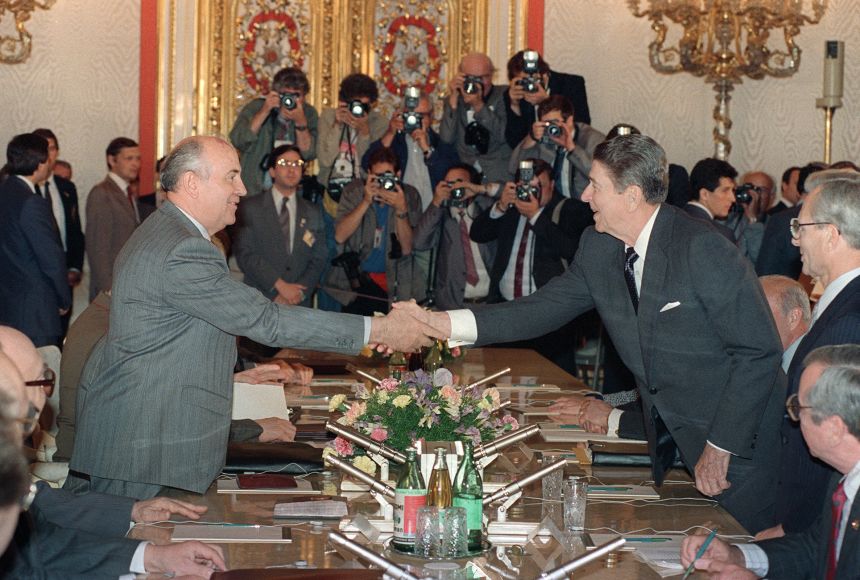
The lavish fanfare President Donald Trump is laying on for China’s leader Xi Jinping implies that a grand global moment is at hand. In an unusual move, Trump traveled to a blustery Joint Base Andrews to greet Xi at the foot of the steps to his plane when he arrived Wednesday for a two-night stay. The leaders chatted, together with their wives, before strolling down a red carpet side by side. There was one blip in the choreography, however, when a jet performing a flyover split the sky with a thunderous roar during the national anthem, causing Trump to flinch and grimace. Still, the imagery suggests two great leaders of the world’s most powerful nations meeting to chart the planet’s destiny. The timing could not be more propitious as the US and China push across a new technological frontier amid warnings from industry chiefs that artificial intelligence may soon race out of control. But pageantry can deceive. Xi’s state visit is no equivalent of the summits between President Ronald Reagan and Soviet leader Mikhail Gorbachev that set the Cold War on course for a soft landing. For one thing, it is expected to end without an agreement to protect humanity that would parallel 1980s nuclear weapons cuts. Forty years on, such moves might include curbs on AI development or the US and China offering mutual visibility into their tech industries to build trust and safety. US President Ronald Reagan shakes hands with Soviet leader Mikhail Gorbachev at St. Catherine’s Hall, in the Kremlin, on June 1, 1988. Mike Sargent/AFP/Getty Images/File There’s still a chance the summit could surprise — though to do so it would have to confound China’s traditional diplomatic codes, which require intricate pre-meeting diplomacy to line up deliverables. In reality, then, a good outcome would be limited to an extension of the bilateral trade truce announced Wednesday evening; new efforts to forge stability between Washington and Beijing; and minor initiatives on AI, fentanyl flows, trade and avoiding military clashes. But why are expectations so low, especially when the rest of the world is looking on as the US and China vie for the lead in an artificial intelligence arms race? The AI issue is especially emblematic of the gulf between the rivals. Each thinks it can prevail, and both understand the stakes for their superpower duel: “Whoever wins AI, wins,” as Trump put it. Both are resisting any meaningful constraints in a sector that is vital to propping up economic growth. Many analysts believe China is trailing in the AI race, and wouldn’t sign up to any mutual slowing of the industry. It typically sees any move to limit its technological rise as part of a Western strategy to deprive it of its rightful global power. A personality mismatch between the improvisational Trump and the deliberate Xi also augurs against spontaneous decision-making. The US and Chinese political systems are so different — and so increasingly weighted to counter the other — that little common ground exists. And each side wants to avoid blowups but lacks the leverage to force concessions. Trump’s plunging poll numbers amid the Iran war risk fraying his global clout. He discovered last year that Chinese threats to cut exports of rare earth minerals to the US could thwart his trade offensive. And while Xi has no worries about angry voters in his totalitarian homeland, and ruthlessly protects his domestic power, he’s facing a property crisis and economic issues back home. The limits of Trump’s summit diplomacy US military personnel walk into position next to a red carpet at the bottom of the stairs of an Air China plane carrying Chinese President Xi as he arrives at Joint Base Andrews, Maryland, on Wednesday. Brendan Smialowski/AFP/Getty Images To be fair to Trump, most global summits under-deliver. And meetings between US and Chinese leaders unfold amid unflattering comparisons to epochal 1970s meetings between President Richard Nixon and China’s Mao Zedong. Still, the president often gives the impression that he’s more interesting in the spectacle of global leader summits than their substance — one reason the Xi meetings this week may yield few concrete outcomes. His high-profile meetings with North Korean leader Kim Jong Un in his first term, and last year’s Alaska encounter with President Vladimir Putin, produced little apart from photos of Trump with strongmen he appears to admire. He’s been relishing the prospect of Xi’s visit for months, and will want to at least match the red-carpet symbolism that he took as a sign of great personal respect when he traveled to Beijing in May. Trump is far from the first president to believe that their intimate personal connections with foreign leaders are decisive in global affairs. During a crisis, such ties could be important. Lyle Goldstein, senior fellow and director of the Asia Program at the think tank Defense Priorities, said the meetings were a “good thing” and that personal diplomacy between Xi and Trump had helped stabilize the relationship and reduced military tensions, including over Taiwan. Still, Trump has taken faith in his own indispensability to new levels. He frequently boasted, for instance, about his “great relationship” with Xi at 2024 campaign rallies in a way that seemed distant from voters’ top concerns. In Beijing, he gushed again about the connection. “It’s an honor to be your friend,” Trump told his host. “There are those that say this is the biggest summit ever.” Chinese leader Xi Jinping, after arriving on Wednesday. Chip Somodevilla/Getty Images Trump’s determination to protect what he sees as his personal bonds with leaders sometimes leads him to make excuses on their behalf. In July, for instance, he told reporters that “we do things to them too; it’s not a one-way street” when asked about allegations of Chinese election meddling in 2020. This month, the president also played down claims that Beijing gave Iran satellite imagery of a base in Jordan before an attack on US troops. China denied the report from the Wall Street Journal, which cited unnamed US officials. The Chinese leader rarely reciprocates with personal warmth toward Trump, showing every sign of playing a long diplomatic game that will endure long after the 47th president has left office. Former officials have said that Xi is more willing to engage in unscripted conversations in private than his dour predecessor Hu Jintao. But he’s still inhibited by Chinese Communist Party protocols and cautious diplomatic customs. He’s also noticeably avoided the ostentatious flattery that other leaders employ to try to get Trump onside. Some Republicans have been withering about Trump’s approach. In extraordinary comments on Tuesday, Sen. Roger Wicker, chairman of the Senate Armed Services Committee, blasted the meeting. “Our commander in chief should keep in mind that his guest is a brutal, unelected and oppressive dictator who seeks to dominate his neighbors and whose massive military arsenal is aimed directly at the United States of America,” Wicker said. AI raised huge global expectations for Trump and Xi Humanoid robots take part in the opening ceremony of the 2nd World Humanoid Robot Games in Beijing, on August 22. Pedro Pardo/AFP/Getty Images The Xi-Trump summit was lent extra relevance by recent warnings by AI developers and leaders that their products could soon slip out of control and threaten humanity. But on Tuesday, Trump rebranded AI as “super intelligence” and told the United Nations General Assembly that he “totally rejects any attempt to construct a globalist scheme to control” the technology. The fast-expanding use of AI in military applications, meanwhile, adds another layer of complexity, because any move by either Beijing or Washington to limit the technology could give the rival superpower a potential battlefield edge. The president’s opposition to any regulation, at home or abroad, has already closed off the potential of a major US-China deal on the issue. While China balks at outside control, it has shown more openness to building institutional safeguards and a global consensus on how to deal with AI’s development, although its willingness to go beyond rhetoric is unclear. AI is exceedingly widely adopted in China. And its closed political society means there has been little of the debate and backlash about the technology that has erupted during the US midterm election campaign. On Wednesday, Beijing’s permanent representative to the United Nations Fu Cong lashed out in a UN Security Council meeting with AI chiefs at “certain major countries” — code for the US — that he accused of creating a “petty us versus them clique” and of forcing other countries to use their technology over China’s. Still, there’s some recognition on both sides of the global concern about AI. Treasury Secretary Scott Bessent told CNBC Monday that ahead of the summit, the US and China were discussing opening a line of communication regarding AI incidents to help determine “what the leading AI dangers are. The post Why the Trump and Xi summit will struggle to live up to its grand pageantry appeared first on Egypt Independent.