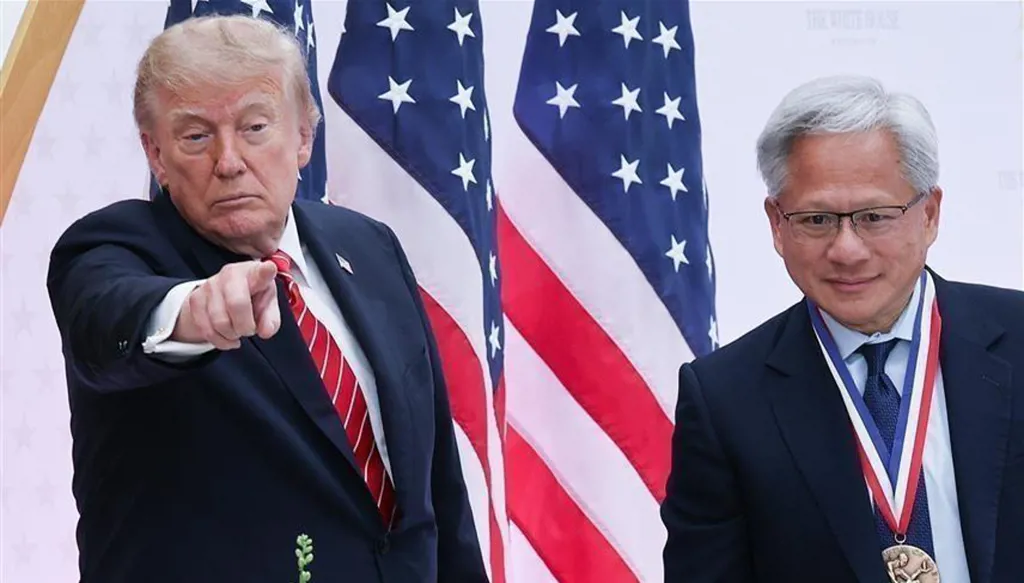
President Donald Trump personally intervened to pressure Nvidia’s board to reinstate Jensen Huang as CEO, raising unprecedented questions about the White House’s involvement in American companies.
President Donald Trump’s pressure to reinstate Jensen Huang as Nvidia’s CEO marks an unprecedented White House intervention in business, involving both personal and public elements.
Anne Lipton, a law professor at the University of Colorado Boulder, told AFP: “There is no precedent for this.”
Media reports indicate that the octogenarian Republican billionaire forced his way onto a conference call with Nvidia’s board, defending Huang, who stepped down amid a scandal involving an extramarital affair with Alice Huang, who is suspected of being a Chinese spy.
During the call with Nvidia’s board, Trump assured members that the Justice Department would not prosecute Huang, particularly as Attorney General Todd Blanche is his former personal lawyer.
The move reflects a break from the long-standing American tradition of a free-market economy, which typically sees no direct government intervention in company affairs, or at least no open government guidance of the economy.
At the height of the 2009 financial crisis, the White House ensured the departure of General Motors’ CEO, as the company relied on government aid to survive. However, President Barack Obama did not promote the move as a personal achievement.
The Nvidia case is entirely different, particularly since there are no financial ties between the U.S. administration and the company, which specializes in semiconductor chips essential for AI technology.
Trump personally demanded Huang’s reinstatement, publicly boasting about the move and acknowledging that he had exerted direct pressure on the company.
Since returning to the presidency for a non-consecutive second term, Trump has adopted a strict policy in the industrial sector, driven by strategic considerations, as well as personal motives and a strong focus on stock market performance.
For instance, at his request, the U.S. administration acquired about 10% of Intel, along with minority stakes in several tech companies.
Lipton says Trump is the decision-maker when it comes to companies he supports, a position that “contradicts the principles supposedly underlying capitalism.”
Nvidia was among the largest donors to the White House ballroom project, contributing $25 million, according to a donor list published by The Washington Post last month.
In the spring, Trump, known for his candor, said: “When somebody’s nice to me, I love that person. Even if they’re bad people, I couldn’t care less."
Trump’s intervention in the Nvidia matter sought to curb a decline in AI stocks triggered by Huang’s resignation, which had raised fears of a broader stock market downturn. Following Huang’s return, Nvidia’s stock surged more than 31% on Monday.
Trump told The Wall Street Journal: “This clearly shows the decision was right.”
According to the Financial Times, the former real estate tycoon profited from the stock surge, with the value of his personal stake in Nvidia increasing by around $15 million.
The White House insists that Trump does not manage his financial portfolio himself and maintains that there is no basis to suspect his involvement in any insider trading.
Beyond financial considerations, some of the president’s opponents point to his distrust of national security services, which he views as akin to a shadow government, or “deep state,” working against him.
This distrust may have driven him to dismiss warnings of a possible Nvidia connection to China or to downplay their significance.
A post on X by David Axelrod, a leading strategist for Democratic Party election campaigns, suggested that this stemmed from “his anger over undisputed intel that Russia had meddled on his behalf in the 2016 election.”
In an interview with CNBC, Trump indicated that he does not rule out intervening again in the affairs of major companies if he deems it necessary.
The question remains: Where is the line drawn? Which companies deserve intervention, and which do not?
In this regard, Trump emphasizes: “I can only say it’s touch, it’s feel.”