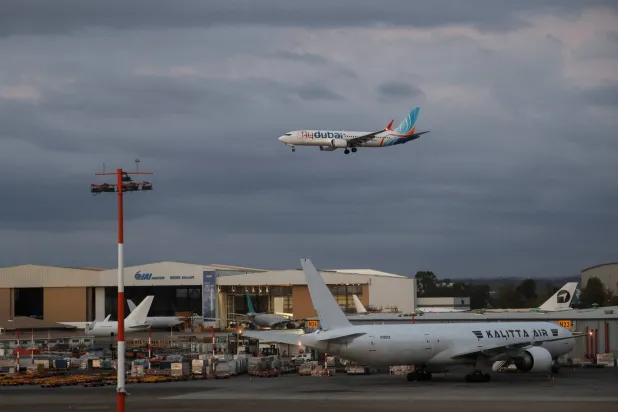
One pilot stabbed another and attempted to crash a flight from the United Arab Emirates to Israel. Passengers, many of them Israelis, feared for their lives as the FlyDubai aircraft lost half its altitude in about a minute. As Israel scrambled fighter jets out of concern for a possible hijacking, a passenger and crew member burst into the cockpit to subdue the attacker, enabling other crew members to gain control of the aircraft, which landed safely in Saudi Arabia. It was not clear what motivated Wednesday's attack. The terrifying flight occurred just days before the anniversary of the Oct. 7, 2023, attack on Israel that launched the war in Gaza. It has rekindled anxieties about airline security and focused attention on an unsettling question: Are pilots a significant threat to the flying public's safety? Here’s what we know — and don’t know — about what happened on FlyDubai flight FZ1073: A fight, an alert and a rapid descent The distress call came at 8:44 a.m. local time, about two and a half hours after the flight with about 170 passengers left Dubai and headed to Tel Aviv. The captain and first officer had been fighting in the cockpit after one stabbed the other and tried to crash the aircraft, according to Israeli Prime Minister Benjamin Netanyahu. The aircraft swiftly lost altitude — dropping from 33,000 feet to 17,000 feet (around 10,000 meters to 5,100 meters) in the span of about a minute. It then circled close to the Jordanian border before landing in Tabuk, Saudi Arabia, about an hour later. Aviation experts said they were surprised that the plane did not crash after a descent so extreme that most of the rudder was ripped off the tail. Both pilots suffered injuries that required hospital treatment, according to a statement from Tabuk's Prince Sultan bin Abdulaziz International Airport. A plane carrying passengers from the flight landed Wednesday evening in Israel. Passengers and crew wrest control A passenger and a crew member managed to enter the cockpit, enabling other crew members to fly the plane to a safe landing, according to Netanyahu, who cited a passenger he had spoken to. The cockpit door on all aircraft is locked during flight for security reasons — a measure that became the industry standard after the Sept. 11, 2001 attacks, in which hijackers broke into the cockpits of four domestic flights in the United States. Netanyahu said on X that the pilot who had been stabbed opened the cockpit door, which "enabled passengers and crew to overpower the attacker — preventing a catastrophic midair disaster.” What security checks do pilots undergo? One question surrounding this incident is how anyone on the aircraft — especially a pilot — was able to get a knife onboard. It's unclear how big the knife was that was used in the attack or if it was a knife. In an interview with Fox News Channel’s Sean Hannity that aired Wednesday night, Netanyahu said the attacker might have hit the captain with an axe. Airlines are generally required to carry crash axes in the cockpit for use in an emergency to break open a window to escape or break open a panel to access a fire. Pilots undergo rigorous screening, including passing through metal detectors, at checkpoints at all airports. It's also standard for airlines to vet their pilots' background for criminal and employment history, their physical and mental health, as well as having them undergo intelligence and security screening. Israel has some of the most stringent airline security measures worldwide. Passengers on Israel-bound flights regularly are taken aside for questioning and baggage searches after passing through normal airport security. There have been extremely rare occasions when airline security protocols fail. In 2015, the co-pilot of Germanwings Flight 9525 locked the captain out of the cockpit and deliberately set the plane on a collision course with a mountainside, killing all 150 people aboard. Cockpit struggles have been blamed in past crashes On Oct. 31, 1999, EgyptAir Flight 990 went down off the Massachusetts island of Nantucket killing 217 aboard, and investigators at the time said the evidence pointed to it being intentionally crashed into the ocean by its co-pilot after a struggle in the cockpit. In its final report adopted in 2002, the National Transportation Safety Board said the co-pilot was heard on the cockpit voice recorder saying “I rely on God” as the plane was going down, while the captain repeatedly urged him to “pull up with me.” The evidence led the NTSB to conclude that the crash was not the result of a mechanical failure but was “the result of pilot inputs, including opposing pilot inputs where the relief first officer was commanding nose-down and the captain was commanding nose-up movement.”