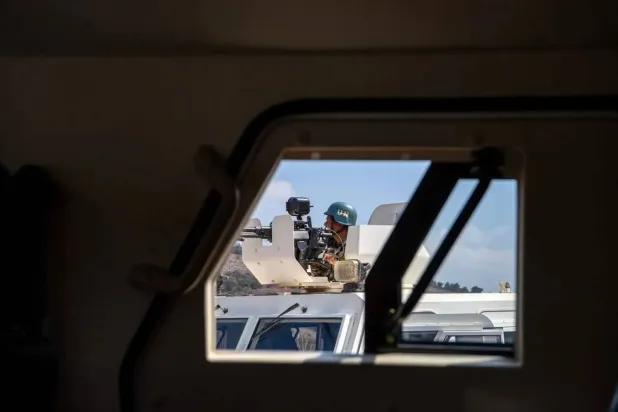
Lebanon fears a vacuum in its south when the mandate of the UN peacekeeping force expires late this year. The United States and Europe agree that the Lebanese army should ultimately secure the border, but differ over whether it can do so alone now. Washington last week blocked a Lebanese proposal to extend the mandate of the United Nations Interim Force in Lebanon (UNIFIL) by six months. UN Under-Secretary-General for Peace Operations Jean-Pierre Lacroix is due in Beirut next week to discuss ways to avoid a vacuum with President Joseph Aoun and other Lebanese officials. Lebanese ministerial sources told Asharq Al-Awsat that Beirut was waiting to hear Lacroix’s proposals. Options raised so far include a European force to replace UNIFIL and more personnel for the United Nations Truce Supervision Organization (UNTSO). The sources also cited a French-Italian initiative to form a replacement force after European and Asian countries contributing to UNIFIL said they were willing to stay in Lebanon to continue the mission. Most UN Security Council members support extending UNIFIL’s mandate or forming a replacement force, but Washington opposes both options. Western diplomatic sources told Asharq Al-Awsat that the US position is that the Lebanese army alone should secure the border. On that basis, they said, “there should be no need for any other force in the area.” Europe agrees that the army should eventually protect the border and maintain security on its own. It says the army cannot yet do the job without international support. “The Lebanese army should ultimately take on the mission by itself, but at present it cannot do so alone and needs international support during this transitional phase,” the diplomatic sources said. The European position rests on two factors. The first is Israel’s occupation of Lebanese territory and the failure of security talks to reach understandings that would allow direct coordination between the Lebanese and Israeli armies. The second is the Lebanese army’s need for more personnel and weapons. That issue was not settled at meetings in Paris last week, despite international willingness to support the army and official security forces. Lebanon backs the European approach. Its army “needs weapons, ammunition and vehicles,” Lebanese sources said. “Without the support it needs, the army cannot carry out the mission alone.” “Washington must begin equipping and strengthening the army before talking about leaving it solely responsible for border security,” the sources told Asharq Al-Awsat. Beirut’s insistence on an international force also reflects a concern about direct coordination with Israel. Lebanese officials believe Washington’s opposition to a force in the south is meant to push the Lebanese army toward such coordination. Beirut, meanwhile, wants an international witness to Israeli violations. “Beirut wants a witness to any violations Israel commits in the south, because Tel Aviv will dispute the Lebanese army’s reports and campaign against it,” Lebanese sources following the issue said. “What is needed is an international force that can testify to Israeli violations before the world and help the Lebanese army deploy.” Lebanon also wants the force to help clear mines and remnants of war, reopen roads, and provide electricity, ambulance services and health care at clinics, the sources said. The army’s duties in the south include securing the return of residents under current conditions. Several countries, particularly in Europe, have expressed interest in a replacement force if efforts to extend UNIFIL’s mandate fail. Representatives of European countries discussed an alternative mission at meetings early this month, Western diplomatic sources told Asharq Al-Awsat. They focused on bringing together countries that could work well together and securing the approval of Lebanon and Israel. Funding was also discussed. France, Italy, Spain and Britain are among the countries willing to join any replacement force, Lebanese sources following the issue said. UNIFIL currently has 8,100 personnel in the south. Its French contingent continues to patrol the border area occupied by Israel and escort convoys of Lebanese residents from three predominantly Christian border villages on journeys to and from other parts of Lebanon. Lebanon has raised the need for an international presence in the south with visiting officials. Aoun most recently discussed it in Beirut with Vice Admiral Edward Ahlgren, Britain’s senior defense adviser for the Middle East. Aoun said that allowing UNIFIL’s mandate to lapse without forming a replacement international force would create a vacuum that would not serve security or stability, particularly while Israel continues to occupy a number of southern villages and towns. Lebanon’s efforts have met US opposition. Prime Minister Nawaf Salam plans to seek a way through the impasse with US Secretary of State Marco Rubio when they meet in Washington next Monday. Salam also raised the issue with several officials he met in New York on the sidelines of the 81st session of the UN General Assembly. They included UN Under-Secretary-General for Humanitarian Affairs and Emergency Relief Coordinator Tom Fletcher, whom he met on Thursday. “We discussed the importance of maintaining an international presence under the UN umbrella in the south after UNIFIL’s mission ends, to prevent any vacuum and support stability and the process of extending state authority,” Salam said.