"The atmosphere is terrifying, and everything is frozen as the world awaits clarity on the course of recent conflicts and their outcomes." This is how environmental journalist Habib Maalouf describes the atmosphere surrounding this year's climate negotiations to "Annahar," as hopes of achieving tangible progress fade while wars and geopolitical conflicts advance at the expense of environmental commitments.
According to Maalouf, the climate crisis cannot be separated from the global struggle over resources, from fossil fuels to the rare minerals used in renewable energy technologies. In his view, the world has not truly transitioned to a new economic and cultural model. Instead, it has shifted from competing over one resource to competing over another, while economic interests, arms races, and markets continue to dictate the course of nations.
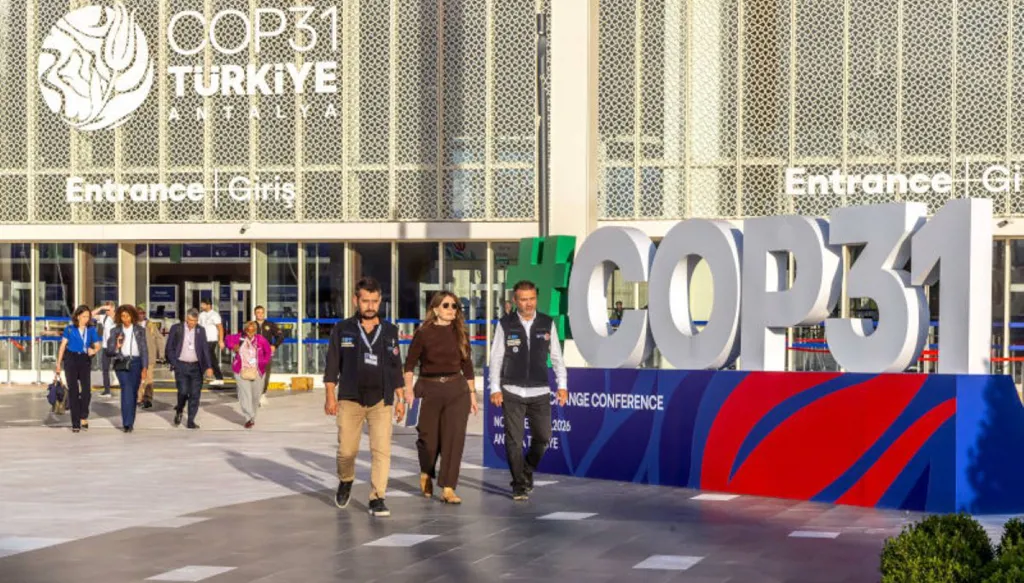
Coinciding with the 31st Conference of the Parties to the United Nations Framework Convention on Climate Change (COP31) in Antalya, Turkey, a summit titled "COP31: From Commitments to Execution: How Will Arab States Affected by Wars and Crises Address Climate Change?" was held in Beirut. It was organized by the Arab Center for Research and Policy Studies - Beirut, in partnership with the Arab NGO Network for Development, Greenpeace Middle East and North Africa, and LRI.
The conference provided an opportunity to discuss the environmental costs of wars, climate justice, and the prospects for green recovery. It also marked the launch of a press file titled "Environment in Lebanon: How to Face the Effects of War, Climate Crisis, and Environmental Degradation."
Lebanon: From Climate Adaptation to Compensation Claims
On the sidelines of the conference, former Minister of Environment and Director of the Arab Center for Research and Policy Studies - Beirut Nasser Yassin told "Annahar" that Lebanon's participation in COP31 carries particular significance amid the shifts that war has imposed on climate action priorities. After years of focusing on adapting to climate change, it has become necessary to bring the environmental damage caused by war into international discussions and agendas.
He noted that the Lebanese government is participating in the Antalya conference through the Ministry of Environment, other ministries, and representatives of various sectors. He stressed the importance of following up on commitments Lebanon previously announced at climate conferences and building on the participation witnessed over the past four years, with contributions from ministries, civil society, environmental organizations, and the private sector.
However, the main challenge today lies in documenting what he described as environmental genocide in southern Lebanon and ensuring that the effects of Israeli attacks on agricultural lands and natural areas are included in international files addressing the consequences of war.
Yassin also stressed the importance of pursuing compensation, recalling the 2006 United Nations General Assembly resolution concerning compensation related to the attacks, estimated at around $850 million. The issue is not limited to seeking compensation. Lebanon must also push for the consequences of wars on the environment and climate to be included on the international agenda, particularly since small countries affected by conflict face additional burdens for which they cannot be held solely responsible.
Beyond the direct damage caused by wars, climate financing remains one of the major obstacles to Arab countries' ability to address climate change and recover from its effects.
In this context, Goue Nact, Executive Director of Greenpeace Middle East and North Africa, told "Annahar" that the gap between developed countries, historically responsible for the majority of emissions, and developing countries bearing their consequences remains wide, with insufficient funding reaching the Arab region.
She pointed out that the region needs around $570 billion, while the funding received so far accounts for no more than 6% of that amount. According to Nact, the problem lies not only in the volume of funding but also in its nature, as a significant portion is provided in the form of loans rather than grants, adding to the financial burdens of countries already facing economic crises, wars, and institutional challenges.
To address this gap, Greenpeace proposes adopting the "polluter pays" principle as a source of climate action funding. Under this approach, companies most responsible for historical carbon emissions would bear a greater share of the costs of the damage they have contributed to.
Nact highlighted the substantial profits made by global oil companies, noting that they reached around $40 billion in the second quarter of the year. She suggested that holding these companies accountable could provide additional resources for climate action, rather than placing the burden of a crisis on vulnerable countries that have contributed relatively little to causing it.
However, the funding crisis and countries' commitments are only part of a more complex picture, according to Maalouf, who believes geopolitical conflicts largely dictate the course of climate negotiations.
He noted that the world has failed to meet the necessary commitments in recent years, whether in terms of gradually moving away from fossil fuels or providing financial support to the countries most affected by emissions. Meanwhile, competition among major powers has increasingly shifted towards rare minerals, after historically revolving around traditional energy sources.
He explained that China has become a major competitor in technological and green industries, from solar panels to batteries and renewable energy technologies. At the same time, other countries are seeking alternatives to their dependence on rare minerals, over whose supply chains China controls a significant share. Thus, the nature of the conflict remains unchanged; only the resources at the center of the competition have shifted.
Maalouf concluded that partial solutions and annual initiatives are no longer sufficient. Saving the climate requires rethinking the prevailing economic and cultural model, including putting an end to arms races and conflicts over resources and markets, as well as curbing production and consumption patterns that exhaust the planet.