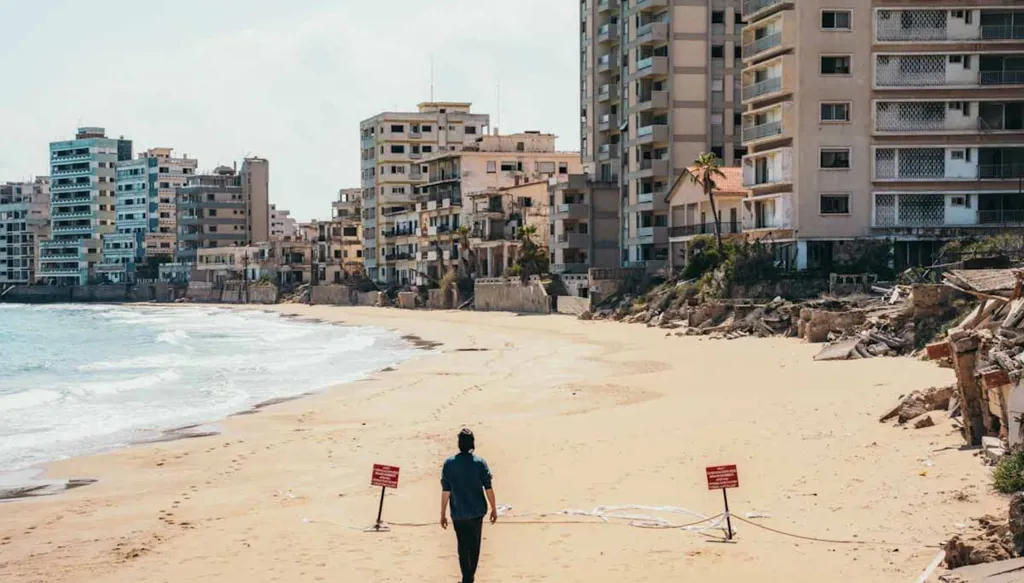
Once known as the “Riviera of Cyprus,” Varosha was a thriving Mediterranean resort until the events of 1974 emptied its streets. Today, abandoned hotels, deserted shops, and homes reclaimed by nature stand as reminders of a city caught between its past and an uncertain future.
Varosha was known as the “Riviera of Cyprus” and thrived as a Mediterranean tourist resort, with its beachfront hotels, shops, and residential streets. However, the events of 1974 emptied it of its residents, turning its dilapidated buildings, abandoned shops, and vine-covered streets into a haunting scene of a city caught between its past and an uncertain future.
There is something chilling about walking through a city where life seems ready to resume at any moment, even though it has remained largely deserted for more than half a century. In Varosha, on the eastern coast of Cyprus, buildings still stand, shop signs remain in place, and hotels overlook the Mediterranean. But the residents who once filled these streets are no longer there.
The wind sweeps through the empty streets, slipping between shattered windows as parts of the buildings’ interiors gradually succumb to time and vegetation. Only the whistle of the wind passing through the deserted structures interrupts the silence, adding to the eerie atmosphere of a place where traces of daily life remain in every corner.
Varosha was once considered the Riviera of Cyprus and a popular tourist destination during the 1960s and early 1970s. Its beaches attracted visitors, while its hotels, restaurants, bars, and shops reflected the prosperity of an expanding Mediterranean resort. Today, the same scenes tell a completely different story.
Varosha’s former ambitions are clearly visible in its hotels. Along the famous John F. Kennedy Street stands the “King George” Hotel, a tall building that was once one of the area’s landmarks. Nearby is the “Florida” Hotel, a multilevel seaside establishment that formed part of the resort’s urban landscape during its peak years.
These structures were built to accommodate visitors, offer sea views, and sustain vibrant tourism activity. Today, their dilapidated shells stand as witnesses to a tourism sector that suddenly lost the place in which it had thrived.
Elsewhere, the abandoned “Bank of Cyprus” branch appears frozen in time, within an area that has remained closed off for decades under military control. The commercial buildings present similar scenes: neglected interiors falling into decay, plants making their way through abandoned spaces, and greenery gradually creeping over storefronts and sidewalks.
Bar and shop signs still hang above their entrances, many bearing inscriptions in Greek that evoke a community that once filled these streets with life. Dust and decay have replaced customer traffic and the bustle of commerce.
These establishments did not simply close. Their surroundings suggest that an entire urban life came to an abrupt halt, leaving behind the infrastructure of a city stripped of the people who gave it meaning.
Beyond the commercial area, Varosha’s residential buildings reveal a more intimate face of abandonment.
Plants grow through windows and balconies, while some broken doors lie on the ground and shards of glass cover deteriorating facades. Signs warning of the danger of collapse stand in front of several buildings, whose condition has worsened over decades without regular habitation or maintenance.
These homes were inhabited by residents who left in 1974, many believing they would one day return. Their departure, however, has become part of one of Cyprus’s most enduring divisions.
The island entered a period of conflict following a coup supported by Greek military forces in July 1974. Turkish forces intervened militarily, and during the second Turkish operation in August, Varosha was evacuated of its Greek Cypriot residents, who made up the majority of its population, and came under Turkish military control. The area was subsequently closed, preventing its former residents from returning to their homes. The United Nations Security Council later called for Varosha to be placed under UN administration, opposing the resettlement of anyone other than its original inhabitants.
More than 50 years later, the effects of those events remain evident in the buildings themselves. The homes still stand, but the details of daily life that once unfolded inside them have vanished.
Amid the abandoned buildings stands a silent Greek Orthodox church, the Agios Ioannis Church and Icon Museum. Its presence serves as a reminder of a community whose religious and social life was rooted in this part of the island, even though its members no longer gather here as they once did.
In the center of the main street stands one of Varosha’s most famous landmarks: the abandoned “Toyota” car showroom.
The logo remains visible on the building and has become a distinctive feature of the deserted city, drawing visitors who take photographs in front of it. Since parts of Varosha were opened to visitors in October 2020, the showroom has become one of the most frequently recalled images associated with the city.
The contrast is striking: the commercial logo, once associated with movement, consumption, and modern life, now symbolizes a place overshadowed by stillness.
On the same street, an empty house displays the flags of Turkey and the “Republic of Northern Cyprus,” which is recognized only by Turkey. Amid the surrounding deserted buildings, the flags signal a clear political presence in an area still missing its former residents.
Allowing visitors to walk along designated streets and observe the city’s relics up close does not mean that life has returned to normal. Large parts of the area remain deserted, while its political status remains contested.
Perhaps the most awe-inspiring scene unfolds from the beach.