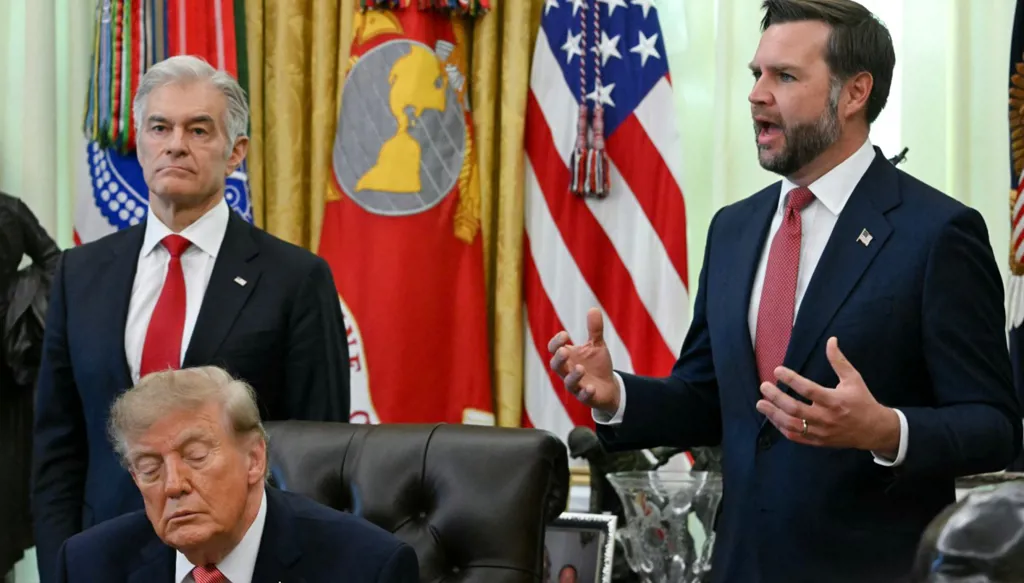
The fallout from the resounding defeat suffered by the Republicans in Tuesday’s US midterm elections has begun to emerge. Vice President JD Vance chose to distance himself from President Donald Trump, attributing the defeat mainly to the Iran war, which he saw as a key factor in rising prices that drove voters away from the Republican Party.
Losing both chambers of Congress to the Democratic Party by a wide margin has left the Republicans at a crossroads and pushed them to search for the reasons behind these disastrous results. Although Trump acknowledged that the Iran war was among the reasons that shifted voters’ opinions, he argued that the absence of his name on the ballot was also a major factor, implying that the defeat belonged to the Republicans, not to him personally.
Disagreement Over the Causes of Defeat
Vance, however, parts ways with Trump in explaining the defeat, attributing it to four causes: failing to end the Iran war, failing to address the high cost of living and inflation, failing to put American interests first, and failing to change the nature of the relationship with Israel.
Trump, for his part, blames inflation and high fuel prices in the United States on Ukrainian President Volodymyr Zelensky’s strikes on Russian oil refineries, while taking a strongly pro-Israel stance and backing its Prime Minister Benjamin Netanyahu.
Still, Vance is merely the tip of the iceberg in the debate raging within the Republican Party over the impact of the Iran war on American voters who backed the Republicans in 2024 but abandoned them in the midterms. Vance has put his finger on the wound: the cause is the Iran war, which worsened inflation and led these voters to cast their ballots for the Democrats.
The pressing question now is how the election results will affect Trump’s decision on Iran. Three possibilities emerge: first, striking a deal; second, escalating and launching military strikes; and third, maintaining the status quo of economic blockade and further sanctions.
Logic suggests that the military option has receded after the election results. But Trump’s nature, which refuses to accept defeat, may push him toward escalation despite the risks it could entail. At the same time, he has little patience for continuing the naval blockade, imposing sanctions, and pursuing contacts through mediators in search of a suitable way out that would end the war.
Vance has reason to fear a prolonged conflict. He has made clear that maintaining the status quo could cost the Republicans the White House in 2028. The vice president is considered one of the leading figures likely to win the Republican Party’s presidential nomination.
Interestingly, Donald Trump Jr. was quick to back Vance’s position. US reports revealed that Trump’s son had advised his father before the war not to get entangled in it. This highlights the opposition to the war voiced by figures in Trump’s inner circle, while others, such as Secretary of War Pete Hegseth, pushed him toward it, portraying it as an operation that would take no longer than the abduction of Venezuelan President Nicolás Maduro last January.
After the electoral defeat, many questions are being raised about the future of Trump’s team. Will he keep this team unchanged, or will he look for a scapegoat? The US president’s insistence, in an interview with the British newspaper the Financial Times, that if he could turn back time he would make the decision to go to war again without hesitation, does not suggest any intention to make changes.
Vance, who knows Trump’s position all too well, put a question to Republicans, saying frankly: “If you want to say that losing the Senate for the next six years was worth it, then do so. Say it was a price worth paying. Whether we agree or disagree, that is at least honest.”