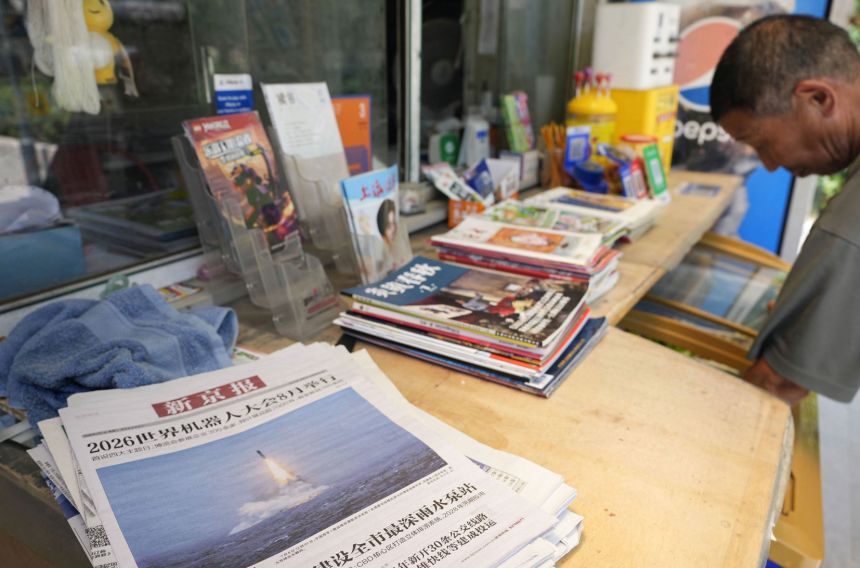
The Trump administration has discussed beginning reciprocal nuclear site visits with China and plans to continue pushing for that possibility during in-person meetings in the coming months, according to sources familiar with the matter. The discussions, which have been informal and preliminary, come amid mounting US concerns about China’s rapidly growing nuclear weapons program and after the last remaining arms control agreement between the US and Russia expired last year. The effort to establish a trilateral agreement began in Trump’s first term, but no tangible progress has been made and formal talks on a new accord have not begun, with China and Russia largely ignoring substantive US outreach efforts. The idea of reciprocal visits was initially raised by the Chinese while meeting US officials this year, one source said, giving some indication that the communist nation may be open to pursuing confidence building measures that could pave the way for a grander agreement. Visits to the US Department of Energy national labs and to China’s equivalent facilities were discussed, and the US would be open to discussing visits to nuclear testing sites, the source said. The nuclear discussions between the US and Chinese officials at the working level so far this year have largely occurred on the sidelines of gatherings by the five permanent members of the United Nations Security Council, known as the P5, sources said. The concept of allowing nuclear site visits could move the needle on the US efforts to engage China on issues related to strategic stability and potentially serve as a building block for a trilateral agreement, but China remains adamant that they will not engage on discussions that could limit their nuclear buildup. The US currently has a much bigger nuclear arsenal with about 5,000 total nuclear warheads while China has about 600, but it is expanding its nuclear weapons infrastructure and has been projected to produce hundreds more warheads over the next decade. A State Department spokesperson referred questions to the White House, which did not provide a comment. CNN has requested comment from the Chinese embassy in Washington, DC. Last Thursday, China began its weeklong National Day holiday, during which all government offices are closed. Paul Dean, who previously served as an acting assistant secretary of state overseeing US arms control efforts, told CNN that the administration needs to approach any Chinese nuclear negotiations with its “eyes wide open,” but said that reciprocal visits would be “an extremely valuable confidence-building measure” that could lay the informational and diplomatic foundation for additional work to reduce nuclear risk between the two countries. “This is a very dangerous time, and there are very few guardrails in place on the US-China nuclear relationship,” Dean, now a vice president at the Nuclear Threat Initiative nonprofit, said. Photo taken at a newsstand in Beijing on July 7, 2026, shows a local newspaper reporting on the Chinese military’s test-firing the previous day of a nuclear-capable ballistic missile from a submarine toward the Pacific. Kyodo/AP President Donald Trump expressed support for trilateral arms control negotiations between the US, Russia and China when he met Chinese leader Xi Jinping last month, but they didn’t discuss the possibility of site visits during their talks, a US official said. Xi did not leave the door open to discussing a trilateral agreement, pointing to the US and Russian nuclear arsenals being larger than China’s – a point that Chinese officials have routinely used to shield themselves from any discussions that could lead to limiting their nuclear stockpile before they are on par with the US, the official added. Still, the topic of nuclear arms control has long been a focus for Trump, who is expected to meet with Xi twice later this year. By the time the two leaders meet again it is expected that further lower-level discussions on possible nuclear site visits will have taken place, the sources said. Visiting nuclear sites for on-site inspections have historically been used as a vital verification tool by the International Atomic Energy Agency to be sure that nations are abiding by their commitments to using the facilities for peaceful purposes. Skepticism about China’s motives Experts and former US officials who spoke with CNN were encouraged by the talks but were not confident that they will immediately lead to concrete progress on a breakthrough agreement. “It has to be taken seriously. It could be a great start,” said a former US official who has engaged China in track two discussions related to strategic stability in recent years. Still, skeptics noted that the Chinese may have floated the idea in an effort to create a positive atmosphere or to appear serious on the topic of nuclear arsenals, said former US officials and experts who questioned the authenticity of such an offer. “In advance of a big summit if the Chinese can put good feelers out there they will do that,” said another former US official who focused on nuclear issues. “It makes them seem more magnanimous as the two sides are engaging.” The Chinese may have a “maligned motivation” they said. About a year ago Trump said that the US would resume nuclear testing on an “equal basis” with China and Russia, but there has been no known US nuclear testing since that pronouncement. The administration earlier this year accused China of carrying out a secret nuclear test in 2020 using a technique known as “decoupling” designed to evade detection by firing the explosion in an empty cavern to minimize seismic shaking. The National Nuclear Security Administration’s nonproliferation directorate conducted a 16-ton underground non-nuclear explosion last week at the Nevada National Security Site that was the second in a years-long series of experiments designed to mimic the alleged Chinese test, according to an agency spokesperson. The decoupled test explosion offered NNSA and other entities a chance to validate the effectiveness of new methods and equipment for detecting such stealthy tests. “You cannot evade American innovation,” NNSA Administrator Brandon Williams said in a news release announcing the test. The Trump administration is also working on a proposal that would enable assure verification that low-yield nuclear testing is not happening at nuclear sites and could share that with the P5 group later this year, a US official said. It is unclear what kind of technical equipment could be part of that proposal. President Donald Trump is greeted by Chinese President Xi Jinping during a welcome ceremony at the Great Hall of the People on May 14 in Beijing. Alex Wong/Getty Images Gerald Brown, who studies China’s military at the Council on Foreign Relations nonprofit, said he is “not particularly optimistic” but that the reciprocal visit scheme, if enacted, is “a potential glimmer of hope” for reducing nuclear risk between the US and China. Brown, a former State Department intel analyst, said that China’s ongoing nuclear buildup “is deeply linked with political goals, namely its aggressive ambitions regarding Taiwan.” China historically has viewed nuclear talks as “tool to gain political concessions” on Taiwan, he argued, rather than as a genuine policy goal. “You won’t know what’s on the table until you engage in a thoughtful, rigorous way to see if this is something in our interest — and it might be,” said Dean. Dean, whose nonprofit has engaged with Chinese entities in nonofficial diplomatic discussions in recent months, said he sees mutual “interest and acknowledgement that the risks are real.” He pointed at the 1962 Cuban Missile Crisis, which sparked some of the first US-Soviet risk reduction measures like a 24-hour phone hotline, as a historical warning. “We don’t need to wait for a crisis to start reducing nuclear risks,” Dean argued. “And the risks are very real right now.” Davis Winkie’s work at CNN is supported by a partnership between Outrider Foundation and Journalism Funding Partners (JFP). CNN retains full editorial control of the reporting. The post US and China discussing reciprocal nuclear site visits amid concerns about a new arms race appeared first on Egypt Independent.