From the streets of Amsterdam to the results of the U.S. midterm elections, growing public opposition to Israeli policies has become increasingly visible. Three years after the outbreak of the war in Gaza, the protest movement is no longer confined to pro-Palestinian demonstrations. It has begun to emerge among independent voters, young people, and segments of the American conservative movement, raising questions about how this shift could affect relations between Washington and Tel Aviv.
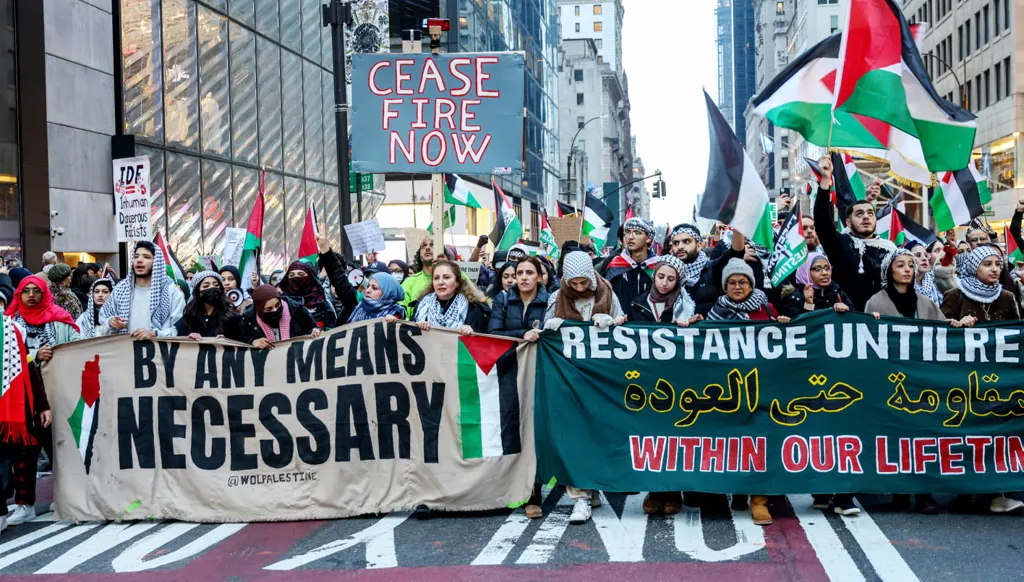
Around 200,000 people participated in a demonstration in Amsterdam on Sunday, November 8, according to organizers' estimates, while the Associated Press reported that attendance reached tens of thousands. Protesters called on the Dutch government to halt arms sales and trade with Israel.The demonstrations highlighted the widening anger over Israeli policies in Gaza. They also reflected a trend that has become increasingly apparent since October 2023: opposition is moving beyond demonstrations exclusively dedicated to Palestinian solidarity toward broader public mobilizations against Israeli practices.
In various countries, the Palestinian flag has become a familiar sight at demonstrations addressing a wide range of political and social issues. While its presence expresses solidarity with Palestinians, for some protesters it has also become a symbol of opposition to Israeli government policies and to the governments and institutions that continue to support them.This shift is particularly significant in the United States, where relations with Israel have traditionally enjoyed broad bipartisan support from Republicans and Democrats.The question is no longer limited to the extent of American sympathy for Palestinians. It now concerns whether declining public support for Israel is beginning to influence electoral choices, placing one of the longest-standing alliances in U.S. foreign policy under domestic scrutiny.When Israel Becomes an Electoral IssueThe November 2026 U.S. midterm elections offered an important indication of this changing political climate. Candidates who criticized unconditional American support for Israel made electoral gains, while the issue featured prominently in several races, exposing divisions that have become increasingly difficult for both parties to ignore.One of the most notable examples was the victory of progressive Democrat Abdulrahman El-Sayed, known as "Abdul," who won a Senate seat in Michigan after defeating Republican Mike Rogers, becoming the first Muslim American to serve in the U.S. Senate.El-Sayed made American policy toward Israel and the war in Gaza central issues in his campaign, calling for an end to U.S. military assistance to Israel.His victory followed an intense campaign that began with a Democratic primary in which he defeated Representative Haley Stevens, who was backed by groups that spent more than $50 million, including over $30 million from the American Israel Public Affairs Committee (AIPAC) and affiliated organizations.The result demonstrated that criticizing American support for Israel no longer necessarily carries the same electoral disadvantage it once did, even when candidates face opposition from well-funded pro-Israel lobbying groups.The broader election results handed Democrats control of both chambers of Congress, the House of Representatives and the Senate, after Republicans had controlled the White House and both chambers.This development opens the door to greater scrutiny of military assistance to Israel and renewed legislative efforts to impose conditions on arms transfers or restrict them.That does not mean the Israeli-Palestinian conflict determined the election results. Economic concerns, immigration, the war with Iran, and dissatisfaction with President Donald Trump's administration also played major roles.Nevertheless, Israel's place in American political debate has changed, with the relationship becoming a more prominent issue in election campaigns and public discourse.Alarming NumbersOpinion polls reflect this shift.A survey conducted by the Chicago Council on Global Affairs and published in October 2026 found that Americans gave Israel an average rating of 44 out of 100, the lowest level recorded since the organization began conducting these surveys in 1978.The council attributed part of this decline to Israel's role in the joint U.S.-Israeli war against Iran, while noting that the downward trend had begun earlier, during the military operations in Gaza.The decline was particularly striking among independent voters, whose rating of Israel fell from 56 points in 2022 to 41 in 2026.Among Democrats, the rating dropped from 52 to 30 points, while among Republicans it declined from 69 to 62.
The same survey found that 56% of Americans supported either reducing U.S. military aid to Israel or ending it entirely.
That figure rose to 64% among independents and 72% among Democrats.
By contrast, 68% of Republicans supported maintaining or increasing military assistance.
These findings suggest that the shift is being driven primarily by Democrats and independents, and that questioning continued military support for Israel is no longer confined to traditionally pro-Palestinian circles.
Similarly, a Pew Research Center survey conducted in April 2026 found that 60% of Americans held an unfavorable view of Israel, compared with 53% in 2025 and 42% in 2022.
The change appears particularly pronounced among younger age groups, suggesting that the consequences of the Gaza war could extend beyond the current electoral cycle.
One of the most significant aspects of this transformation is that it is no longer limited to progressive Democrats or traditional pro-Palestinian activists.
Divisions have also emerged within the American conservative movement, where several media and political figures have begun questioning the extent of U.S. involvement and the influence of pro-Israel lobbying groups on Washington's policies.
Conservative commentators Tucker Carlson and Candace Owens have become two of the most prominent voices criticizing Israel and its government's relationship with the U.S. administration.
Their positions have helped broaden the debate within the Republican movement, particularly among younger conservatives who increasingly question why military assistance to Israel continues to occupy such a prominent place in American foreign policy.
The position of Charlie Kirk, founder of Turning Point USA, who was assassinated in September 2025, offers another example of these tensions.
Despite his support for Israel, Kirk expressed concern about the country's deteriorating image among younger generations and the widening divisions within the MAGA movement over American policy toward Israel.
These concerns exposed a growing contradiction within the conservative base: support for Israel remains present, but it no longer commands the same degree of political consensus it once enjoyed.
This debate also intersects with Americans' domestic priorities.
Amid concerns over healthcare, housing, and living costs, the scale of military assistance provided to other countries has increasingly come under scrutiny.
For some voters, the question has become whether spending billions of dollars to support Israel should remain a priority at a time when the United States faces growing domestic needs.
Beyond American electoral calculations, the growing presence of Palestinian flags at demonstrations worldwide reflects how the war in Gaza has become central to broader public debates.
What initially began largely as protests demanding a ceasefire and the delivery of humanitarian assistance has gradually expanded to include calls for arms embargoes, trade restrictions, and political accountability.
The recent demonstration in Amsterdam illustrates this development, as participants urged their government to move beyond diplomatic statements and adopt concrete economic measures toward Israel.
Consequently, the Palestinian flag is no longer merely a symbol of solidarity with the cause of Palestinian statehood.
For some, it represents opposition to occupation and settlement expansion in the West Bank. For others, it reflects frustration over what they perceive as double standards in the application of international law, particularly when comparing Western governments' responses to different conflicts.
These criticisms have intensified amid continued settlement expansion in the occupied West Bank, where Israeli authorities continue to advance and approve projects for new settlement housing units.
This has reinforced arguments that the conflict cannot be understood solely through the events in Gaza, but must also be viewed within the broader context of occupation and the absence of a viable path toward establishing a Palestinian state.
The recognition of the State of Palestine by France, Australia, and Portugal, alongside Britain and Canada, in September 2025 also demonstrated how public pressure and opposition to the status quo had entered political and diplomatic discussions.
However, recognition does not necessarily translate into changes in military or economic relations with Israel.
Three years after the outbreak of the war in Gaza, the changing attitudes of large segments of public opinion toward Israel have become increasingly difficult to ignore.The growing presence of Palestinian flags at demonstrations, declining support for Israel in the United States, and electoral gains by candidates criticizing unconditional assistance all point to a transformation that extends beyond traditional political divisions.However, public opinion and government policy do not move at the same pace.The United States remains Israel's most important military partner, and strategic and political interests continue to shape the relationship between the two countries.Growing criticism of the Israeli government does not necessarily imply opposition to Israel's existence or a rejection of its right to security.What appears to be changing, however, is the scope of unconditional political support.As more voters question the costs and consequences of the U.S.-Israel relationship, politicians are confronting an issue that can no longer be treated as a distant foreign policy debate.Perhaps the question is no longer simply how widespread public anger toward Israel has become, but whether that anger can move from the streets to the ballot box and impose a domestic political cost on governments that continue to maintain the same positions.