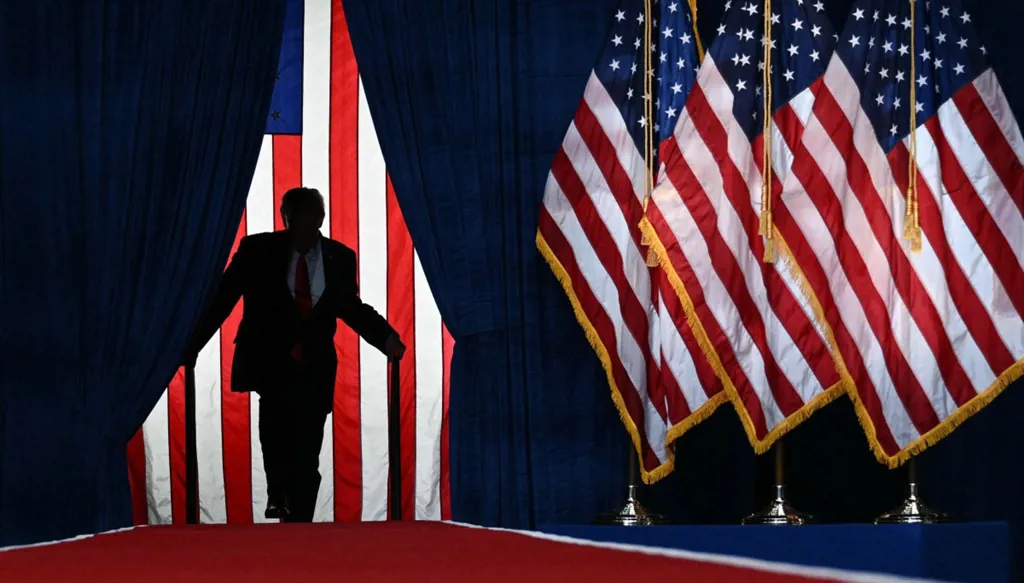
The U.S. midterm elections could spark an early battle over who will succeed President Donald Trump, reshaping the political landscape within both the Republican and Democratic parties, regardless of the outcome of the race for Congress.
As Republicans contemplate the future of Trump's leadership and Democrats clash over leadership and policy, the ballot box could redefine the balance of power within both parties and influence the prospects of presidential hopefuls in 2028.
An Associated Press report examines these emerging shifts, amid the possibility of a backlash vote against Trump that could prompt Republicans to reassess their ties to him, while progressive Democrats seek to turn any electoral gains into changes in their party's leadership and political direction.
Some Republican candidates have already begun distancing themselves from the president.
Over the past decade, Trump has reshaped the Republican Party to such an extent that his personality has become one of its main unifying forces, taking precedence over traditional principles and policies.
The party has gradually moved away from the foundations established by Ronald Reagan, particularly fiscal conservatism, limited government and free trade, alongside conservative social values and a foreign policy centered on projecting strength.
These principles have increasingly given way to populist positions that shift according to the president's views and priorities.
At the same time, Trump has succeeded in broadening the party's electoral base, attracting working-class voters and segments of Latino Americans, African Americans and younger voters, groups that historically formed part of the Democratic base.
The durability of this coalition will face a crucial test.
If turnout among these groups declines because of dissatisfaction with the economy or the war, questions will arise about the Republicans' ability to retain their support and which political figure could mobilize them in the future.
Republican strategist David Urban believes the voting behavior of these groups will reveal much about the party's future and the identity of its next leader.
Former Senator John Sununu, meanwhile, warns of a "huge vacuum" that Trump's departure from office would leave behind.
Vice President JD Vance is among the leading names mentioned as a potential successor. However, his close association with Trump could become a liability if Republicans suffer significant losses, in addition to the challenge of establishing an independent political identity.
Secretary of State Marco Rubio could face a similar dilemma.
Any electoral setback could open the door to other figures, including Texas Senator Ted Cruz, Florida Governor Ron DeSantis and possibly former New Jersey Governor Chris Christie, one of Trump's most prominent critics within the party.
On the other side of the political divide, Democrats are hoping for electoral gains that could restore their control of the House of Representatives. However, a potential victory would neither resolve their internal disagreements nor automatically address their declining popularity.
The party's traditional leadership is counting on the rise of Hakeem Jeffries, who could become the first Black Speaker of the House if Democrats regain the majority.
Progressives, however, view Jeffries and Senate Democratic leader Chuck Schumer as part of the party's leadership crisis and are demanding changes to both its leadership figures and policies.
This divide reflects a widening rift between progressives, the party establishment and its moderate wing.
From the progressive perspective, regaining the majority could simply return the same figures to positions of power without any fundamental reassessment of the party's political direction.
This trend is reinforced by expectations that the number of House members backed by the Democratic Socialists of America could rise from two to at least seven, following the success of candidates supported by New York City Mayor Zohran Mamdani in the primaries.
The disagreement also extends to the pace of political action and the nature of the confrontation with Trump.
Progressives want to capitalize on any electoral victory to push for sweeping reforms in healthcare, housing and infrastructure, while questioning whether the current leadership can seize the opportunity.
The divide is also evident in the position of Maryland Governor Wes Moore, whose name has been mentioned as a potential presidential contender in 2028.
Although Moore has called for swift action and a departure from the status quo, he has stopped short of explicitly welcoming the Democratic Socialists of America into the party, highlighting the continuing disagreement over which political forces should lead change and what methods they should adopt.
Thus, the elections could conclude only for a broader political confrontation to begin within both parties.
Republicans will face the challenge of determining who succeeds Trump and how to preserve his electoral coalition, while Democrats will have to settle questions surrounding their leadership and political platform.
Nevertheless, discussions about the post-Trump era remain premature.
The president will remain in the White House for another two years and retain considerable influence over the selection of the Republican presidential nominee, even if he emerges from the elections politically weakened.