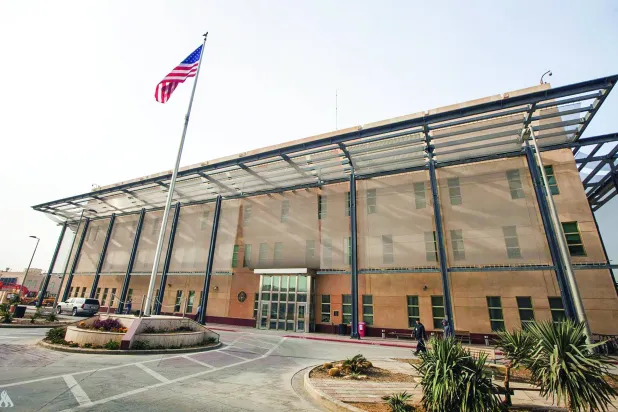
Air defenses at the US Embassy in Baghdad shot down two suspected reconnaissance drones over the heavily fortified Green Zone on Tuesday, Iraqi security sources said, triggering a security alert in the capital. The sources said the drones were believed to be unarmed and intended for surveillance. The embassy sounded its alarms as the aircraft flew over the Green Zone, which houses government buildings and foreign diplomatic missions. Iraq’s Security Media Cell, however, reported the interception of only one unidentified drone. “The sound heard in Baghdad resulted from the interception of an unidentified aircraft near the Green Zone,” Lieutenant General Saad Maan, head of the cell, said in a statement. Witnesses told Asharq Al-Awsat they heard two loud explosions near the interception sites, while residents reported finding drone wreckage near Al-Rasheed Street in Baghdad’s old city center. Reuters cited two security sources as saying the embassy’s air defenses were activated after detecting the drones approaching the Green Zone. Both were shot down, with wreckage recovered at separate locations. Security forces were investigating their origin and intended destination, the sources added. The US Embassy has faced rocket and drone attacks since the United States and Israel launched strikes on Iran. Sources told Asharq Al-Awsat that debris was scattered around the Green Zone, the Shorja market, Al-Rasheed Street and the Kadhimiya district. No civilian casualties or injuries were reported. The incident marked the first breach of its kind in the area in many months. In previous years, the Green Zone had repeatedly come under attacks targeting the US Embassy and other diplomatic missions, often blamed on Iran-backed armed factions. Motives The incident came less than a month after the withdrawal of US-led coalition forces from Iraq, whose presence armed factions had long cited to justify attacks on diplomatic and military facilities. The purpose of the drone flights remains unclear. Some observers linked the incident to tensions between Washington and Tehran, while others suggested it could be political signaling between rival groups within the Coordination Framework and armed factions. Baghdad launched a campaign months ago to bring factional weapons under state control and integrate armed groups into the security forces. The initiative was initially due to be completed by September 30, coinciding with the coalition’s withdrawal, but the government later postponed the deadline until June 2027. While some factions have complied, others continue to oppose the plan, including the Iran-backed Kataib Hezbollah. The group calling itself the Islamic Resistance in Iraq had previously pledged to support Iran if the United States resumed its war in the region.