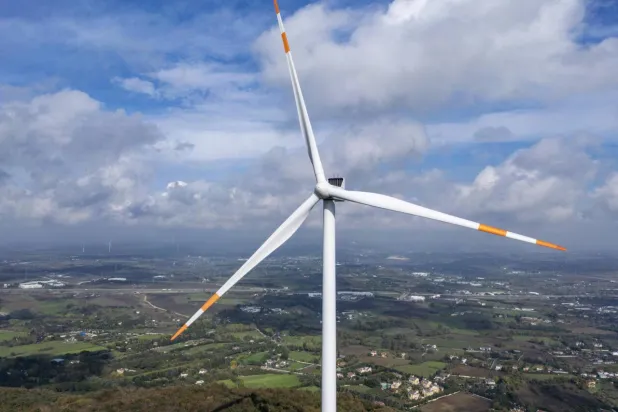
On a windy hillside about an hour's drive northwest of Istanbul, the Catalca power plant was one of Türkiye's first large-scale wind farms and has been feeding electricity into the grid for 18 years. With an installed capacity of 93 megawatts, it generates 287 million kilowatt-hours of electricity a year, enough for around 115,000 households, said AFP. "By replacing electricity that would otherwise come from fossil fuel-fired power plants, this output avoids 185,936 tons of carbon emissions each year," operator Sanko Enerji says. Nearly two decades on, Catalca is one of nearly 300 wind farms, its giant turbines a symbol of the rapidly expanding capacity for renewable energy in Türkiye which is hosting the COP31 UN climate summit that opens in Antalya on Monday. Last year, 43 percent of Türkiye's electricity came from clean energy sources, of which wind and solar accounted for 22 percent, according to energy think tank Ember. With electrification emerging as one of the central themes of COP31, Türkiye has been pushing hard for it to be an implementation-focused summit that turns existing climate pledges into action. Energy Minister Alparslan Bayraktar has outlined plans to triple Türkiye's installed solar and wind capacity from around 40 gigawatts to 120 gigawatts by 2035. But with coal still the leading source of power generation, Türkiye is under pressure to pair its impressive renewables growth with a definitive shift away from fossil fuels. Not only is it still building coal-fired power plants, it has yet to set a date to phase out fossil fuels. - Coal still dominant - "Türkiye's continued reliance on coal, alongside plans for further expansion, highlights the contradiction at the heart of its current trajectory," Duygu Kutluay of Beyond Fossil Fuels told AFP. Embracing an electrification agenda alone did not amount to a genuine energy transition because "coal remains the country's largest source of electricity generation", she said. Coal-fired power plants accounted for 33.5 percent of Türkiye's electricity production in 2025, energy ministry figures show, with Ember saying almost two-thirds of its coal was imported. Plans to expand coal capacity "risk locking in further fossil-fuel dependence", she warned. "As Türkiye increases renewable capacity, it must ensure clean electricity replaces fossil-fuel generation rather than simply meeting additional demand," Kutluay said. The challenge is not only expanding renewables but establishing "a clear pathway to phase out coal". Asked about Türkiye's continuing reliance on coal, Bayraktar told AFP in February that Ankara prioritized securing affordable energy supplies and reducing dependence on imports. "Coal can initially be replaced with gas, but in the medium and long term it can be substituted with nuclear," he said. Ibrahim Erden, president of the Turkish Wind Energy Association, said every country's transition was different with "no single path that suits everyone". - Need for investment - Emin Emrah Danis, chief executive of MOBEN consultancy, said Türkiye's energy policy was shaped by rising electricity demand and the need for "baseload" generation to deliver constant power around the clock. "This is why Türkiye has invested heavily in gas- and coal-fired power plants over the past 30 years," he told AFP. "For coal's share of power generation to fall to meaningful levels, Türkiye needs substantial investment in electricity storage and nuclear power," he said, referring to battery storage for renewable power. Türkiye is currently putting the finishing touches on the first reactor of its Akkuyu nuclear power plant, which should be online by the start of 2027, Bayraktar told an energy summit last week. But Türkiye's nuclear expansion, with two more plants in the pipeline, was unlikely to add enough baseload capacity to replace coal-fired electricity generation before around 2040, Danis said. And coal would likely remain part of the energy mix for decades, with the need for baseload power and dependence on imports making a full phase-out infeasible before "the mid-2050s". Türkiye relies heavily on imports of oil, natural gas and coal from countries like Russia, Iran and Azerbaijan. Erden said infrastructure updates were essential to give greater place to renewables. "We cannot simply shut down coal-fired power plants today and rely solely on wind and solar energy ... The technological and physical infrastructure is not yet capable of supporting that." Beyond the climate argument, geopolitical tensions have also strengthened the case for domestic renewables. "Renewables ... are not only one of the most effective tools for tackling climate change, but also an important means of strengthening energy security and reducing dependence on foreign supplies," he said.