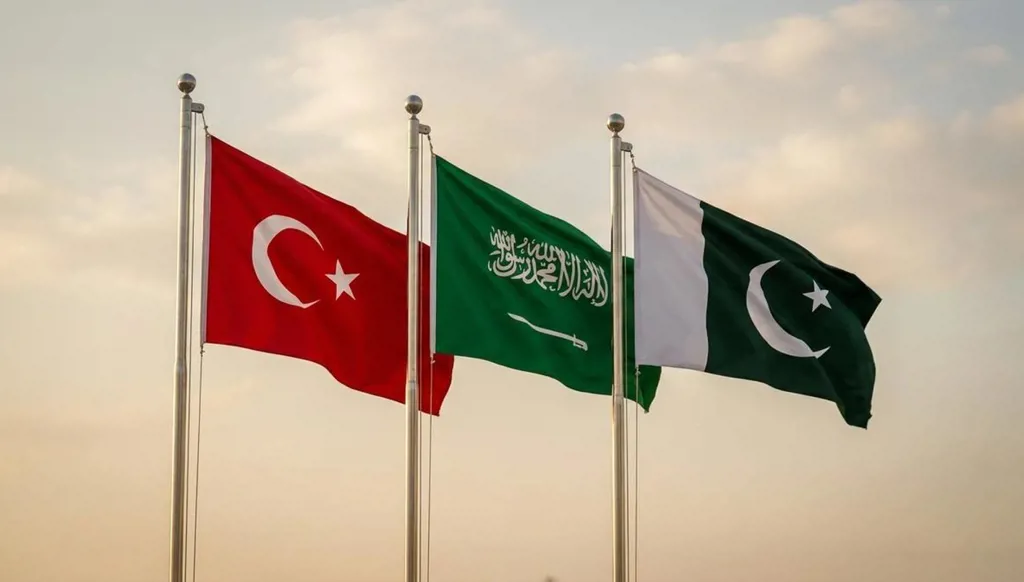
The Turkish government submitted the full text of a new trilateral defense pact to the Turkish parliament, formally advancing an agreement signed by Turkiye, Saudi Arabia and Pakistan in August under the Makkah Joint Defense Agreement. The pact commits the three countries to mutual defense, military assistance, intelligence sharing and defense-industry cooperation, and bars any signatory from withdrawing for its first ten years in force. According to an unofficial translation of the text, obtained by Middle East Eye, the agreement does not identify any specific country or region as a threat. Instead, it emphasizes that the participating states will take necessary measures to support one another in the event of an armed attack against their independence, sovereignty or territorial integrity.
The treaty's first two articles set out its central commitment. Article 1 states that if the territorial integrity, sovereignty or internationally recognized borders of any party are threatened, the parties "shall use all necessary means to eliminate such threat(s) or danger(s)." Article 2 goes further, declaring that "an externally originating armed attack against any of the Parties shall be considered an attack against all the Parties" — language that mirrors the collective-defense logic of NATO's Article 5. Under that article, if one signatory faces armed attack, the others are to immediately assist, drawing on "all means of mutual assistance" they can provide, calibrated through an "objective assessment of the assistance required."
Beyond the headline commitment, the pact lays out a fairly detailed institutional architecture. Article 8 establishes a Strategic Political and Defence Committee comprising the foreign ministers, defense ministers and chiefs of general staff of the three countries, tasked with providing strategic direction for joint defense and resolving obstacles that arise in implementing the agreement. The committee is set to meet twice a year, with hosting rotating among the parties, while national leaders may convene once a year if needed. A secretariat headquartered in Saudi Arabia will support the committee's work, headed by a secretary-general serving a three-year term on a rotating basis; the first secretary-general is to be a Pakistani citizen.
Other articles address cooperation beyond crisis response. Article 7 commits the parties to technology sharing, joint research and development, and joint production in defense industry. Article 6 encourages personnel exchanges and joint training to improve interoperability between the armed forces. Article 9 provides for intelligence sharing through secure channels, subject to confidentiality safeguards in Article 13, which restricts classified information to those with appropriate clearance and bars sharing it with any outside state, company or person.
Stripped of legal language, the agreement's core obligations include:
The agreement, which runs sixteen articles in total, has no expiration date and is intended to remain in force indefinitely once ratified. A signatory may withdraw only after ten years have elapsed from entry into force, and only after giving the other parties at least three months' written notice through diplomatic channels. Any dispute over interpretation or implementation is to be settled through consultation among the parties rather than external arbitration, and the agreement itself may be amended only by unanimous consent among its founding signatories. It was signed in Mecca in August, with the Turkish, Arabic and English texts all considered equally authentic — though the English version is designated to prevail in the event of any interpretive dispute.
Coverage of the pact circulating under Middle East news roundups has largely framed it as a significant, if carefully worded, step toward deeper institutionalized security cooperation among three regionally influential Muslim-majority states. Notably, the text itself goes out of its way to avoid naming any adversary, grounding its provisions instead in general principles drawn from the UN Charter and international law, including non-interference in internal affairs and respect for sovereign equality. That framing leaves plenty of room for outside analysts to debate the pact's broader strategic implications, but the agreement's own language is measured and defensive in character rather than confrontational.
For now, what is firmly established is the text itself: a sixteen-article mutual-defense and industrial-cooperation framework between Turkiye, Saudi Arabia and Pakistan, built around shared institutions, long-term durability and an explicit avoidance of naming any particular threat. Its practical effect will likely become clearer only as the Strategic Political and Defence Committee begins its work and the three governments move from