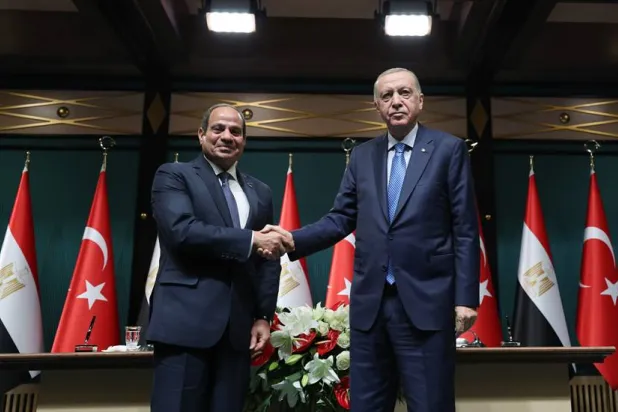
Türkiye has once again expressed willingness to sign a maritime boundary delimitation agreement with Egypt that would "serve the common interests of both countries," despite Cairo's firm rejection of the Turkish-Libyan memorandum of understanding on maritime jurisdiction zones signed in late 2019 and ratified by Libya's House of Representatives last week. A Turkish Defense Ministry official said that the Libyan parliament's approval of the memorandum signed between Türkiye and Libya on October 20 represented “an important development supporting our approach based on international law, the principles of equity, and respect for the legitimate rights and interests of the coastal states concerned." Responding to a question during the ministry's weekly press briefing regarding objections to the memorandum, the official reiterated Türkiye's readiness to conclude a maritime delimitation agreement with Egypt "in line with mutual interests." He added that, according to Turkish estimates, if Egypt were to sign such an agreement with Türkiye, it would gain an additional maritime area of more than 15,000 square kilometers compared with a potential agreement with Greece. He stressed that Türkiye would continue to protect its legitimate rights and interests in the Eastern Mediterranean within the framework of international law while contributing to regional peace, security, and stability. Turkish Effort to Preserve Relations The official's remarks echoed comments previously made by Turkish Defense Minister Yasar Guler, who said that an agreement with Egypt would grant Cairo an additional 15,000 square kilometers of maritime jurisdiction in the Eastern Mediterranean. From Fidan's meeting with his Italian counterpart Antonio Tajani on the sidelines of the Istanbul meeting last week (Turkish Foreign Ministry) During a Euro-Middle East meeting held in Istanbul last Friday and attended by the foreign ministers of Saudi Arabia, Egypt, Türkiye, Pakistan, Germany, Britain, and France, as well as Italian Foreign Minister Antonio Tajani, Egyptian Foreign Minister Badr Abdelatty reaffirmed Cairo's categorical rejection of Libya's parliamentary ratification of the Turkish-Libyan memorandum. Abdelatty stated that the ratification would have "no legal effect" on Egypt. Türkiye refrained from publicly criticizing Egypt's position, whether through official channels or media outlets, including those critical of the government. Türkiye has sought to continue improving relations with Egypt and avoid another diplomatic dispute. This approach was reflected in remarks by President Recep Tayyip Erdogan following a cabinet meeting on Monday, when he stressed that Ankara does not seek to harm any party in the Eastern Mediterranean, advocates dialogue with all countries in the region, and intends to maintain relations with all influential actors in Libya. Overtures to Greece Following Libya's ratification of the Turkish-Libyan memorandum, Greece sent a letter to UN Secretary-General Antonio Guterres reiterating its objections. Meeting between Erdogan and Mitsotakis on the sidelines of the UN General Assembly meetings in 2024 (Turkish Presidency) Athens argued that the ratification does not alter the memorandum's legal status, cannot create new legal obligations for third countries, conflicts with the 1982 UN Convention on the Law of the Sea (which Ankara has not signed), and lacks a valid legal foundation because of the geographical configuration of the coastlines between Türkiye and Libya. Meanwhile, Turkish Foreign Minister Hakan Fidan revealed in Brussels last week that Erdogan had made an energy-related proposal to Greek Prime Minister Kyriakos Mitsotakis during the UN General Assembly meetings in September. Erdogan reportedly suggested that Greece purchase electricity from Türkiye rather than spend more than €2 billion in European funds to transport electricity over a distance of 2,000 kilometers to Cyprus. The proposal referred to the "Great Sea Interconnector" project, which aims to link Greece, Cyprus, and Israel through an undersea electricity cable in the Eastern Mediterranean, a project Türkiye insists requires its approval. According to Fidan, Erdogan told Mitsotakis: "It would be better to buy electricity from Türkiye, which is only 70 miles away from you. We can also supply you with water, electricity, and natural gas." A New Eastern Mediterranean Equation For Italy, the ratification of the Turkish-Libyan memorandum has raised political and economic concerns, particularly regarding Türkiye's expanding influence in Libya and its implications for Italian interests in the Eastern Mediterranean. From Fidan's meeting with his Italian counterpart Antonio Tajani on the sidelines of the Istanbul meeting last week (Turkish Foreign Ministry) Some political circles in Rome have questioned whether Italy moved too quickly in supporting US-backed efforts to unify Libya under a framework that could place Saddam Haftar at the head of the Presidential Council. They argue that such a course could strengthen ties between eastern Libya and Türkiye, a direct competitor to Italy in Libya, particularly after Italy's support for Khalifa Haftar helped increase Russia's influence there. Türkiye has also floated the possibility of negotiations involving Egypt, Italy, and Libya as part of what observers describe as an effort to establish a new framework for the Eastern Mediterranean, one that could undermine the model promoted by Greece, Israel, and Cyprus. Turkish political analyst Ahmet Erdi Ozturk noted that despite Egypt's continued objections, Cairo's ongoing direct contacts with both Ankara and Libya suggest that diplomatic options have not yet been exhausted. He pointed in particular to a phone conversation last Saturday between Egyptian intelligence chief Major General Hassan Rashad and Libyan Prime Minister Abdul Hamid Dbeibeh, during which Dbeibeh expressed readiness to discuss Egypt's concerns regarding maritime jurisdiction. Ozturk also cited Fidan's proposal for talks involving Türkiye, Egypt, Italy, and Libya as part of the same diplomatic context. Ozturk adding that it would not be surprising if Greece and Israel eventually adjusted their positions as circumstances change.