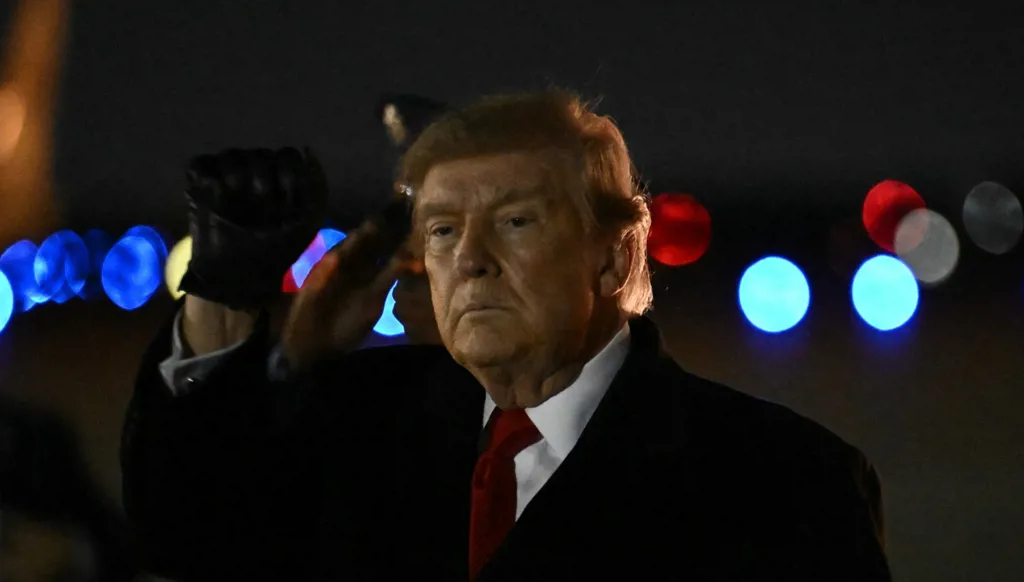
U.S. President Donald Trump hinted at using his veto power against Democratic legislation during an interview with CBS on Tuesday, signaling a potential confrontation between the White House and Congress. However, this constitutional tool, while giving the president the ability to block laws, does not guarantee him the final word.
So, what is a “veto” in the American political system? How does the president use it to obstruct legislation? Can Congress override his objection, and what are the limits to this authority?
The veto gives Trump the ability to block his opponents’ legislation, but it does not shield him from congressional investigations, nor does it allow him to secure approval for his nominees to positions or obtain funds that Congress refuses to allocate.
The Constitution allows the U.S. president to reject a bill passed by both the House of Representatives and the Senate and return it to the chamber where it originated, accompanied by the reasons for the objection.
But this power does not grant him the ability to issue alternative legislation he prefers or force Congress to pass his agenda. The veto is a tool to prevent a law from being enacted, not an authorization for the president to legislate independently.
However, its power is not limited to its actual use, as the threat of a veto can lead lawmakers to amend bills before sending them to the White House, seeking to avoid their downfall at the president’s desk.
The president’s objection is not final in the case of a regular veto, as Congress can turn a bill into law despite his rejection with the approval of two-thirds of the voting members in each chamber, provided a quorum is present.
This equals 290 votes in the House of Representatives and 67 in the Senate when membership is complete and all members participate in the vote. Therefore, a simple majority is not sufficient to override a veto, nor is reaching two-thirds in only one chamber.
Congressional investigations and hearings do not require the president’s signature to begin, meaning Trump cannot block them using the veto.
The administration may withhold some information or correspondence on the basis of what is known as “executive privilege,” but that is a different mechanism from veto power, and its limits are subject to constitutional and legal disputes between the branches.
Similarly, the president cannot veto impeachment proceedings, as the House of Representatives can bring charges with a simple majority, while the Senate conducts the trial, which requires the approval of two-thirds of its present members for conviction and removal. These proceedings are not presented to the president for approval.
The veto does not extend to Senate decisions regarding appointments that require its approval, including Supreme Court justices, ambassadors, and many senior officials.
If the chamber rejects a presidential nominee or does not move to confirm them, Trump cannot use the veto to turn that rejection into approval. Therefore, the Senate’s authority over appointments remains independent of legislative battles.
Funding represents one of the most significant limits on presidential power. While Trump can reject a spending bill, he cannot obtain the allocations he wants simply by using the veto, as withdrawing funds from the Treasury requires legal appropriation.
This means rejecting a funding package does not turn the president’s proposed budget into law, nor does it grant him unlimited spending power.
If available appropriations expire without new funding being approved, some government activities may halt, except those the law allows to continue. Thus, the confrontation may turn into a government shutdown crisis rather than a decisive victory for either party.
The president also cannot strike out opposed items while keeping the rest of a bill using a “line-item veto.” The Supreme Court ruled in 1998 that the law granting the president the power to cancel specific items after signing a bill was unconstitutional. Under constitutional veto mechanisms, the objection must apply to the entire bill.
These limitations reveal that the veto gives Trump significant influence, but it does not eliminate the influence of his opponents. While the president can block legislation he disagrees with, Congress remains capable of exercising oversight, controlling funding approval, and reviewing appointments through the Senate.
The potential political outcome is not one party’s automatic submission to the other, but more intense negotiations or mutual deadlock when an agreement fails.
The veto can prevent Trump’s opponents from passing some of their policies, but it is not enough on its own to pass his.