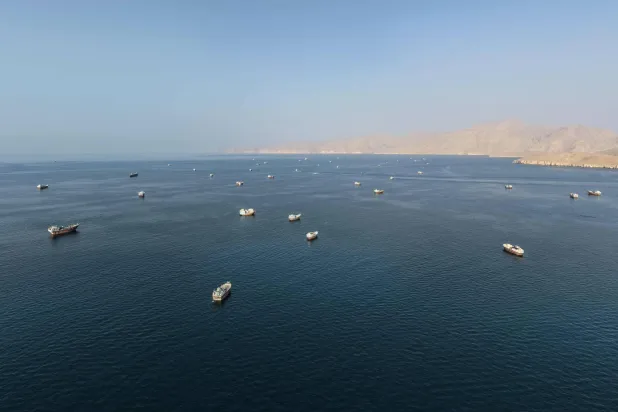
The administration of US President Donald Trump has threatened “tremendous economic consequences” on any country that does business with Iran, as Treasury Secretary Scott Bessent unveiled a new package of sanctions on Monday aimed at isolating Tehran further from the global economy. The New York Times listed some of the countries that could be most affected by new Trump administration measures, including China, India, Türkiye and Iraq. China China is Iran’s largest trading partner and the primary consumer of its oil, according to recent analysis by the US-China Economic and Security Review Commission, a group founded by Congress to examine America’s bilateral ties to China. For years, China has been practically alone in its willingness to defy Western sanctions on Iranian oil, buying up to as much as 90% of Tehran’s oil exports. In recent months, however, Iran’s ability to ship oil by sea has been all but cut off by a US naval blockade. But from a Chinese perspective, that is a drop in the ocean compared to the size of its overall economy, said William Figueroa, an expert in Chinese-Iranian relations at the University of Groningen in the Netherlands. “It wouldn’t be catastrophic for China if it was to have its trade or its ability to import Iranian oil impacted,” he said. The biggest advantage Beijing draws from that trade relationship is geopolitical, said Andrea Ghiselli, a political scientist who specializes in China at the University of Exeter in England. Beijing has some interest in preserving the Iranian regime as a thorn in the side of the United States, he said. Ghiselli described the share of oil that China imports from Iran as marginal, and said that “it can easily be swapped out” for other sources on the global market. India According to NYT, Iran was once India’s most important energy supplier. But US sanctions have pushed New Delhi to reduce ties, and the value of trade between the two countries has shrunk dramatically in recent years, according to official data from the Indian embassy in Iran. The data estimates that in the 2025-26 financial year, total bilateral trade was $1.63 billion, down sharply from over $17 billion in 2018-19. In 2019, India stopped buying Iranian oil altogether, under pressure from Trump. In the last financial year, Indian officials said the country mainly imported apples, pistachios, dates and kiwis from Iran. But in April, after the US Treasury issued a 60-day waiver authorizing countries like India to purchase Iranian oil to alleviate war-driven supply disruptions and soaring energy prices, crude from Iran officially returned to India for the first time in seven years. United Arab Emirates The UAE also appear vulnerable to Trump’s threat, said Esfandyar Batmanghelidj, chief executive of the Bourse & Bazaar Foundation, a London-based think tank focused on Iran’s economy. On Wednesday, the UAE appeared to pre-empt Trump’s comments by announcing a halt to all trade and financial transactions with Iran. According to data from the World Trade Organization, Iranian-Emirati trade was worth roughly $28 billion in 2024. The Emirati decision could affect the ability of Iranian importers to pay for goods, as a lot of those financial services are provided through the UAE, Batmanghelidj told the NYT. Iraq, Türkiye and Pakistan Pakistan and Türkiye have so far been relatively shielded from US economic measures against Tehran, even as they have continued significant overland trade with Iran, Batmanghelidj said. In 2022, the latest year for which World Trade Organization data was available, Iran imported more than $11 billion worth of goods from Türkiye, its third largest source of imports that year. For both Pakistan and Türkiye, “it is politically and geopolitically very important that both these countries maintain a good relationship with Iran,” said Batmanghelidj. “And I think this is where the Trump administration is really going to struggle.” Burcu Ozcelik, a researcher at the Royal United Services Institute research group in London, said Iraq was also vulnerable to US economic pressure because of its continued trade with Iran. American sanctions have already targeted Iranian-linked groups in Iraq. But Ozcelik said that broader sanctions on Iran’s trading partners would be far more complicated to impose, and that implementing them “will be slow, uneven and difficult to monitor.” It was far from clear, she added, that “greater pressure would produce the political behavior Trump is seeking.” The NYT wrote that the Trump administration is not wrong to think that Iran’s economic situation is dire. But it’s counting on Iranian authorities responding to more pressure by negotiating; they might well respond by escalating the conflict.