The image was expressive, and more importantly, incorrect.
Following the conclusion of the Shenzhen Summit, U.S. President Donald Trump posted a composite image: one featuring Chinese President Xi Jinping and Russian President Vladimir Putin, and another showing Soviet leader Joseph Stalin, U.S. President Franklin Roosevelt, and British Prime Minister Winston Churchill.
He captioned it: "Great Powers 1945, 2026," implicitly comparing the Shenzhen Summit to the Yalta Conference.
The formal error was that the image of Stalin, Roosevelt, and Churchill dates back to the 1943 Tehran Conference, not Yalta. The second question mark concerns Russia's motivation for seeking this summit: restoring its position after setbacks in the Ukraine war, amid demographic decline and its inability to become a technological hub. Yet Trump's post portrays him as delighted with this status, as though it were newly acquired and facilitated by America's adversaries. The third question mark is Trump's characterization of America as a major power rather than a superpower.
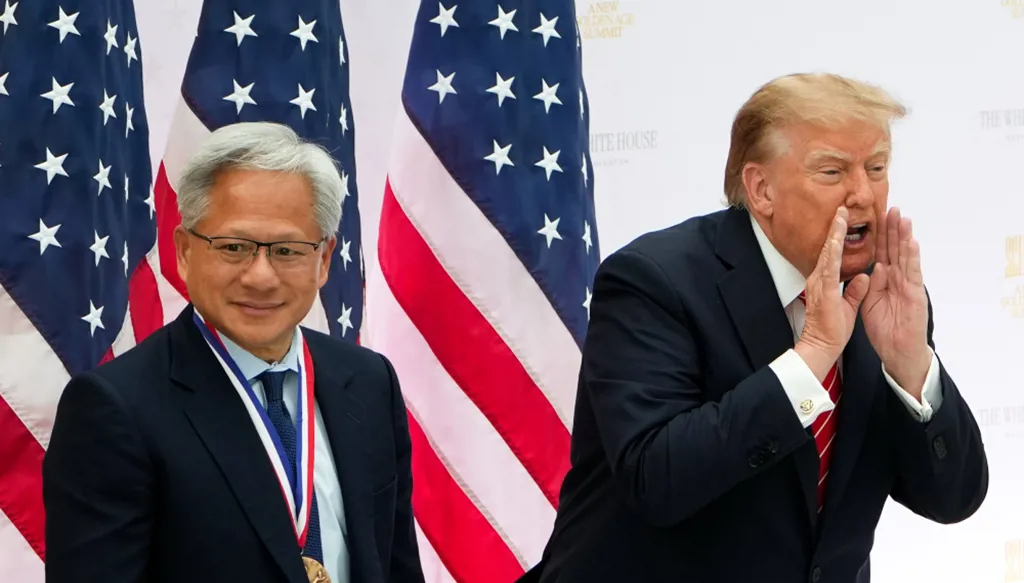
This image is one of the essential premises for understanding Trump's worldview and, consequently, his approach to governing the United States. Its most recent manifestation is his success in pushing Jian-Hsun "Jensen" Huang back to the executive presidency of NVIDIA. This happened less than two weeks after reports surfaced about Huang's extramarital relationships, including one with a woman accused of spying for China.
In a media interview with CNBC following the announcement of Huang's return, Trump said: "People say, 'Is it a threat for him to stay (at the helm)?' No, the threat is losing him." Following Huang's resignation, the company's shares lost about 30 percent of their value, and fears emerged that the losses could spread to other companies. Trump has investments in NVIDIA, valued at roughly $12 million through the end of 2025, which may currently exceed $60 million.
Even before the issue reached Congress, it appeared that part of the U.S. administration itself disagreed with its leader's assessment. On Monday, the U.S. Department of Commerce announced plans to add Megaspeed, headquartered in Singapore, to the blacklist, preventing it from buying or selling goods in the United States.
While Huang was involved with the woman suspected of being a spy, Alice Huang, the company purchased billions of dollars' worth of critical chips from NVIDIA for artificial intelligence development. The U.S. judiciary is investigating Megaspeed's alleged smuggling of those chips to China. Recently, Treasury Secretary Scott Bessent accused the Department of Commerce, led by Howard Lutnick, of obstructing efforts by the Treasury, Defense, and State Departments to ban chip sales to Megaspeed.
Washington Post columnist Josh Rogin wrote on X that Trump sided with Lutnick against Bessent and even against his Secretary of State, Marco Rubio, who was the first to bring Huang's romantic involvement under security scrutiny. More concerning in Rogin's account is his indication that Trump "was never fond of putting national security concerns above making money. He thinks Xi is his friend. He was never a hawk (against) China."
And this brings observers back to the story of the image.
Trump believes Xi and Putin are his friends, whereas the two presidents do not use this term to describe their relationship with him. Trump's admiration for Russia also dates back to the Soviet era, when he visited Moscow in 1987 in search of hotel investment opportunities. He later returned to write a paid-opinion piece published in several American newspapers, including The New York Times, attacking U.S. policies and alliances with wealthy countries "that don't pay" and "won't help."
The likelihood is that a fine thread indeed links Moscow, Shenzhen, and Huang's return to NVIDIA. The purported "friendships" with "major" powers come first for Trump. Money is more important than national security. At best, it stands alongside it.