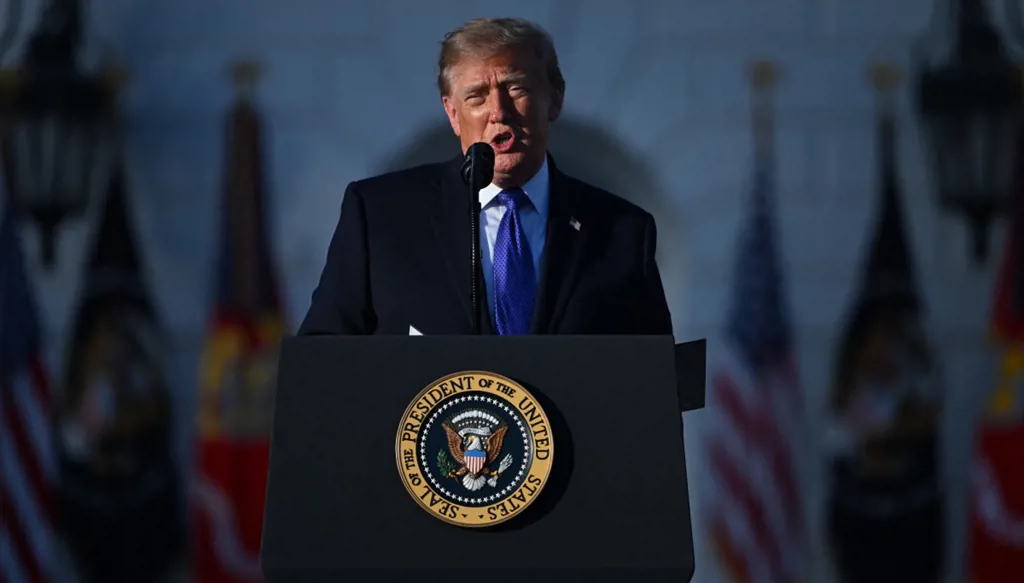
After returning from a four-day visit to China and the Philippines, U.S. President Donald Trump held a press conference at the White House on Friday, which was expected to provide an opportunity to present the results of his trip and highlight its achievements to the American public.
Banners were displayed on both sides of the platform. One featured a series of general agreements Trump had reached with his Chinese counterpart, Xi Jinping, and Russian President Vladimir Putin, including a reaffirmation that nuclear war would benefit none of the countries concerned. The other showcased the deals that the White House claimed had been secured during the trip.
However, Trump quickly moved away from the topics at hand. He began by praising the speed of his new presidential aircraft, gifted by Qatar, before questioning whether the COVID-19 vaccine rollout had come too late to boost his re-election chances after his first term. He then discussed rising interest rates before returning to Iran.
Surrounded by senior aides, including Vice President J.D. Vance, Secretary of State Marco Rubio and new White House Chief of Staff Stephen Miller, Trump said of Iranian leaders: "They have been deceiving people for 51 years."
Trump's performance, marked by randomness and inconsistency, lasted an hour and a half. It came after the departure of several officials credited with maintaining discipline in the White House's messaging, including former spokeswoman Caroline Levitt and former White House Chief of Staff Susie Wiles.
This was Trump's first address to the American public since his Republican Party suffered a crushing defeat in the congressional midterm elections earlier this month.
At times, Trump hinted at his interest in working with Democrats, who will hold substantial majorities in both the House and the Senate starting in January. At other moments, he appeared unapologetic about policies that strategists say contributed to the Republicans' electoral defeat.
He announced plans to penalize companies building data centers abroad, despite growing concerns among Americans about the establishment of such centers within the United States. He also rejected criticism that he had been too lenient toward Moscow, a position opposed by most Americans, including many Republicans, according to opinion polls. He reiterated his assertion that Russian President Vladimir Putin was willing to reach an agreement on Ukraine.
Trump also signaled his willingness to reach agreements with Democrats on immigration and healthcare.
With Rubio and Vance, both viewed as potential presidential candidates in 2028, in attendance, reporters pressed Trump to identify his preferred successor. However, he offered no answer.
The U.S. administration faced sharp criticism over the past week for its faltering response to a series of technology-related disruptions. Trump said the various disruptions were separate incidents that had been resolved.
He also confirmed a Reuters report about the dismissal of Sean Kierancross, the White House's National Cyber Security Director, saying that he "didn't believe that person was good enough."
Trump appeared cheerful throughout most of the press conference, marking a noticeable shift from his recent encounters with journalists, during which he hurled personal insults at several reporters.
He said he appreciated the large number of journalists in attendance and invited them to a reception in the South Garden, where refreshments would be served in the evening.
However, a more combative Trump resurfaced toward the end of the press conference when he confronted an NBC reporter who tried to ask a question loudly.
"You are really a rude person, so I won't talk to you," he told her.