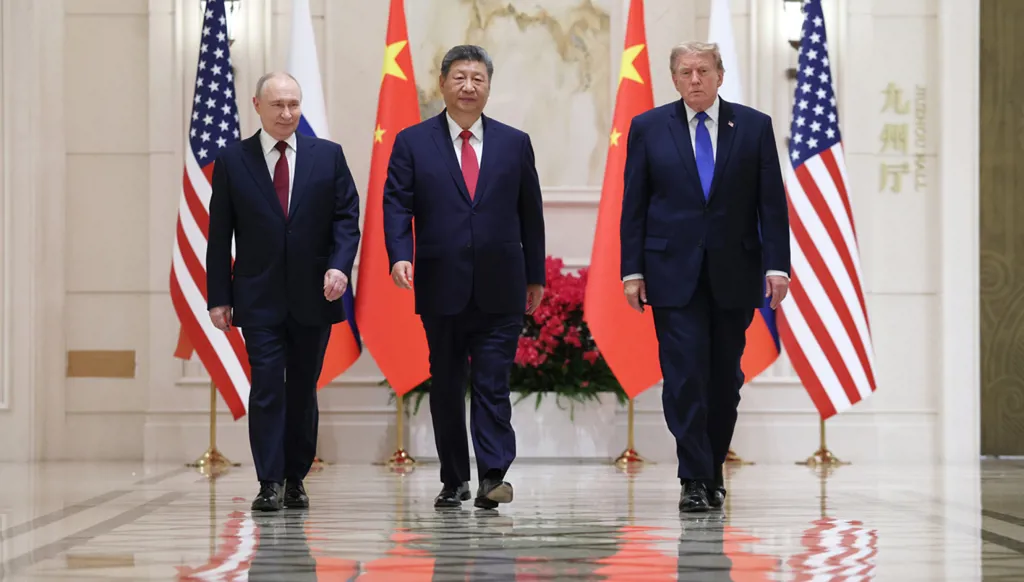
U.S. President Donald Trump, Chinese President Xi Jinping, and Russian President Vladimir Putin emerged from the Shenzhen Summit with a historic image and a joint declaration titled "Towards Peace," but major questions remained unanswered.
The three countries agreed to reform the United Nations, increase the production and supply of refined petroleum products, reduce nuclear risks, and respect officials' immunities from the International Criminal Court. However, the declaration made no mention of the wars in Ukraine and Iran, despite both conflicts featuring in the discussions.
The summit revealed the limits of what the three powers can agree on. Putin described the meeting as historic, expressing hope that the trilateral format would continue, while acknowledging that the talks had produced mutual understanding rather than specific agreements. Xi called for mechanisms to be established for communication and crisis management to prevent miscalculations, without announcing any agreement on holding regular meetings.
The question remains how these principles will be translated into practical steps. No timetable or joint working groups were announced, while issues such as Ukraine and Iran require negotiations involving the parties directly concerned. Differences in priorities among the three capitals could become the first obstacle to any subsequent progress, particularly if tangible results take time to materialize.
Following the leaders' departure, attention turned to Washington, Beijing, and Moscow, each with its own calculations. Trump, coming off Republican losses in the midterm elections, faces the challenge of turning the meeting into diplomatic achievements. Xi seeks to strengthen China's position in managing international balances, while Putin remains committed to his positions on the war in Ukraine, keeping channels of dialogue open.
The Middle East figures prominently in post-Shenzhen calculations. The American-Chinese convergence on the importance of maintaining oil flows through the Strait of Hormuz opens the door to dialogue on Iran, although no approach to addressing the escalation was announced.
On Ukraine, attention quickly shifted to Berlin, where American envoys Steve Witkoff and Jared Kushner are participating in consultations with Ukrainian President Volodymyr Zelensky and European leaders on security guarantees and the next round of negotiations, amid anticipation over the outcome of the contacts held in Shenzhen.
Ultimately, the significance of the summit may depend more on what it sets in motion over the coming weeks than on what was stated in its declaration. Will the trilateral contacts succeed in opening paths toward a settlement? Will the understandings reached in Shenzhen translate into decisions on the ongoing wars? The leaders have left the table, but the most complex issues remain unresolved.