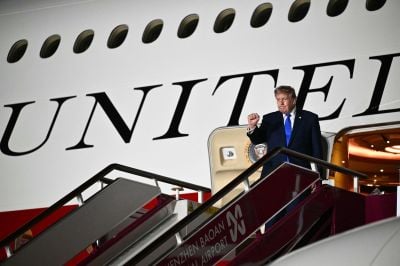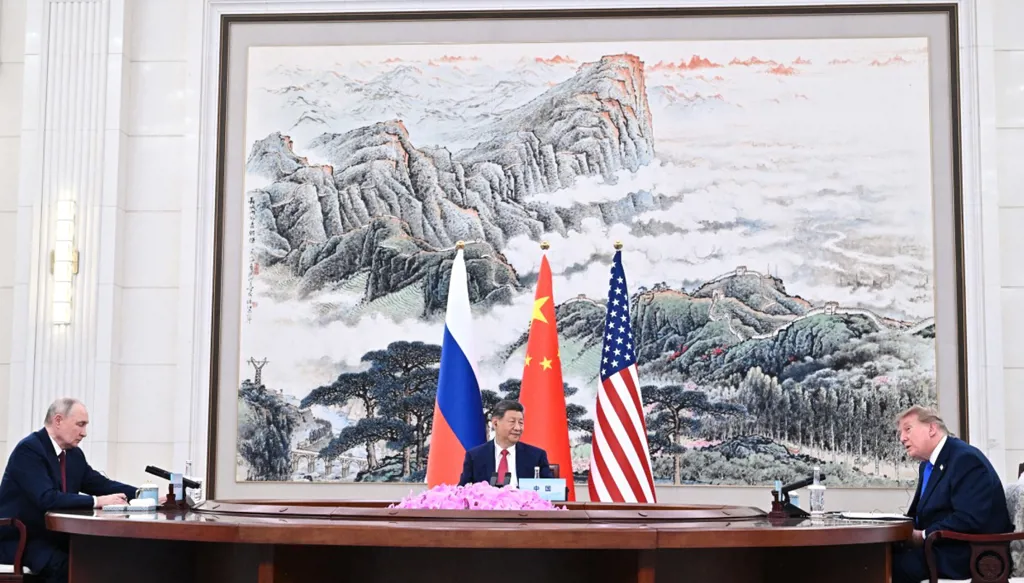
In a rare gathering of the leaders of three of the most influential powers shaping the global balance, U.S. President Donald Trump, Chinese President Xi Jinping, and Russian President Vladimir Putin met in Shenzhen. Economically, militarily and in terms of nuclear capabilities, each holds different cards of strength, while their interests intersect on issues ranging from the Middle East to Eastern Europe.
But did the Shenzhen Summit mark the beginning of a new world order, or was it an attempt to manage disputes and prevent escalation?
In an interview with Annahar, Khattar Abou Diab, Professor of International Relations at the University of Paris, addresses the most pressing questions.
Because, for the first time, it brought together the presidents of China, the United States and Russia in this format.
China is playing this role for the first time, securing a leadership position, though not necessarily the leading one.
Talk of a new world order remains premature.
The transition to a multipolar system requires global governance, which is not yet in place.
The summit is about managing disputes and avoiding the worst.
In principle, the summit gives the impression that the leaders are moving towards resolving conflicts and wars.
The meeting of the three powers could pave the way for easing international tensions.
Abou Diab raises the question of whether Beijing will engage more clearly with Trump on the Iranian issue, following the momentum Trump gave China through the summit.
China continues to supply Iran with equipment.
Conversely, the Iranian economy needs Chinese support.
Assessing the summit's outcomes on the Ukrainian issue requires waiting to see what Trump might offer Russia.
A swap between Ukraine and Iran is a possibility.