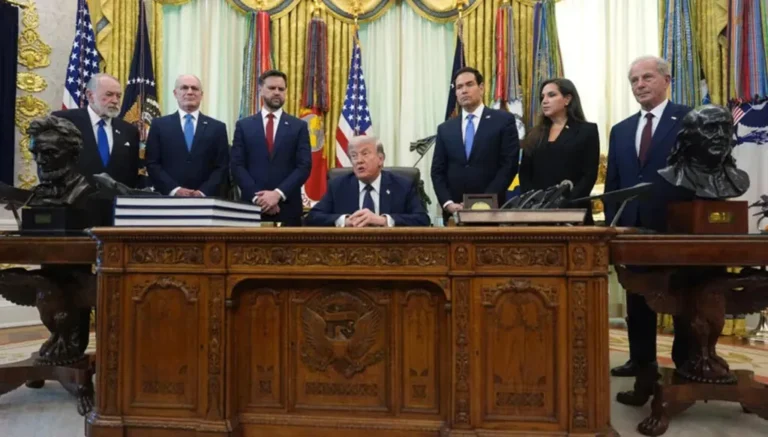
President Donald Trump framed his rejection of the Iranian proposal to reopen the Strait of Hormuz in exchange for lifting the American blockade by implying that he is in no hurry to reach an undesirable agreement. In other words, he will not fall into the trap of the memorandum of understanding he signed in June under pressure from the global oil shock.
In fact, the conditions Tehran attached to its proposal reveal that its substance does not differ from the memorandum of understanding, with the main difference being the reduction of the timeframe from 60 days to seven days for both sides to begin negotiations on contentious issues, including the nuclear issue, which led the United States and Israel to wage wars against Iran in 2025 and 2026.
Alongside the seven-day timeframe, Iran played on a highly sensitive issue for Trump: giving him the opportunity to conclude a deal before the midterm elections, where polls predict that Republicans will lose in less than two months due to inflation resulting from the war. Such an outcome would deal a political blow to a president who cannot tolerate defeats. Therefore, he maintains that the elections concern the Republican Party and will not influence his decisions in any way.
In rejecting the agreement, Trump, as usual, displayed a show of strength. He again called the Strait of Hormuz the "Trump Strait" and affirmed that Iran has lost control over the waterway, as evidenced by the U.S. Navy ensuring the passage of 29 ships carrying millions of barrels of oil on Friday alone.
The message Trump is sending to Iranian leaders is that Hormuz is no longer exclusively under Iranian control and, consequently, Washington will not be forced to meet the remaining conditions set by Tehran, such as a ceasefire on "all fronts" in the Middle East, including Lebanon, lifting the naval blockade on Iranian ports, releasing $12 billion in frozen assets, and lifting sanctions related to oil exports.
Although Trump still seeks to reach a deal, he wants one that reflects the leverage points America has gained since the fall of the memorandum of understanding in July. The U.S. administration believes the economic war has begun to bear fruit by cutting off lifelines to the Iranian economy, most recently grounding civil aviation, while many countries have refused to provide services to Iranian companies.
An Iranian commercial airplane lands at Mehrabad Airport in Tehran, September 25, 2026. (AFP)
However, the American rejection of the Iranian proposal, which was delivered by Foreign Minister Abbas Araghchi through the Qatari intermediary to U.S. envoys Steve Witkoff and Jared Kushner on the sidelines of the 81st regular session of the UN General Assembly in New York last Tuesday, does not necessarily mean that diplomatic opportunities are currently absent.
A senior U.S. official confirmed to Reuters that Washington is conducting "positive and constructive talks" with intermediaries. On the other hand, Araghchi confirmed that his country has not yet received an official response from the intermediaries to his proposal and that Tehran remains committed to the conditions attached to it.
In the meantime, Tehran sought to clarify the position of the Secretary of Iran's Supreme National Security Council, Mohsen Rezaei, regarding the Iranian response to restrictions on Iranian flights. The General Secretariat of the Council denied reports suggesting a move toward military retaliation for these restrictions. Nevertheless, statements by some Iranian officials have continued to include threats of "military surprises" should the United States launch a new attack.
In any case, Trump has placed himself in the mindset that a solution will be possible after the midterm elections, with Iran, according to him, monitoring the impact of the results on him. He, too, is observing the impact of the tightened blockade and financial sanctions on Tehran's positions.
In this context, U.S. Assistant Treasury Secretary for Terrorism Financing Jonathan Burke toured the Middle East and Europe for two weeks earlier this September, while the U.S. Treasury held talks with representatives of more than 50 countries to urge them to adhere to the sanctions.
Disclaimer: The opinions expressed by the writers are their own and do not necessarily represent the views of Annahar.
Thank you for subscribing to our newsletter