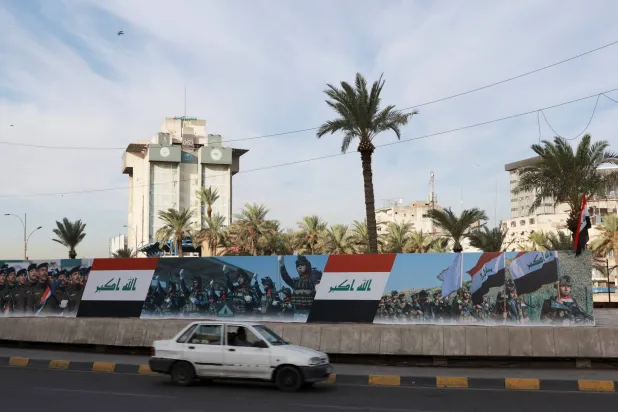
The US military announced on Wednesday that it has completed the withdrawal of all American troops from Iraq, ending a 12-year mission to fight the ISIS group. The last US troops left an air base in northern Iraq under a deal between Baghdad and Washington. The withdrawal, agreed on two years ago, comes against the backdrop of the ongoing war between the United States and Iran that has also sometimes spilled over into Iraq, with Iran-backed militias firing on US troops and the US striking the groups' strongholds. Baghdad touted the end of the US mission as a sign of the country's increasing strength and sovereignty. The withdrawal was also celebrated by Iran-backed groups but raised concerns among some other Iraqis, particularly in the Kurdish region. Meanwhile, questions loom around the future of the Iraqi militias, which the Baghdad government has sought — with little success so far — to disarm. Pentagon spokesperson Sean Parnell said in a statement that US troops and equipment had completed an “orderly departure” from the air base in Irbil, in northern Iraq's semi-autonomous Kurdish region. “This milestone reflects the success of a 12-year campaign that defeated ISIS as an organized military threat in Iraq and across the region,” he said. “It also marks a transition from a wartime coalition mission to an Iraqi-led security effort supported by a more normal bilateral security relationship.” Iraqi Prime Minister Ali al-Zaidi presided over the handover ceremony and described the US withdrawal as the beginning of a “new phase, one defined by Iraq’s sovereignty, the strength of its institutions, the readiness of its forces, the unity of its decision-making, and balanced partnerships with its friends.” He said Iraqi security forces will continue the fight against ISIS and the government will ensure that non-state groups no longer hold weapons. US troops invaded Iraq in 2003 to topple Saddam Hussein. They departed in 2011, but three years later, Iraqi authorities invited a smaller US-led mission to fight the ISIS group, which had rampaged across Iraq, seizing large swaths of territory. With the extremist group reduced to scattered sleeper cells, Washington and Baghdad agreed in 2024 to wind the mission down. US troops pulled out of bases in most areas of Iraq last year but maintained a small presence of hundreds of troops in the semiautonomous northern Kurdish region. Bases there have regularly come under attack since the US and Israel launched their war against Iran on Feb. 28. The Iraqi government initially linked the Sept. 30 deadline for US withdrawal to the disarmament of non-state armed groups by that date. While a handful of less-influential militias have agreed to turn over their weapons, powerful groups close to Iran rejected the prospect or set conditions for disarming that the government would be unlikely to meet. Al-Zaidi has since walked back the deadline. He told The New York Times earlier this month that the deadline for militia disarmament has been pushed to June 2027. The effects of the US withdrawal may not be immediately visible, particularly since the US military presence had already been scaled down. But officials in Iraq's Kurdish region have expressed anxiety about the departure and particularly about the removal of US air defense systems. The Kurdish regional government's Peshmerga Ministry said the Kurdish region had faced more than 1,000 drone and ballistic-missile attacks during the recent US-Iran conflict. “The departure of the United States from the Kurdistan Region under these complex regional circumstances, without the provision of a defense system, is a matter of concern,” the statement said. Iran-allied groups in Iraq, meanwhile, have celebrated the US withdrawal. “The expulsion of the occupation forces, defeated, from the land of Iraq is the beginning of full sovereignty,” Abu Mujahid al-Assaf, a security official with the powerful Kataib Hezbollah militia, said in a statement. He added a warning to al-Zaidi and his government not to carry out American plans, threatening that “any government that does not work for the benefit of the people will be overthrown by all means.”