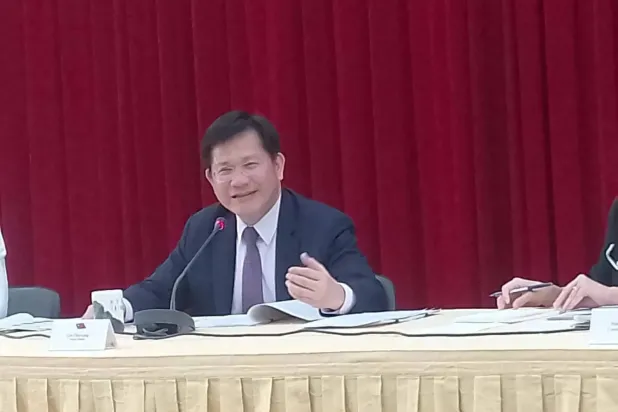
Taiwanese Minister of Foreign Affairs Lin Chia-lung emphasized that Taiwan attaches great importance to fostering strong economic and investment partnerships with Saudi Arabia and the broader Middle East. He praised major regional development initiatives, led by Saudi Arabia's Vision 2030, and renewed Taiwan’s readiness to deploy its technological capabilities and resources to foster sustainable cooperation in advanced industries. Lin made his remarks in response to questions posed by Asharq Al-Awsat newspaper, which covered prospects for economic and technological collaboration, investment opportunities under Vision 2030, Taiwan’s economic performance, as well as its position on regional geopolitical challenges and global energy security. The Taiwanese Foreign Minister during the opening of a new Taiwan office in the city of Phoenix, Arizona (X) Economic Cooperation with Saudi Arabia & Vision 2030 In response to a question regarding economic, industrial, and technological ties with the Kingdom, Lin highlighted the global transition from traditional oil-based economies toward digital technology, semiconductors, and artificial intelligence (AI). "We are aware that Saudi Arabia is actively pushing forward with Vision 2030 and transitioning toward modern technologies. We believe Taiwan is the ideal partner for Middle Eastern nations in these sectors," Lin stated. Addressing future investment plans, Lin noted: "We are currently looking for partner countries in the Middle East that are willing to engage in normal exchanges and interactions with us.” “Whenever such engagement is established, we stand fully prepared to invest and allocate our resources—whether in Saudi Arabia, Oman, Qatar, or other friendly nations that maintain strong relations with our international allies,” he added. Robust Economic Performance and Market Growth Regarding Taiwan’s economic trajectory and challenges, Lin strong growth indicators, noting that Taiwan’s economy grew by 8.68% last year, with projections expected to exceed 11% this year, fueled by technological innovation and surging global demand for semiconductors and AI technology. The minister further pointed out that Taiwan’s stock exchange has become the fourth largest in the world, outperforming major G7 economies such as France, the UK, and Italy. In the semiconductor sector, he noted that major Taiwanese tech firms (such as TSMC) have secured orders stretching over the next five years, exceeding their current manufacturing capacity. FILE - A worker walks past the logo of TSMC or Taiwan Semiconductor Manufacturing Corp., a Taiwanese multinational semiconductor contract manufacturing and design company, in Hsinchu, Taiwan, on Jan. 29, 2026. (AP Photo/Daniel Ceng, File) Middle East Crises and Energy Security Addressing questions regarding regional instability and energy supply routes through the Strait of Hormuz, Lin acknowledged that Middle Eastern conflicts affect Taiwan due to its reliance on imported energy. However, he emphasized that Taiwan has taken proactive measures to diversify its energy sources by increasing purchases and investments from the United States and Australia, while expanding domestic investments in renewable energy to safeguard national energy security. Lin reiterated that Taiwan has built significant resilience in risk management amidst geopolitical challenges, expressing the country’s eagerness to share these experiences and forge robust economic bonds with partners around the world.