Syrian Foreign Minister Arrives in Riyadh
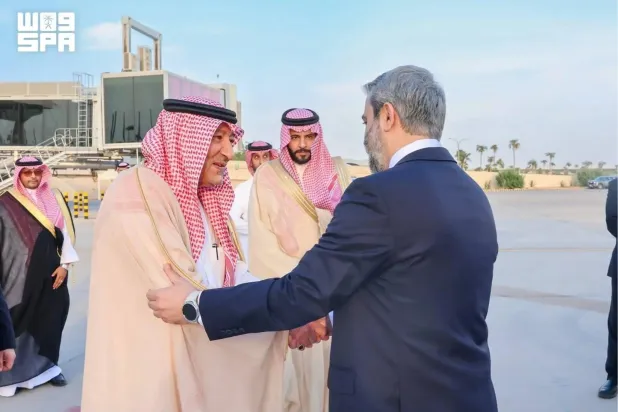
Syrian Minister of Foreign Affairs Asaad Al-Shaibani arrived in Riyadh on Thursday on a visit to discuss bilateral relations and regional developments.
He was received upon arrival by Vice Minister of Foreign Affairs Waleed Elkhereiji.
GCC General Secretariat Announces Postponement of GCC-EU Summit
Secretary-General of the Gulf Cooperation Council (GCC) Jasem Albudaiwi announced on Thursday the postponement of the GCC-EU Summit, which was set to be held in Riyadh on October 24, due to continued terrorist Houthi threats to Saudi Arabia.
He underscored the determination of both the GCC and the EU to work towards establishing the appropriate conditions for convening the summit, in a manner that serves their long-term objectives of advancing and building upon the trajectory of cooperation across numerous fields between the member states of both organizations, thereby achieving growth and prosperity for their countries and peoples.
Saudi FM Receives Phone Call from Japanese Counterpart Condemning Houthi Attacks on Saudi Arabia
Saudi Minister of Foreign Affairs Prince Faisal bin Farhan bin Abdullah received a phone call from Minister for Foreign Affairs of Japan Toshimitsu Motegi.
During the call, the two sides discussed the terrorist Houthi militia's attacks against the Kingdom.
The Japanese foreign minister expressed his country's strong condemnation of these repeated attacks targeting airports and civilian facilities in the Kingdom, SPA reported.
The two ministers also reviewed cooperation relations between the two friendly countries and discussed the latest regional and international developments, as well as ways to enhance coordination and cooperation to ensure energy security and freedom and safety of navigation in regional and international waterways.
Saudi Air Defenses Thwart Cruise Missile Threats
Saudi air defense forces have successfully countered various types of aerial attacks targeting several parts of the Kingdom, particularly cruise missiles, demonstrating their high level of combat readiness and exceptional ability to safeguard national security. Their performance underscores the strength of an integrated defense system designed to protect civilian facilities and critical infrastructure against cross-border threats.
In recent weeks, Saudi forces have intercepted several cruise missiles, most recently on Thursday over Madinah and another over Al-Kharj Governorate. They also intercepted five missiles targeting the capital, Riyadh, including one aimed at the vicinity of King Khalid International Airport.
Although the successful interceptions over residential areas sent debris falling to the ground, causing limited damage to approximately 15 homes and minor injuries among civilians, the missiles failed to achieve their intended destructive objectives, thanks to the operational readiness of Saudi air defense systems.
Advanced Capabilities and Integrated Defense
The Royal Saudi Air Defense Forces have demonstrated their ability to counter the challenges posed by cruise missiles and low-altitude aerial threats, drawing on an integrated and interconnected air defense network considered among the most advanced and capable in the region.
Saudi Arabia has developed sophisticated capabilities to counter such threats through a multilayered approach built over the years. This includes surveillance and early warning systems capable of detecting difficult-to-identify threats, precision interception systems designed to track and destroy cruise missiles and drones, and short- and medium-range air defense systems that protect critical facilities, airports and urban areas against potential breaches.
Understanding the Threat and the Challenges of Detection
A cruise missile is essentially a one-way unmanned aircraft resembling a small fighter jet in its design. Powered by a jet engine, either a turbofan or turbojet, it can travel long distances, potentially covering thousands of kilometers.
Cruise missiles pose a complex challenge for air defense networks because of their small radar signatures and ability to fly at extremely low altitudes, allowing them to remain below the radar horizon of conventional ground-based systems until relatively late in their flight.
Brig. Gen. Hassan Al-Shehri, a military analyst and expert, explained that a cruise missile is a guided weapon powered by a jet engine and equipped with wings, flying through the atmosphere much like a one-way attack drone. Its extremely low flight altitude makes it difficult for radar systems to detect.
"The strengths of cruise missiles lie in their high precision, the ability to program flight paths that circumvent air defenses, and their small radar signatures," Al-Shehri said.
He noted that several countries are prominent manufacturers of these weapons, including the United States, China, France and Britain, which produce different families of cruise missiles.
Among the leading air defense systems capable of intercepting such weapons, Al-Shehri highlighted the Patriot system, deployed in Saudi Arabia and other Gulf countries.
He explained that the mobile system is designed to intercept aircraft, low-flying cruise missiles and tactical ballistic missiles, alongside other air defense capabilities.
"More important than the system itself are airborne early warning aircraft, which Saudi Arabia also possesses, in addition to fighter jets capable of engaging cruise missiles flying at low altitudes below the horizon of ground-based radars," he said.
"Detecting these missiles early requires airborne radar."
Al-Shehri praised Saudi Arabia's advanced air defense capabilities, emphasizing that the Kingdom operates a multilayered defense network capable of responding to different types of threats.