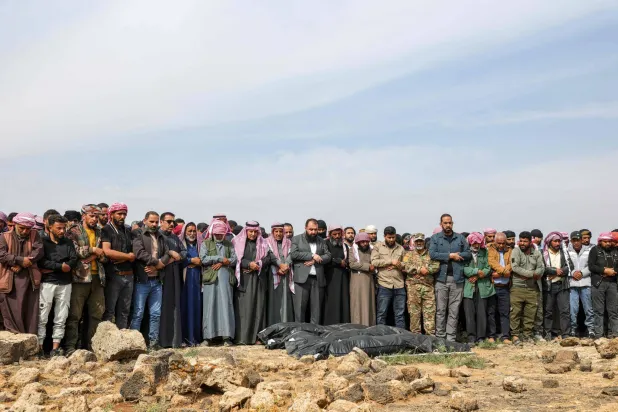
Residents of Syria's southern Daraa province mourned seven civilians killed in Jordanian airstrikes on Tuesday, as public anger mounted over the deaths of children and elderly people and calls grew for an investigation. Syria's Foreign Ministry condemned the military action as "completely unacceptable," accusing what it called "suspicious parties" of seeking to undermine the close ties between the two countries. In a statement on Tuesday, the ministry said Syria and Jordan were coordinating to urgently establish a joint field and security committee to address on-the-ground violations and prevent their recurrence. Mourners in Daraa demanded an investigation into the strikes, which hit several locations across the province, and called on Jordan to explain the intelligence behind its choice of targets. Syria's state-run Al-Ikhbariya television quoted mourners as insisting the targeted sites were civilian and that no terrorist organizations operated in their province. Military expert Imad Shahoud called the proposed joint committee "a belated measure that should have been taken before the operation." A man inspects the damage in the aftermath of airstrikes carried out by Jordan on the village of Al-Taf in the Al-Lajat region, located in the northeastern countryside of Daraa, on October 27, 2026. (AFP) Speaking to Asharq Al-Awsat, Shahoud said an error had caused civilian deaths and that the victims' families were entitled to compensation. He placed primary responsibility on Jordanian intelligence, saying it should have verified its information and target coordinates in coordination with Syrian authorities. Shahoud also pointed to what he described as a professional failure to conduct surveillance of the targets for at least 24 hours. Questioning the use of F-16 fighter jets against a "terrorist cell," he said such operations should aim to capture suspects alive whenever possible. Jordanian warplanes struck several locations in Daraa overnight Monday into Tuesday. Daraa's Health Directorate put the casualty toll between dead and wounded at 10. Syria's People's Assembly joined calls for a joint investigation, condemning the "crime that killed civilians, including women and children." The assembly also underscored the deep ties between the Syrian and Jordanian peoples. Despite the condemnation, official statements from Damascus and Amman signaled a shared desire to protect bilateral relations. Syrian politician and People's Assembly member Moayad Ghazlan said relations between the two countries were "greater than any mistakes," while cautioning against blaming a third party without evidence. "We are counting on bilateral relations being stronger than any mistakes, but we cannot accept a failure to investigate what happened, take responsibility for this grave incident or compensate families for the devastating loss of our martyrs' lives," Ghazlan told Asharq Al-Awsat. Mourners join the funeral procession for five family members, including three children, killed in a Jordanian airstrike in southern Syria's Daraa province, Tuesday, Oct. 27, 2026. (AP) He said security cooperation and broader ties between Syria and Jordan were improving, but suggested their joint fight against terrorism and firm opposition to Israeli violations had angered parties seeking to undermine the relationship. Asked whether the strikes could damage bilateral ties, Ghazlan was emphatic. "Our relationship with Jordan must not be affected. It is strong and deeply rooted," he said, adding that such ties required full respect for sovereignty and coordination with Syrian authorities under agreed counterterrorism protocols. Syrian analysts broadly agreed that a security failure had led to the civilian deaths, though questions remained over how the operation unfolded. Political and media analyst Ali Eid pointed to a wider security gap in southern Syria, blaming Israeli actions for preventing Damascus from deploying sufficient security forces and carrying out adequate sweeps to secure the region. Eid, himself from Daraa, told Asharq Al-Awsat that Israel was a major underlying cause of the disorder that had created conditions for such interventions, even if its role was not immediately visible. He said the lack of coordination over the strikes exposed differences between Damascus and Amman on security matters, with the civilian deaths laying bare the consequences. Eid said the Syrian Foreign Ministry had sought to balance its response by preserving relations with Jordan while asserting Syrian sovereignty and insisting on prior coordination for any future operations. "Syrian territory is the responsibility of the Syrian state, not the Jordanian side," he said. With no tangible evidence that terrorists were among those killed, Eid said the strikes had fueled widespread public anger and intensified pressure on Syria's government and president. That pressure would likely force a different approach to security coordination, he said, though any such effort would probably "run into Israeli obstacles."