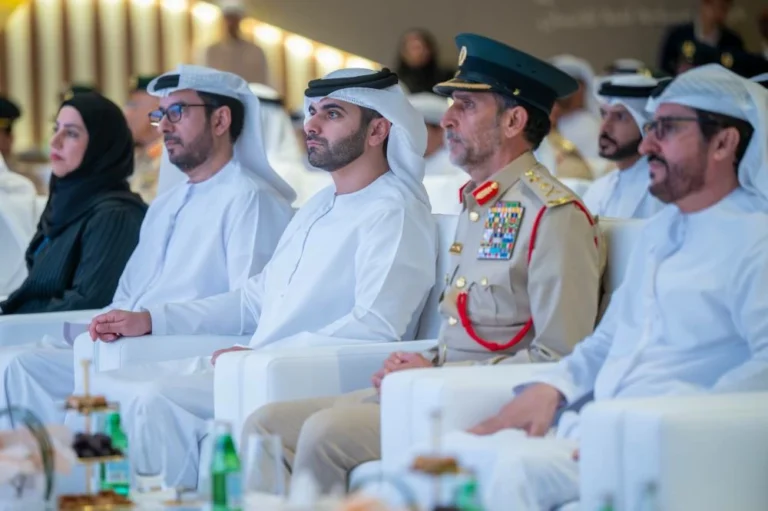
Abu Dhabi: The crisis in the Strait of Hormuz has brought the world to a crossroads, raising the risk that disruption of international waterways could be replicated elsewhere, Dr Sultan Al Nuaimi, Director-General of the Emirates Center for Strategic Studies and Research (ECSSR), said.He said the international community now faced a choice between continuing to respond to the consequences of crises or moving towards an approach aligned with the Gulf’s vision for international stability.“The most dangerous implication of the crisis is that it goes beyond the threat to navigation and tests the legal framework governing international waterways,” Al Nuaimi said.“This raises a question that must be asked: Are we now facing terrorism targeting straits and waterways? The right of transit passage cannot be impeded or suspended.”He said attempts to apply a similar approach in the Bab Al Mandab Strait showed that what happened in the Strait of Hormuz could become a precedent replicated in other waterways.Such a development, he said, could undermine the certainty on which global trade depends — that key routes remain open and disputes concerning them are resolved according to law rather than “the will of those who escalate and threaten”.Al Nuaimi made the remarks in his welcome address at the opening of the third annual Hili Forum in Abu Dhabi, organised by ECSSR and the Anwar Gargash Diplomatic Academy (AGDA) under the theme “Gulf at Crossroads: Conflict, Consequences and Course Correction”.The forum brings together 75 speakers and 1,000 participants from 35 countries, including senior officials.Al Nuaimi said the Hili Forum provides a platform for responsible and constructive discussion, bringing together different perspectives and expertise and expanding opportunities for productive cooperation on issues whose consequences extend beyond national and regional borders.### Hormuz disruption hits global energy suppliesHighlighting the economic consequences of the crisis, Al Nuaimi said around 20 million barrels of oil passed through the Strait of Hormuz every day before the war, equivalent to nearly a quarter of seaborne oil trade. The waterway also accounted for one-fifth of global liquefied natural gas trade.With navigation disrupted, more than 10 million barrels of oil and around 500 million cubic metres of gas were lost from daily supplies, he said.Brent crude prices subsequently exceeded $100, compared with around $72 previously.European gas prices rose 60%, while urea prices increased 40%. War-risk insurance premiums surged by more than 1,000% in some cases, while maritime transport costs rose between 30% and 50%, he said.Food prices are expected to increase by 8%, while global inflation is projected to rise from 4.1% to 4.7%, according to the figures cited by Al Nuaimi. He put the estimated cost of the war to the global economy at around $2.2 trillion.“These are not separate figures, but an interconnected chain,” he said.“When a waterway is disrupted, supplies decline and the costs of energy, insurance and shipping surge. The impact then reaches food, inflation and growth.”He said the figures demonstrated how the shock of war had moved into international markets, factories and households around the world, turning geography during a conflict into a prolonged economic cost.### ‘Gulf has never been a geographical margin’Al Nuaimi said the scale of the impact demonstrated why the Gulf had never been merely a geographical margin or a regional space where crises could unfold without consequences beyond its borders.The Strait of Hormuz embodies this reality, he said, describing it as more than an ordinary waterway.It is a point where the interests of global energy and trade converge, meaning a regional security event can produce economic consequences across continents.Disrupting navigation through Hormuz therefore affects not only vessels passing through the waterway but also the regular flow of global energy supplies and international trade, he said.### International response at a crossroadsAl Nuaimi said this was where the crossroads facing the international community became clear.“Either the international response remains confined to dealing with the consequences of crises, or we move towards a vision that keeps pace with the Gulf’s vision for international stability and places course correction at the heart of the discussion,” he said.He raised several questions for policymakers, including how navigation could be protected from disruption or threats during every crisis, how responsibility should be shared between Gulf states and their partners, and how deterrence, dialogue and international law could work together to establish stability.Al Nuaimi said the forum would highlight the Gulf’s role in supporting international stability and the deep connection between Gulf security and global security.It would also provide a platform to examine how that interdependence could be translated into more sustainable political, economic and legal cooperation, strengthening the ability to assess risks and develop more effective responses.