Drone Strikes Rock Sudan’s El-Obeid After Army Secures Highway
Drone strikes blamed on paramilitary forces shook the Sudanese flashpoint of El-Obeid on Monday, hours after the army regained control of the city's highway to the capital Khartoum.
The army's rival, the paramilitary Rapid Support Forces (RSF), have for months amassed troops around El-Obeid, attempting to encircle it ahead of an apparent large-scale assault.
Following a days-long advance across North Kordofan state, the Sudanese army on Sunday managed to push the RSF west, off the 400-kilometer (250-mile) highway that connects Khartoum with the embattled Kordofan region's largest city, two army sources told AFP Monday on condition of anonymity.
Drone strikes were reported on the city at dawn, with local officials attributing them to the RSF.
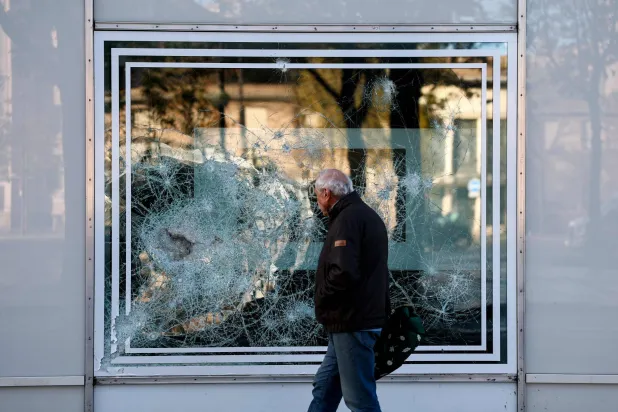
The local lawyers' association and a branch of the Agricultural Bank of Sudan were left in ruins, an AFP reporter saw, though no casualties were reported.
Since the start of the year, drone strikes by both forces have killed more than 1,000 people in Kordofan alone, according to the UN.
Since April 2023, the war between Sudan's army and their one-time allies the RSF has torn the country apart and killed more than 200,000 people, aid workers estimate.
It has also created the world's largest displacement and hunger crises, with over 33 million people in need of humanitarian aid.
For months, each side has sought to cut off the other's supply lines around El-Obeid, which sits at an important crossroads.
Its north-south highway runs from Khartoum through Kordofan to the southern border, while its east-west axis connects RSF strongholds in the Darfur region to army-controlled central and eastern Sudan.
"Now the militia has to turn to defend West Kordofan, which is the front line for Darfur," a retired army officer told AFP.
The highway to Khartoum remains closed to civilians, who have for most of the war relied entirely on the eastern road to the White Nile, where the RSF regularly launches deadly drone strikes.
The army advance "opens a second supply route to El-Obeid and beyond", said one of the army sources.
Inside the city, where the UN says hundreds of thousands are in need of aid, relieved El-Obeid native Sabreen Mohamed told AFP that "the highway opening means goods can flow".
Praising the army's advance in North Kordofan, Mohamed brushed off the RSF's dawn drone strikes as "death throes".
"We're used to it, every time the army advances, they retaliate against North Kordofan," she said.
As the RSF mobilized on El-Obeid, the UN has for weeks warned of a repeat of atrocities committed during the RSF's takeover of the Darfur city of al-Fashir in October last year, which a UN inquiry found bore the "hallmarks of genocide".
A city of about half a million people, which the UN says has doubled in size because of displacement, El-Obeid has been caught in the crossfire since the war began.
It was under paramilitary siege from April 2023 until February of last year, when the army broke through.
Ever since, RSF attacks on roads, neighborhoods and critical infrastructure such as power stations have worsened a humanitarian crisis, where the UN says only a fraction of the city has reliable access to food.
Leadership Crisis in Hezbollah After Nasrallah's Assassination
Two years after the assassination of former Hezbollah Secretary-General Hassan Nasrallah, the group has not fully overcome the absence of the man who led it for more than three decades and transformed the secretary-general's office into a center of political, organizational, military, and popular influence that is difficult to replace.
Hezbollah will mark the second anniversary of the assassinations of Nasrallah and his successor, Hashem Safieddine, on Sunday with a public rally at Nasrallah's shrine in Beirut's southern suburbs. Its new Secretary-General, Naim Qassem, will speak at the event. Security measures will include closing roads leading to the shrine from the direction of the old airport road and Ziad Rahbani Highway and diverting traffic to other routes.
According to people close to the group and its opponents, current Secretary-General Naim Qassem does not appear to have succeeded in filling the vacuum left by his predecessor. At the same time, there has been an increasing shift in the center of decision-making within the group, with the room for internal initiative narrowing in favor of decisions coming directly from Iran.
The group's opponents say the issue is not simply a matter of the difference in charisma and popular presence between the two men, but also the nature of the role Nasrallah played within Hezbollah. He combined political, organizational, and military leadership, and served as the principal link with the group's supporters and its Iranian ally. Hezbollah today, by contrast, appears to have a more collective and structured leadership, but with a more direct Iranian role in shaping its choices and decisions.
While people close to Hezbollah believe that, despite the blows it has suffered, the group has managed to reorganize its ranks and maintain its cohesion under Naim Qassem, its opponents argue that the period following Nasrallah has exposed a leadership crisis and a decline in its ability to mobilize supporters, as well as internal divisions resulting from Qassem's performance.
A New Approach to Confronting the Challenges
Political writer Dr. Qassem Qassir, who is closely familiar with Hezbollah's position, acknowledges that after Nasrallah, the group "faced many internal and external obstacles" following a long period of centralized leadership during which Nasrallah held the reins of the organization for about 33 years, from 1992 until 2024, before his assassination under extremely difficult circumstances.