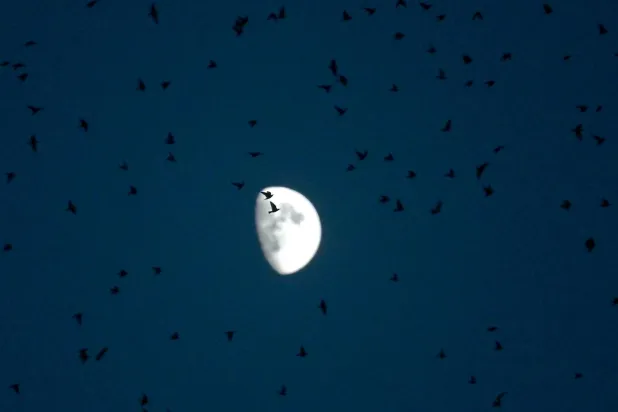
All roads lead to Rome, including for raucous starlings whose noisy, messy habits have left residents of the capital determined to send them flying. Known for their spectacular aerial displays, a behavior known as murmuration, and for their exceptional vocal mimicry, starlings migrate in the millions to Italy from northern Europe in winter in search of warmth. For years, the city has tried in vain to chase the unwelcome visitors from the trees in busy areas where they rest to build up strength before the breeding season. A three-day experiment this week in a northeast Roman neighborhood may have worked, with shopkeepers and citizens blaring an ear-shattering noise simulating a starling distress call from their windows, in the hope it would deter them from settling in. "It's nature. They're birds flying in trees, so I don't think we can claim the right to get rid of them," Matteo Zocchi, the councilor charged with environmental issues for Rome's third administrative borough, told AFP. Zocchi said officials were realistic about what could be done about the "hundreds of thousands" of starlings in his neighborhood, with the goal being just to "push them away a bit to give this area some breathing space". "The problem has been huge because we've had to clean the streets constantly," he said. Mesmerizing in the air but disruptively loud at bedtime, the social, polka-dotted birds swoop down from the sky at dusk to roost in leafy trees, their cacophonous chatter impossible to ignore. When the birds fly off at dawn to feed in open fields, pavements and cars are covered by slippery guano, an unpleasant by-product of their visit. Some residents and shoppers on Rome's hard-hit Viale Jonio have taken to using umbrellas as protection. Residents look at starling flocks that come to spend the night in the trees of their neighborhood, in Rome on November 19, 2026. (Photo by Filippo MONTEFORTE / AFP) Roberto Benenato, 29, who works at a pastry shop underneath the avenue's line of plane trees, said it's been impossible to park on the street for fear of returning to a guano-covered vehicle. "But the worst thing... is really the horrible stench of guano we've had these past weeks. It would get right up your nose, into your head. You couldn't breathe properly. Really unpleasant, let's say," he said. Timing is everything when it comes to disrupting the starlings. Once snug on their branches to rest overnight, the birds don't budge -- meaning that the moment to dissuade them from settling in is immediately after arrival. In the past, city officials used just the distress call to ward off the starlings. But given the perceived increase in their numbers this year, they chose a multi-pronged effort, including lights from lasers directed into the trees. More impressive was a raptor named Geronimo who was calmly promenaded on the arm of his falconer beneath the trees, never once leaving his perch. For three days this week, city residents and shopkeepers were invited to tune into the live broadcast of the distress calls and point their stereo speakers, laptops or cellphones towards the trees for an hour beginning at 4:15 local time (1515 GMT). Starlings in Rome are a draw for tourists and photographers mesmerized by their murmurations. They choose the city to roost because it affords better protection from predators than open countryside. But no one knows exactly how many arrive in the city each winter -- either from northern and eastern Europe or from other parts of Italy. A 2021 study by conservation coalition BirdLife International found their numbers were decreasing moderately in the country as a whole. Starling expert Alessandro Montemaggiori of Rome's Sapienza University says they have been migrating to Rome for 80 years. A decade ago, there were an estimated one million in the city at night in winter. By some accounts, that number may have fallen by half now. From a rooftop on Thursday at sunset, one could see several murmurations weaving through the sky and then gathering in the distance. Suddenly the birds were directly overhead, the sky nearly black as the piercing noise from distress calls blasted out from rooftops and balconies. As Zocchi and other officials held their breath during the dramatic display, some starlings who had dived into the tops of nearby trees quickly took off again. The murmurations reformed and gradually moved away, appearing to settle somewhere in the distance. "This is the greatest result we could have hoped for," smiled Zocchi.