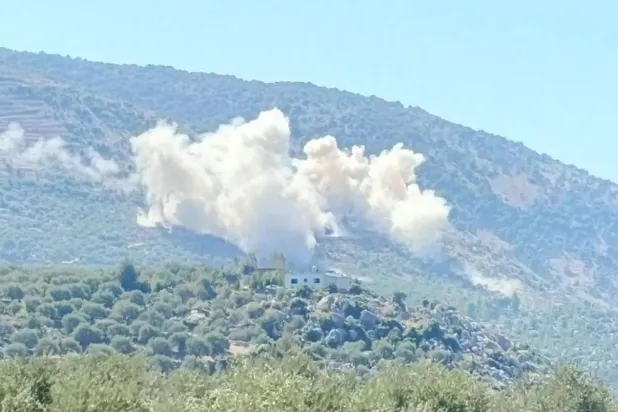
Israeli forces pushed into the border town of Halta in South Lebanon on Wednesday before withdrawing to its outskirts after conducting searches and sweeps, amid reports that a local resident had been abducted. The incursion came as Lebanese concern mounted over the scale of Israeli demolitions in the south, with Environment Minister Tamara El Zein warning that their repercussions could extend beyond direct destruction to geological risks affecting public safety. Lebanon’s National News Agency reported that Israeli forces withdrew from Halta after entering the town Wednesday morning, amid reports that resident Fadi Abdel Aal had been abducted. Troops searched several homes and conducted sweeps with machine guns, while bulldozers razed olive groves. Israeli forces also blew up several houses, while other homes were reportedly vandalized and solar panels on the ground and rooftops smashed. Three mortar shells struck the town, including one near homes. Powerful explosions heard across several villages in the Arqoub area were traced to demolitions carried out by Israeli forces inside Halta. The operation followed previous Israeli incursions, searches, arrests and bulldozing in Halta and its surroundings. The town lies in the Arqoub area of Hasbaya district, near Kfar Shuba, the Kfar Shuba Hills and Shebaa Farms, in a geographically and militarily sensitive border area. Israel says its operations in South Lebanon are intended to prevent Hezbollah from rebuilding its capabilities near the border. Elsewhere, Israeli artillery struck the outskirts of Kfar Shuba and Kfar Tibnit in Nabatieh. In the western sector, Israeli forces carried out powerful demolitions in Mansouri, south of Tyre, following similar explosions targeting homes and valleys at dawn that caused strong tremors felt in neighboring villages. Geological concerns El Zein warned that the succession of massive Israeli explosions posed risks beyond the extensive destruction they caused, citing potential geological damage and ground disturbances. She pointed to the demolition of the Ali al-Taher ridge two weeks ago using about 1,100 tons of explosives. According to data from Lebanon’s National Center for Geophysics, she noted, the blast generated seismic waves comparable to a magnitude 4.2 earthquake. El Zein highlighted the site’s proximity to the Roum Fault, about one kilometer away, and the Yammouneh Fault, about seven kilometers away, arguing that the location and scale of the explosion raised additional concerns. She also cited the demolition in Majdal Zoun using about 80 tons of explosives, which generated waves comparable to a magnitude 3.1 tremor and, according to her, physically split the town in two. Another explosion near Beaufort Castle involved about 700 tons of explosives and generated waves comparable to a magnitude 3.8 tremor, with vibrations felt at considerable distances, she added. The minister cautioned that massive underground explosions could, under certain geological conditions and particularly near existing faults, cause movement or reactivate faults, potentially increasing seismic risks. She stressed that the inability to determine with certainty the future consequences of such effects did not mean the risks should be minimized or ignored. ‘Reshaping the geography’ El Zein argued that the scale of the explosions should not be measured solely by their immediate destruction, describing the operations as going beyond their direct military dimension to the “reshaping of geography.” She warned that violent ground motion could damage the natural and built environment, infrastructure and homes across a wide area. The minister linked the explosions to what she described as “ecocide,” stressing that the Lebanese state and government must respond to the scale of the damage and risks rather than merely document and catalogue what she called war crimes. El Zein presented the findings and concerns to the Cabinet, which tasked her with preparing a detailed report on the repercussions of the explosions. The report will be submitted to the Foreign Ministry for referral to the UN Security Council and other relevant international bodies.