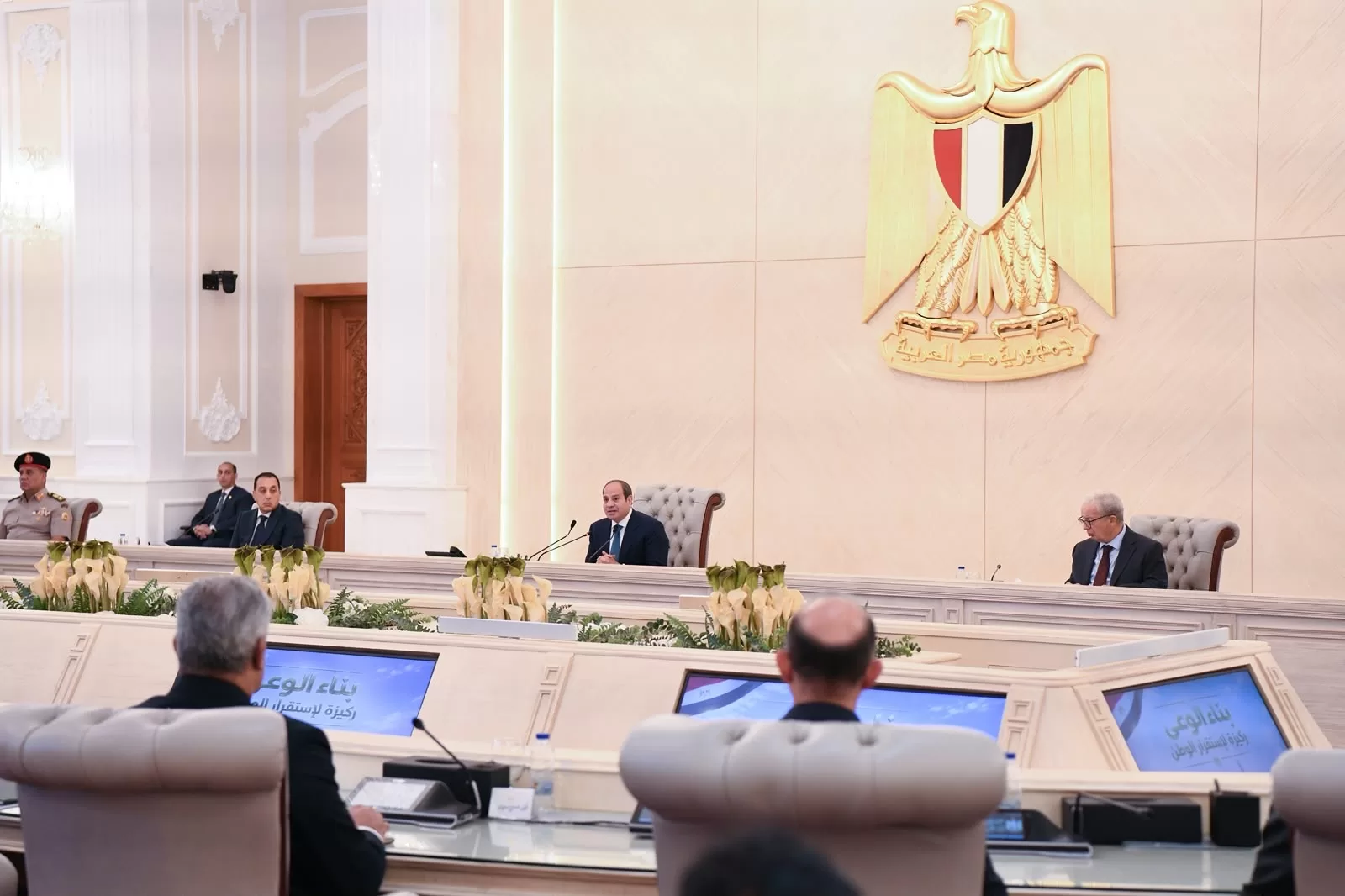
President Abdel Fattah El‑Sisi chaired an expanded meeting on Tuesday at the Strategic Command headquarters in the New Capital, attended by Prime Minister Mostafa Madbouly, the full cabinet and governors, senior Armed Forces and police officials, a number of village mayors and local leaders from across Egypt, as well as experts and specialists. According to Presidential Spokesman Mohamed El‑Shennawy, the President stressed the importance of holding such meetings on a regular basis to exchange views and ideas, particularly as Egypt continues to face multiple challenges. He emphasised the need to make the best use of state resources, strengthen confidence in national institutions, and protect the domestic front against repeated attempts to harm the Egyptian state. During the meeting, the president noted that Egyptians’ awareness remains the country’s first line of defence, referring to the economic contraction that followed the events of 2011–2013 and stating that recovery from their impact could take up to 15 years. He added that preserving the state and its institutions was the greatest challenge following 2013. The President also highlighted a series of external shocks affecting Egypt since 2020, including the Covid‑19 pandemic, the Russia‑Ukraine war and the conflict in Gaza. He reiterated that attempts to promote Palestinian displacement have not ended and will not end, stressing that peace remains Egypt’s strategic choice. He reaffirmed that the Palestinian issue remains the central issue in the Middle East and that the two‑state solution is the only path to lasting peace and stability. Sisi also underlined Egypt’s commitment to supporting the security and stability of Gulf countries, while stressing the importance of preserving freedom of navigation in international waterways. He noted that regional instability had cost Egypt around $20 billion in Suez Canal revenues in recent years. The President warned that social media platforms are among the tools used to target states and spread misinformation, stressing the importance of strengthening state capabilities and maintaining national cohesion. He stressed that protecting Egypt is a collective responsibility and called for greater confidence and closer co‑operation among institutions and citizens. During the meeting, Sisi listened to contributions from village mayors, including the mayor of Al‑Sarariya village in Minya Governorate, who outlined local initiatives to combat rumours, support vulnerable families, care for orphans, encourage Quran memorisation and address child marriage. The President praised these efforts as a positive model to follow. The President also stressed the need for institutional efforts to raise public awareness, suggesting greater involvement by religious leaders and educational institutions in explaining the dangers of undermining the state. He noted that national security awareness is a central component of training programmes provided by the Egyptian Military Academy to new public sector employees. The spokesperson said ministers responsible for transport, health, local development, interior affairs, electricity, finance, education, housing and higher education reviewed key achievements recorded over the past decade, highlighting efforts to improve public services and address long‑standing challenges through comprehensive reforms. Sisi directed that all necessary measures be taken to improve services for citizens and instructed the Ministry of Interior to rationalise vehicle licensing costs. He also reiterated the importance of treating citizens respectfully when providing public services. The President further stressed the need to improve educational quality, noting that Egypt’s development and reform agenda remains a shared responsibility among all officials. Following the meeting, Sisi joined Military Academy cadets, ministers, governors and senior officials for lunch, during which discussions addressed water security, Ethiopian dams, artificial intelligence and developments in the Middle East, including the Strait of Hormuz and Bab al‑Mandab. On the issue of Ethiopian dams, the President said Egypt continues to prioritise diplomacy and peaceful solutions but stressed that this would not come at the expense of the country’s existence or the rights of its people. He added that Egypt is pursuing projects in desalination, water treatment and water recycling to strengthen national water resources. Regarding artificial intelligence, Sisi highlighted the importance of improving the quality of education to prepare future generations capable of keeping pace with technological developments, while stressing the need to maximise the benefits of AI and remain alert to its potential risks. The President concluded by noting that regional tensions have contributed to higher oil and commodity prices, affecting costs in Egypt, while reaffirming that the Egyptian state is making every effort to reduce regional escalation and prevent a return to conflict. The post Sisi reviews national challenges, development priorities appeared first on Egyptian Gazette.