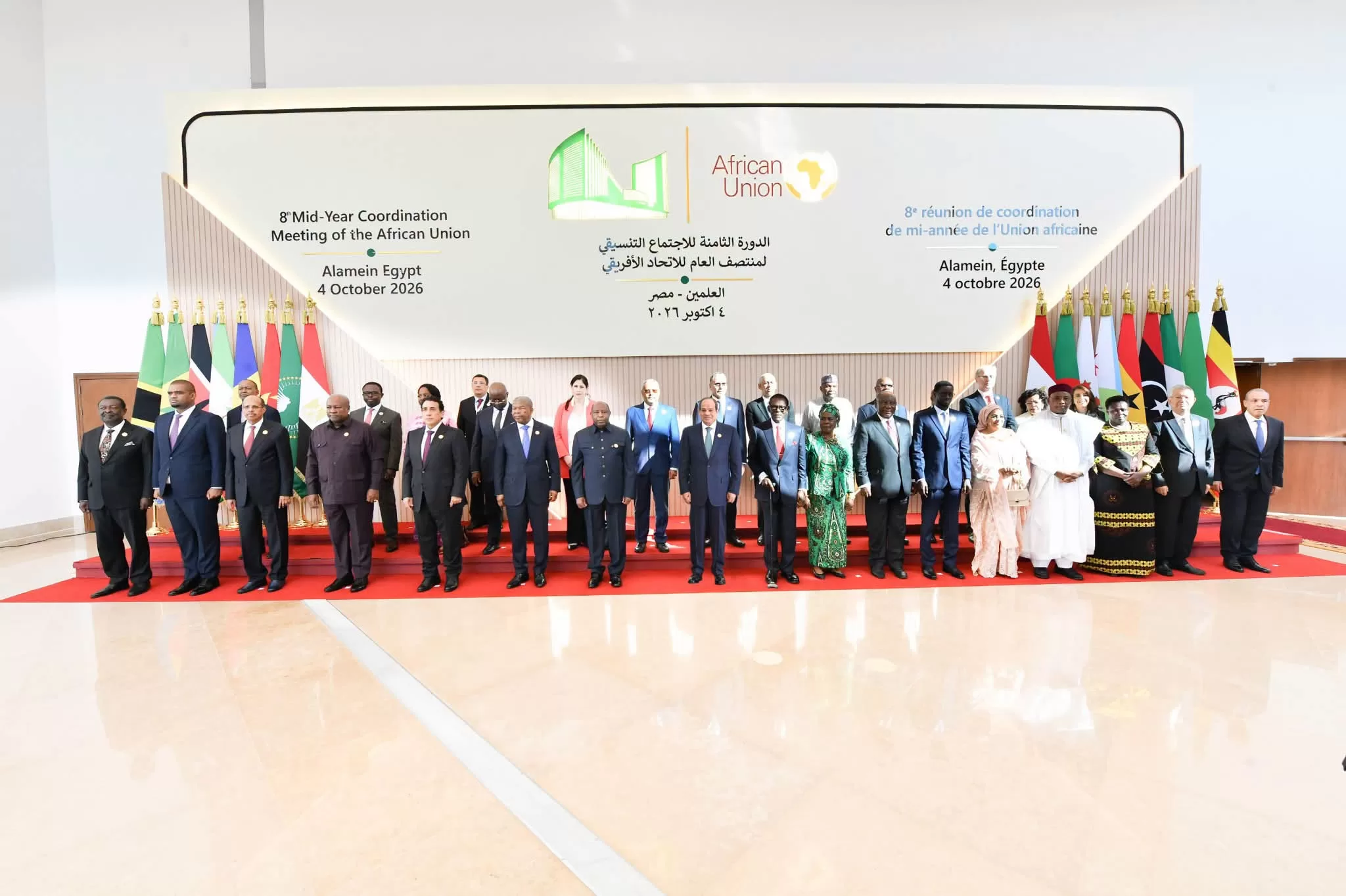
President Abdel Fattah El-Sisi called for stronger African integration and closer co-operation among the continent’s countries, stressing the need to move from co-ordinating positions to integrating capabilities and from shared ambitions to practical projects. Sisi made the remarks on Sunday during the opening session of the eighth Mid-Year Co-ordination Meeting of the African Union and Regional Economic Communities, hosted by Egypt in New Alamein. The meeting was attended by African leaders who are members of the African Union Bureau for the current year, as well as heads of African regional economic communities and mechanisms. The meeting discussed progress on the African Union’s main theme for 2026, “Ensuring Sustainable Water Availability and Safe Sanitation Systems to Achieve the Goals of Agenda 2063”. It also addressed efforts to strengthen co-ordination and integration among Africa’s regional economic communities, advance institutional development within the African Union and implement the African Continental Free Trade Area (AfCFTA). The opening session began with the national anthem of the Arab Republic of Egypt and the official anthem of the African Union, followed by speeches by President Sisi, Chairperson of the African Union Commission Mahmoud Ali Youssouf, and President of Burundi and current Chairperson of the African Union Évariste Ndayishimiye. In his speech, Sisi welcomed the participating leaders to Egypt and stressed the importance of co-ordination among African Union member states, the AU Commission and regional communities and mechanisms to advance sustainable development across the continent. He said co-ordination should not be an end in itself, but a means of moving from separate efforts to integration and from shared ambitions to specific, implementable projects and programmes that have a tangible impact on African peoples. Referring to New Alamein, Sisi said the city demonstrated how development could overcome the legacy of conflict. He noted that the area had once been the site of one of the fiercest battles of the Second World War and had suffered for years from mines and the remnants of conflicts in which Africa was not a party. Today, he said, Alamein has become an example of how determination can transform land from a battlefield into a platform for investment, work and construction. Sisi said Africa was capable of turning the effects of conflicts into development opportunities, transforming challenges into drivers of growth and strengthening its capacity to rebuild and recover from conflicts. He said the continent was facing a delicate period amid geopolitical tensions, conflicts, external interference, terrorism and extremism, transnational organised crime, disrupted supply chains and rising energy, food and financing costs. These pressures, he said, exceed the capacity of individual countries to address them alone. “Our message today must be clear: it is no longer sufficient to co-ordinate our positions; our capabilities must be integrated, and we must shape our future through our joint efforts,” Sisi said. The President reaffirmed Egypt’s position rejecting any external interference in the internal affairs of African states and called for respect for state sovereignty, unity and territorial integrity. He also stressed that relations among African countries should be based on mutual respect, good neighbourliness, dialogue and consultation, away from unilateral policies and narrow interests. Sisi called for cross-border issues to be addressed through co-operation rather than competition and dialogue rather than confrontation, including the management and use of natural resources and transboundary rivers in accordance with international law. On water, he said sustainable management of shared resources represented a genuine test of Africa’s ability to achieve integration and turn overlapping interests into opportunities for cooperation. He welcomed the African Union’s selection of “Ensuring Sustainable Water Availability and Safe Sanitation Systems” as its theme for 2026, as well as the adoption of the Africa Water Vision and Policy 2063. Sisi said Egypt looked forward to working with other African countries to swiftly prepare and adopt the first implementation plan for the document, contributing to continental water security, stability and sustainable development. He stressed that co-operation on transboundary rivers should be based on relevant international law, consultation and coordination, good neighbourliness and the principle of non-harm. While acknowledging every state’s right to develop and benefit from its natural resources, Sisi said such rights must be exercised responsibly and without harming other countries. He added that common interests were greater than differences and that prosperity could be achieved when dialogue prevailed and the principle of mutual benefit was respected. Turning to economic integration, El-Sisi said economic co-operation was one of the key tools for consolidating peace. Greater economic interdependence and stronger trade and investment links, he said, would help Africa build a more stable and prosperous future. He called for the full implementation of the African Continental Free Trade Area, which entered into force in 2019 during Egypt’s presidency of the African Union. The agreement, he said, would help establish a genuine African market, harness the continent’s productive capacity, increase intra-African trade, support industrialisation and technology transfer, and create more employment opportunities. Sisi said Africa should not remain a source of raw materials that are later imported back as finished products. Instead, the continent should develop integrated value chains, strengthen production and industrialisation, and make economic integration a genuine driver of growth. He also highlighted Egypt’s launch of the “Alamein-Africa Business Forum”, describing it as a regular platform bringing together African leaders and decision-makers with investors and financial institutions. Sisi said several African leaders had participated in the opening of the forum’s first edition on Wednesday, adding that Egypt looked forward to their participation in its second edition, which Egypt will host in 2028. On post-conflict reconstruction, El-Sisi said rebuilding countries affected by conflicts was not only a humanitarian or economic undertaking but also an integral part of Africa’s peace and security architecture. He noted that 2026 marks the 20th anniversary of the launch of the African Union Policy on Post-Conflict Reconstruction and Development and called for the occasion to be used to review progress, identify shortcomings and renew the commitment to turning the policy into tangible programmes and projects. He commended the efforts of the African Union Commission and the African Union Centre for Post-Conflict Reconstruction and Development, which is hosted in Cairo, in supporting national institutions and building capacities. Sisi renewed Egypt’s commitment to supporting these efforts and called for increased funding, programmes and projects, with priority given to initiatives that have a rapid and direct impact on citizens’ lives. He said African efforts should form an interconnected cycle in which “peace protects development, development strengthens stability, economic integration creates opportunities, and cooperation on shared resources prevents conflicts”. Sisi concluded by expressing confidence in Africa’s future, saying the continent had the resources, human potential and opportunities needed for development. He called for African countries to unite their efforts to turn decades of co-operation frameworks into more effective tools for advancing the interests of their peoples. The meeting, he said, should mark a new step “from c-oordination to integration, from crisis management to capacity-building, and from ambitions to achievements.” The post Sisi calls for stronger African integration, co-operation on water, trade appeared first on Egyptian Gazette.