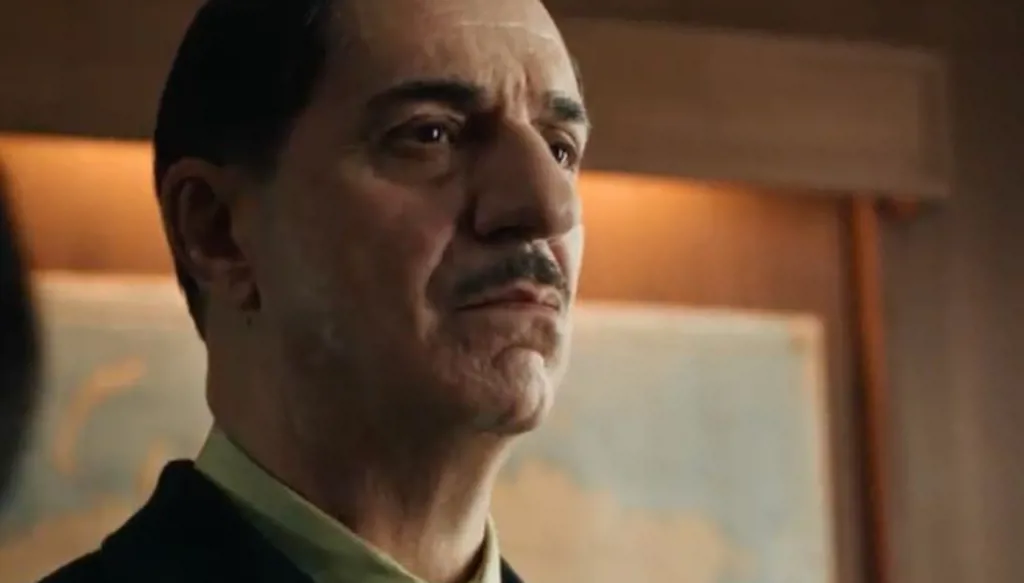
From Armenia to Lebanon, and through France, Simon Abkarian carries within him stories, cultures, and multiple languages. He sees this mosaic of identities not as a contradiction, but as a source of richness that has shaped his human and artistic personality and influenced his acting career. At the third edition of the French Film Festival in Beirut, Abkarian attended the Lebanese premiere of La Bataille de Gaulle, in which he portrays one of the most prominent figures in French political history.
The French Institute in Lebanon is organizing the "Great Weekend for French Cinema" festival from November 12 to 15, featuring seven films that have never been screened in Lebanon before, including two premieres, across four days of cinematic screenings.
In an interview with Annahar, Abkarian first reflects on his multiple identities as an Armenian, Lebanese, and French actor, and how they have contributed to shaping his personality and career. He explains that the diversity of languages and cultures he carries represents a richness in his experience: "I speak several languages, and thus have multiple minds within me."
Growing up in Lebanon, a country familiar with both war and celebrations, tragedy and joy, left its mark on the person and actor he would become. Abkarian also highlights a cultural characteristic he considers essential to Lebanon: its tradition of oral storytelling and passing down narratives through speech rather than writing.
"In Lebanon, there is more of a tradition of storytelling than writing. Everyone here shares stories, and the tales pass from one generation to another through oral expression," he says.
The character of Charles de Gaulle was not entirely unfamiliar to Abkarian's personal history. During his school years, his friends nicknamed him "De Gaulle" because he had come from France. The nickname never bothered him. On the contrary, he considers the general an important national figure whose name is also associated with a special relationship with Lebanon.
Portraying a historical figure such as Charles de Gaulle involved far more than physical resemblance or a change in appearance. For Abkarian, the greatest challenge lay in the voice, particularly in capturing its musicality, rhythm, and distinctive way of expressing thoughts.
He explains that the task was not simply to imitate De Gaulle's tone, but to understand the connection between his voice and the way he thought. "I couldn't tell his story with my own voice. I had to find the music of De Gaulle's voice, linked to his soul and his way of thinking," he says.
For the actor, the voice is not merely a tool of expression, but an integral part of a person's character and the way they interact with the world.
This understanding also shapes his approach to De Gaulle as a whole. Abkarian believes that the man cannot be separated from the soldier he was, just as he cannot separate his multiple identities from his own personality as an actor.
Behind the image of the general and military leader was a man who carried a deep sense of responsibility and love, particularly in his relationship with his daughter Anne, who had Down syndrome. Abkarian highlights the great tenderness De Gaulle showed towards her, considering these human aspects essential to understanding the character beyond his political and military image.
He explains that portraying such a complex figure requires meticulous work, particularly because De Gaulle was not merely a military leader, but a man who carried his own contradictions, emotions, and responsibilities.
After 43 years in acting, Abkarian does not consider his profession an ordinary job, but an art in itself. "For me, acting is not just work; it is art," he says.
Asked how he manages to detach himself from a character once filming ends, he offers a simple answer: "It's very easy, you have to take off the costume and go home."
However, this distance only comes once the work is complete. Throughout filming, the actor remains fully immersed in the character, to the extent that he continues repeating his lines even in his sleep. He explains that portraying De Gaulle demanded great precision in movement and thought, as the character could not be reduced to his outward appearance or political speeches.
Beyond the artistic challenges, the conversation with Abkarian turns to Lebanon and the lessons De Gaulle's character could offer younger generations, particularly amid the political and sectarian divisions that continue to hinder the building of an inclusive national project.
For Abkarian, one of the key lessons is the concept of "consensus": reaching a shared vision that transcends political and partisan affiliations.
He points out that despite his political affiliation, De Gaulle had a vision that extended beyond the boundaries of his party. France, for him, was not a homeland belonging to a particular group or political movement, but an inclusive national project.
"He had a vision for all of France, not just his party. He was someone who carried a vision for a unified France," Abkarian says.
Nevertheless, he does not overlook the fundamental differences between the French and Lebanese experiences. He considers comparisons between the two difficult because of the different nature of their political systems and institutions. France is a secular state, whereas, in his view, Lebanon's sectarian system remains an obstacle to building a shared national vision.
"As long as there is a sectarian system, it will be challenging in Lebanon. We must strive for it, as it is not a fruit that will fall from the sky," he says.
In this sense, Abkarian does not simply invoke De Gaulle as a historical figure, but also raises questions about Lebanon's future: How can a national project be built that transcends divisions? And how can the Lebanese move beyond their multiple affiliations towards a common space that unites them?
Asked why audiences should watch the film today, Abkarian's answer goes beyond the historical significance of its central character or its portrayal of a pivotal chapter in French history. He sees the film as a human adventure that explores values extending beyond its time, from courage and honor to struggle and responsibility.
"It is a film about adventure, courage, honor, and struggle," he says, adding that the work can revisit certain issues and place them in their proper context, particularly those relating to morality.
Through his portrayal of De Gaulle, Abkarian invites audiences to look beyond the general's historical image and reflect on the meaning of responsibility, commitment, and collective vision. These are questions that extend beyond French history and remain relevant to a Lebanese reality still searching for a common project capable of bringing its people together.