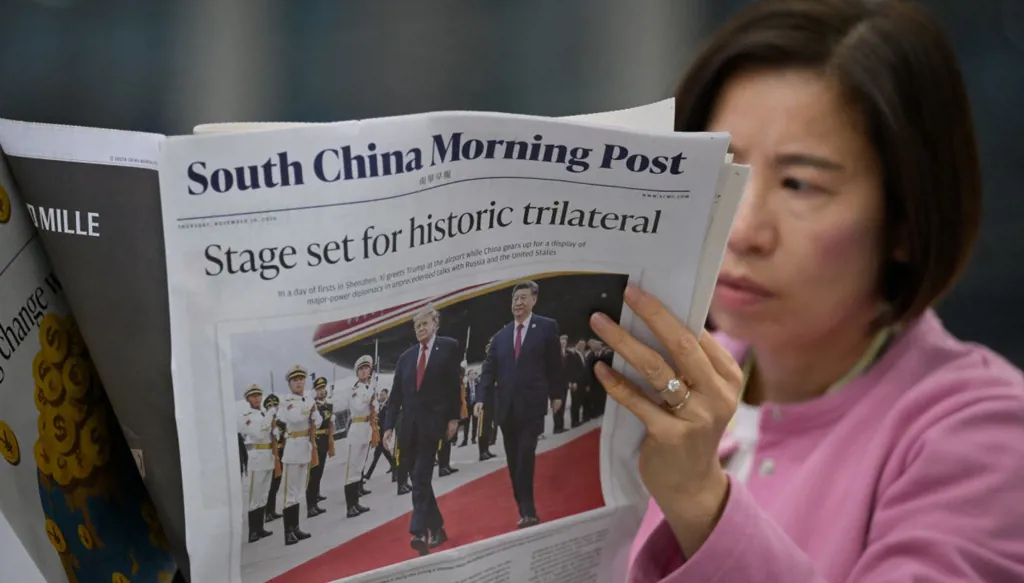
The Shenzhen Summit brought together the leaders of the world's three most influential powers: US President Donald Trump, Chinese President Xi Jinping, and Russian President Vladimir Putin. Amid discussions on the global order, nuclear affairs, and artificial intelligence, the war in Iran and the Strait of Hormuz emerged as key areas of contention.
In an interview with Annahar, Samir Al-Taqi, a senior researcher at the Atlantic Council in Washington, explains the implications of the summit and China's position in the confrontation between Washington and Tehran.
The initiative came at Moscow's request, followed by the agreement of the United States and then China.
The summit reflects the level of international tension, from the wars in Ukraine and Iran to developments in the South China Sea and the Western Pacific.
Washington believes that Beijing and Moscow can exert influence over Tehran and deprive it of strategic sources of support.
China remains the most significant player in this process, yet it has not offered to mediate in any meaningful negotiations.
Al-Taqi describes the confrontation as a "finger-biting" game between China and the United States, with each side trying to force the other to back down.
He expects the Iranians to be the first to cry out, followed by the Chinese.
China holds the reins of the war, as an end to its support for Iran could bring everything to a halt.
The other critical factor is the extent to which the Iranian economy is being suffocated.
Negotiations remain suspended, and China has not offered to mediate.
Trump prefers maintaining a siege and a low-intensity, manageable confrontation rather than allowing a wider escalation.
Al-Taqi links the timeline to the upcoming session of the new, Democrat-majority Congress.
Trump expects the United States to have strengthened its military readiness and secured bipartisan consensus on the conflict by then.
However, Al-Taqi does not consider this timeline a critical deadline, describing Trump as being in a hurry when setting dates.
Al-Taqi believes Trump consolidated the issues of reopening the Strait of Hormuz and preventing Iran from acquiring nuclear weapons.
However, he has yet to secure a clear commitment to Chinese intervention.
Al-Taqi points to declining Chinese oil inventories and Iran's approach toward a critical point in its exports, factors that will increase sensitivity in the coming period.
Al-Taqi does not consider the meeting comparable to the Yalta Conference or see it as establishing a new world order.
He highlights the possibility of an understanding between the United States and China on early missile warning systems and controlling nuclear proliferation.
Trump is seeking to establish the principle that artificial intelligence should not independently determine whether to launch a nuclear strike, insisting that such a decision must remain in human hands.
China has yet to agree to the principle of keeping decisions on nuclear strikes in human hands rather than entrusting them to artificial intelligence.
No committees or mechanisms have been established to follow up on the understandings reached. As a result, Al-Taqi describes the summit's impact as a relative and temporary de-escalation.
He notes that Europe is strengthening its defense capabilities and continuing to support Kyiv.
He warns that Europe will be reluctant to consider the matter closed if it is not included in the negotiations.
The United States has intensified its military maneuvers in the region, deploying missiles and weapons in several countries.
A military axis involving the United States and the Philippines is growing stronger, alongside Washington's alliances with South Korea and Japan.
Meanwhile, China is deploying around 200 warships and destroyers, extending its movements toward Australia, Guam, and areas near American islands.
This activity reflects mounting military tensions, turning the Pacific into a potential arena for further escalation.