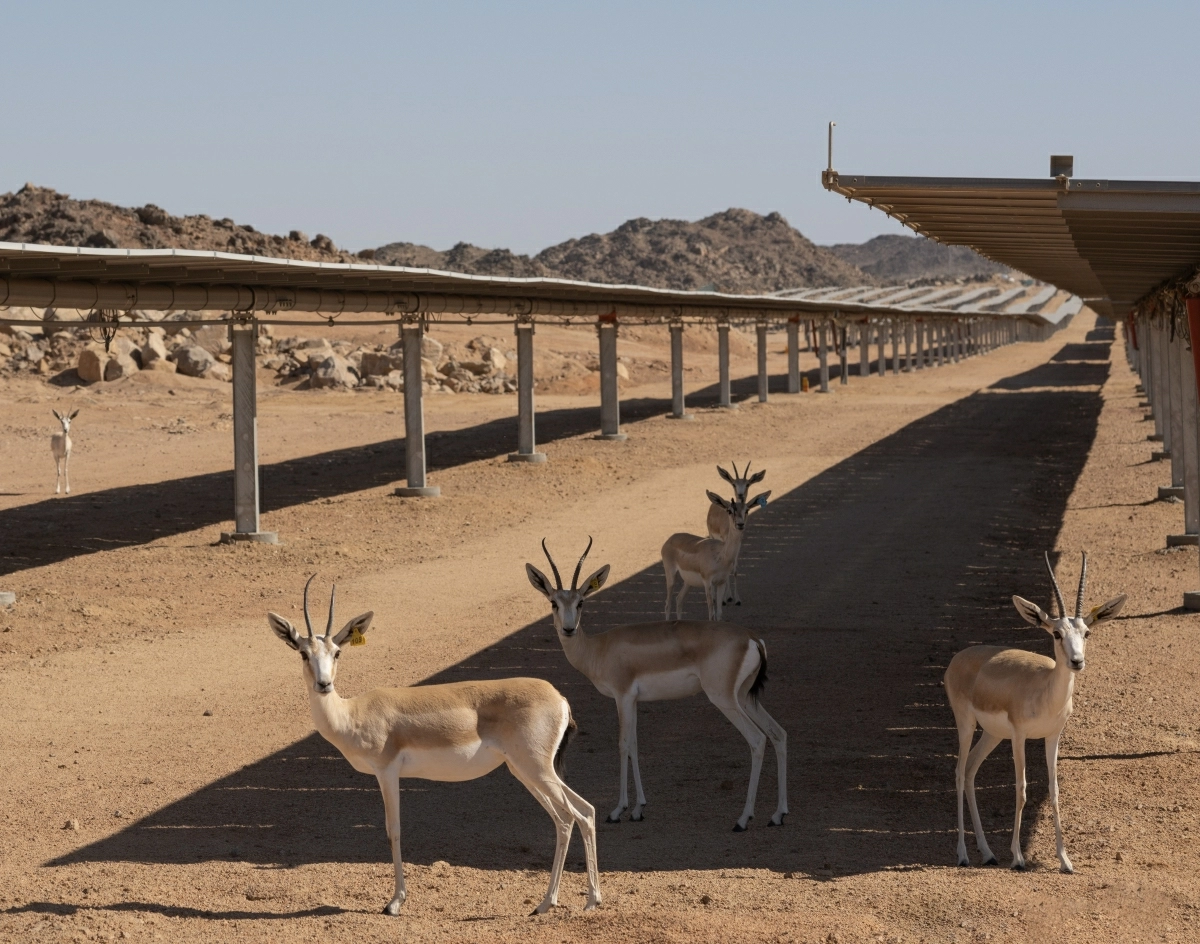
RIYADH — An operational solar park in Saudi Arabia has become a breeding ground for threatened wildlife under a conservation initiative that combines renewable energy production with efforts to restore native animal populations.Prince Mohammed bin Salman Royal Reserve said Sunday that 38 vulnerable Sand gazelles have been introduced into a 250-megawatt solar park serving Red Sea Global’s AMAALA destination, in what it described as the first initiative of its kind globally.The 505-hectare facility, built and managed by AMAALA Sustainable Company for Energy (ASCE), provides a protected environment where gazelles can breed before populations are eventually reintroduced into the wild.The approach, named “ReWildingVoltaics,” is designed to produce what the Reserve calls a “double-green dividend” by generating renewable electricity while supporting biodiversity restoration.Following a seven-month proof-of-concept phase launched in October 2025 involving Sand gazelles, Mountain gazelles and Arabian hares, the project moved into its breeding phase in May.A total of 33 female and five male Sand gazelles were introduced into the solar facility, with the first offspring expected in December.Population modeling by the Reserve’s Scientific Services Division projects that the herd could grow to around 600 animals by 2031. The Reserve said a minimum founder population of 500 is required for successful reintroduction into its 24,500-square-kilometer protected landscape.“Our rewilding goal is to build self-sustaining wildlife populations that can survive in the wild without ongoing human intervention,” said Andrew Zaloumis, CEO of Prince Mohammed bin Salman Royal Reserve.“This collaborative innovation not only accelerates that work but also introduces a novel ‘double-green’ framework with global scalability. We are calling it ‘ReWildingVoltaics.’”The solar park’s predator-proof perimeter creates a controlled breeding environment, while its panels provide shade that reduces ground temperatures by approximately 5°C to 10°C.Around 73% of the 505-hectare site can be used as habitat for captive breeding, including shaded areas beneath the panels and open terrain featuring natural rocky outcrops.According to the Reserve, the project has increased its wildlife husbandry capacity 15-fold and allows specialist rangers to continuously monitor animal behavior, health and reproductive success.Sand gazelles were selected because of their ecological importance and suitability for the facility. Their size allows them to move beneath the solar panels without affecting the infrastructure, while their grazing and browsing can help manage vegetation and disperse seeds.Omar AlDaweesh, CEO of EDF Group in Saudi Arabia and Bahrain, said the project demonstrated how renewable energy infrastructure could deliver benefits beyond clean electricity.“By bringing biodiversity conservation into an operational solar facility, we are showing how energy infrastructure and nature can coexist,” he said.The initiative supports Saudi Green Initiative targets to protect 30% of the Kingdom’s land and sea and generate 50% of its electricity from renewable sources by 2030, while working toward net-zero emissions by 2060.The Reserve said lessons from the project could eventually be applied in other regions where large-scale renewable energy developments and wildlife restoration programs coexist.