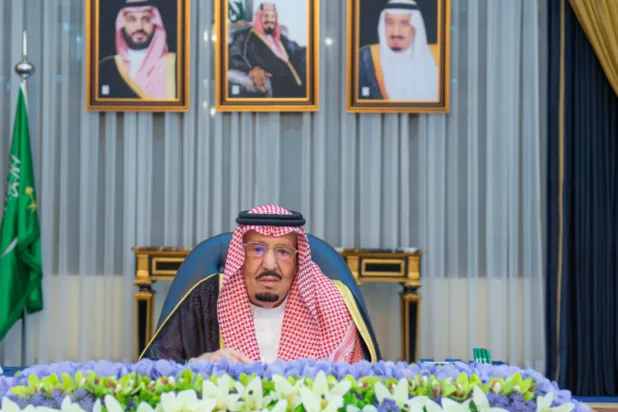
Custodian of the Two Holy Mosques King Salman bin Abdulaziz Al Saud chaired the Cabinet session held on Tuesday in Riyadh. The Cabinet was briefed on the letter the Custodian of the Two Holy Mosques received from Emir of Qatar Sheikh Tamim bin Hamad Al Thani, and on the meeting between Prince Mohammed bin Salman bin Abdulaziz Al Saud, Crown Prince and Prime Minister, and Iraqi Prime Minister Ali Faleh Al-Zaidi. In a statement to the Saudi Press Agency following the session, Minister of Media Salman Al-Dossary said that the Cabinet reviewed regional and international developments and the Kingdom's efforts, through communication and consultation with brotherly and friendly countries, to promote regional stability and mitigate the repercussions of conflicts and tensions on global energy security, international trade, supply chain sustainability, and maritime navigation, all of which are shared responsibilities requiring international cooperation to protect the global economy from risks that could affect the entire world. The Cabinet welcomed the UN Security Council members' presidential statement, which condemned the terrorist Houthi militia's attacks on civilian assets, airports, and energy infrastructure in Saudi Arabia, as well as the continued threats to maritime navigation in the Red Sea and the Bab al-Mandab Strait. The statement emphasized the importance of fully implementing UN Security Council Resolution 2216 and subsequent resolutions, and called for practical cooperation to prevent the terrorist group from obtaining weapons and other forms of support. The Cabinet commended the decision by the Council of Foreign Ministers of the Organization of Islamic Cooperation (OIC) to establish an OIC council of ministers of cybersecurity and designate Riyadh as the headquarters of its general secretariat and executive office. The decision followed a proposal submitted by Saudi Arabia as part of its efforts to promote stability in cyberspace and host regional and international cybersecurity headquarters and entities, building on its strong record of supporting strategic initiatives in this field. The Cabinet also reviewed the outcomes of several international conferences hosted by the Kingdom, commending the recommendations issued by the Riyadh Economic Forum, which will contribute to serving the national economic system, strengthening economic policies and directions, and consolidating the complementary partnership between the public and private sectors, in line with the intended targets and comprehensive development transformations. The Cabinet considered the 33.5% increase in foreign direct investment in Saudi Arabia in 2025, compared to 2024, as a testament to the Saudi economy's attractiveness and promising future prospects, as well as the effectiveness of the economic and structural reforms implemented in recent years under Saudi Vision 2030.