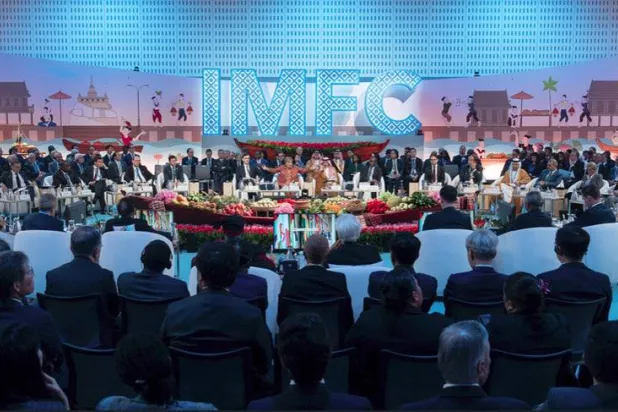
Saudi Arabia’s diversified energy infrastructure and logistics networks have enabled the Kingdom to maintain oil supplies and regional trade despite the widening economic fallout from the Middle East conflict, said Saudi Central Bank (SAMA) Governor Ayman Al-Sayari. Addressing the International Monetary and Financial Committee (IMFC) of the International Monetary Fund in Bangkok, chaired by Saudi Finance Minister Mohammed Al-Jadaan, Al-Sayari highlighted the Kingdom’s ability to withstand the crisis, supported by prudent policies, substantial financial and nonfinancial buffers, and a well-capitalized banking sector. He stressed Saudi Arabia’s commitment to supporting economic activity and preserving monetary and financial stability without compromising fiscal sustainability. Al-Sayari stressed that energy security depended not only on the availability of supplies but also on their reliable and affordable delivery to international markets. He called for sustained investment throughout the energy supply chain, from production and refining to storage and diversified transport routes, as well as across all energy sources, including oil and gas. The conflict’s initial impact, concentrated in energy markets and major shipping corridors, had gradually spread to trade, transportation, inflation, financing conditions and investor confidence. Disruptions had also extended beyond crude oil and natural gas to refined petroleum products, particularly transportation fuels, as well as fertilizers and essential production inputs, increasing price pressures and threatening food security and production. While rerouting supplies and drawing down inventories had helped cushion the immediate shock, those measures had reduced the capacity to absorb further disruptions, Al-Sayari cautioned. Banking sector withstands shocks Turning to the domestic economy, Al-Sayari highlighted the resilience of Saudi banks, whose capital and liquidity positions remain robust, with financial soundness indicators among the strongest in the region. He attributed the Kingdom’s ability to preserve domestic stability to decades of prudent economic management, effective risk management and strategic investment, explaining that its extensive energy and logistics infrastructure had also helped maintain oil supplies and regional commerce and mitigate the impact of disruptions in global energy markets. He underlined that Saudi Arabia would continue adjusting its response as the conflict evolved, preserving room to address further developments while maintaining fiscal discipline. Saudi Central Bank (SAMA) Governor Ayman Al-Sayari. (IMF) Vision 2030 strengthens economic foundations Al-Sayari said Saudi Vision 2030, now entering its tenth year, had reinforced the Kingdom’s economic foundations by expanding non-oil activity, increasing private sector participation and strengthening institutions and reform implementation. He underlined the government’s commitment to productivity-enhancing reforms, greater private investment opportunities, more efficient public spending and sound public finances. The next phase would focus on further diversification, deeper financial markets and human capital development, alongside improvements in infrastructure and institutional capacity to support sustainable and inclusive growth. IMF urged to implement institutional reforms On international cooperation, Al-Sayari called on the IMF to prioritize the implementation of recently reviewed institutional reforms covering economic surveillance, program design and conditionality, financial sector assessments and the debt sustainability framework for low-income countries. Fund-supported programs should reflect individual countries’ circumstances, needs and capacity to implement reforms with conditions focused on measures essential to their success, he remarked. He also advocated closer coordination between surveillance, lending and technical assistance, as well as timely and orderly resolution of unsustainable debt and stronger cooperation among creditors. Al-Sayari reiterated Saudi Arabia’s support for IMF capacity development, including its $279 million pledge and backing for the Fund’s regional office in Riyadh. He also drew attention to risks stemming from volatile capital flows, rising sovereign bond yields and the expanding role of nonbank financial institutions. Artificial intelligence and stablecoins presented implications for both productivity and financial stability, underscoring the importance of strengthening analysis and oversight to address emerging risks, he noted.